Thursday, May 06, 2004
Copyright © Las Vegas Review-Journal
Arguments for, against rail line made
Some ranchers oppose DOE waste plan; others say economic benefits will be reaped
By KEITH ROGERS
REVIEW-JOURNAL

Rancher Wade Poulsen of Alamo, second from left, asks a question Wednesday about a proposed rail line that would take nuclear waste from Caliente to a planned repository at Yucca Mountain. Looking on from left are Terry Jones of Pioche, Yucca Mountain Project Mapping Specialist Matt Knop and Jim Case of Cedar City, Utah. Photo by K.M. Cannon.

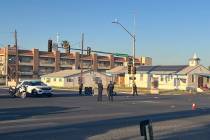
The Caliente Youth Center was the site for Wednesday's public meeting on the Energy Department's proposed rail line to transport nuclear waste to Yucca Mountain. Photo by K.M. Cannon.

Click image for enlargement
|
CALIENTE -- The railroad the Department of Energy wants to build in this historic train town is causing the biggest stir since tracks were first laid here 104 years ago.
The federal government intends to use those tracks by 2010 to haul the nation's high-level nuclear waste from Caliente to a planned repository at Yucca Mountain, 100 miles northwest of Las Vegas.
More than 110 ranchers, environmentalists, downwinders and retirees -- along with a couple of city officials -- converged Wednesday on the Caliente Youth Center to give their two cents on the proposal. They also came to listen to Energy Department officials explain how they would build a 319-mile rail line across rugged Lincoln and Nye counties to reach the mountain, 100 miles northwest of Las Vegas.
Some who came wondered whether it could ever happen.
Others, like the bevy of ranchers in boots and cowboy hats, said it would severely affect their livestock operations, in many cases limiting where cattle and sheep roam the open range.
And a few welcomed the idea, saying a new railroad would benefit the local economy, providing jobs for Lincoln County's 4,000 residents. If it's a multiple-use railroad, they reasoned, it would offer a way to transport oil, ore, hay and other freight to the western edge of the state.
"I think it's great. I just wish these people wouldn't fight it," said Ronald Kozak, a retiree from Pioche who wore a cowboy hat and a black shirt embroidered with U.S. flags and eagles.
"Why not let Lincoln County reap the benefits of it?" he asked. "My question is, why is our governor spending all our money on frivolous lawsuits?"
The state is fighting the Yucca Mountain Project in the courts and has several lawsuits pending.
Cattleman Wade Poulsen of Alamo had a different perspective. Although he's not opposed to using a rail line to transport 18-foot-long casks of spent nuclear fuel assemblies, the 41-year-old questioned the Energy Department's logic in selecting the mile-wide Caliente rail corridor. That land would be withdrawn from certain public uses, potentially affecting grazing allotments.
"If that goes through there, that's 50 head of cows gone, and that's a big concern," Poulsen said, pointing to a map of the rail route.
"I think they ought to go across the test range," he said, referring to the Nevada Test Site and Nellis Air Force Range. "I don't understand why they take 319 miles to go around it. Look how much you can save if you punch right through it."
The Energy Department envisions spending $880 million to construct the rail line, a figure that state officials contend would be more than doubled given the steep grades the route would encounter and the many bridges that must be constructed.
The state's transportation consultant, Robert Halstead, estimates that at a minimum, the rail line will cost $3.5 million per mile to construct.
Air Force officials have said the Energy Department's plan to haul three waste casks per train, up to three times per week over 24 years, would greatly affect the planning and logistics of air combat training activities on the range if the railroad were to cross the test range. Those protests prompted the Energy Department to design the Caliente rail line to skirt the Air Force range.
Some ranchers are upset the Energy Department trotted out its plan this week, in three scoping meetings that attracted a combined 263 attendees to see maps and displays here and in Amargosa Valley and Goldfield.
"Sometimes you feel you get it jammed down your throat," Poulsen said.
Ranchers Roger Hatch of Alamo and Rocky Hatch of Hiko fear their cattle will have to be moved if the rail line goes through Garden Valley.
"I'm not for it. It's going to hurt me," Rocky Hatch said.
While he's not happy with the plan either, Roger Hatch said the rail line probably would be built despite his objections.
"I think it's going to go whether you're opposed to it or not," he said.
Dorothy Phillips and Dorothy Ray, 80-year-olds from Caliente, said a nuclear-waste railroad would only compound their distrust for the same government that said fallout from above-ground nuclear weapons tests wasn't all that dangerous.
"I wish an earthquake would swallow it up," Ray said of the rail corridor plan.
A downwinder, Phillips blames the deaths of her father, sister and brother on fallout. The family received $50,000 from the government in downwinders compensation.
In a written statement, Ray said, "I want to see the head of the DOE and (Mayor) Kevin Phillips and the county commission put on their boots and jeans and walk the 319-mile supposed railroad É to acquaint themselves with this catastrophe."
Phillips, who backs the Energy Department's plan, provided the railroad has multiple uses and would boost the economy, said he's not swayed by opponents of it. Even an 11-car train derailment on March 27 in nearby Rainbow Canyon failed to deter his faith that the project will be safe.
"It's not any more of a concern than anything else," he said, noting that trains have derailed over the past century in the area and trains still haul hazardous chemicals through his city.
"That derailment wouldn't have included radioactive materials, most likely," he said.
The city has revolved around trains ever since the Salt Lake-San Pedro-and-Los Angeles tracks were laid in 1900.
Terry Jones, 72, a retired schoolteacher from Pioche, said he's skeptical about the Energy Department's rail plan.
"I'm a firm believer that if you're not doing something for somebody, you're doing it to them," he said. "It's David versus Goliath. We're David and DOE is Goliath, and we don't have a slingshot."