Home Subscribe
Jobs Cars Homes Shopping Travel Weddings Golf Best of Las Vegas Photo
.
Member Center

Recent Editions
WThFSSuMT
>> Search the site
.
.
.
.
NEWS
.
.
.
.
.
.
.


Wednesday, November 10, 2004
Copyright © Las Vegas Review-Journal

PROJECT CITYCENTER: Strip `metropolis' planned

MGM Mirage development will bring 12,000 jobs

By HUBBLE SMITH
REVIEW-JOURNAL


MGM Mirage unveiled plans Tuesday for a 66-acre development on the Strip, between the Bellagio and Monte Carlo hotels. The 18 million-square-foot first phase of the project calls for a 4,000-room hotel and casino, three 400-room boutique hotels, 1,650 luxury condominium-hotel units and 550,000 square feet of retail, dining and entertainment space.
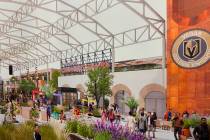
IMAGE COURTESY OF MGM MIRAGE

MGM Mirage Tuesday unveiled plans to develop a multibillion-dollar "urban metropolis" on the Strip between Bellagio and the Monte Carlo.

The 66-acre development, named Project CityCenter for now, will accelerate the evolution of Las Vegas into a sophisticated, multidimensional city, said Jim Murren, president and chief financial officer of MGM Mirage.

The 18 million-square-foot first phase of the project calls for a 4,000-room hotel and casino, three 400-room boutique hotels to be operated by internationally recognized companies not currently in Las Vegas, 1,650 luxury condominium-hotel units and 550,000 square feet of retail, dining and entertainment space.

"I can't think where there is an opportunity (anywhere else) in the United States to create a world-class market," Murren said. "We have all the elements. We have the land, the intellectual and financial capabilities and the imagination of the private sector and government."

"Our master plan represents a significant new direction for our city and our company," Terry Lanni, chairman and chief executive officer for MGM Mirage, said in a prepared statement. "Las Vegas has taken initial steps to becoming a major urban center in the western United States."

Project CityCenter would be the most significant privately funded project in the United States, Murren said, creating more than 12,000 permanent positions, the largest single new employment opportunity in the history of Las Vegas, upon completion.

The first phase, which is expected to cost between $3 billion and $4 billion, would create more than 7,000 construction jobs.

MGM Mirage has been working for eight months on development plans for the site that extends from the Boardwalk casino property to the edge of Bellagio, across Harmon Avenue.

Murren said the company has been analyzing the property since MGM Grand Inc. acquired Mirage Inc. in 2000 with the intent of maximizing the economic value of the land, which is going for about $20 million an acre on the Strip.

"This site is probably the best developable opportunity in Las Vegas, maybe the planet," he said. "We believe the economic opportunity is there to get a return on investment that's superior to simply building a casino-hotel."

The project is dramatic in scale and, over time, will be developed into a master-planned urban complex. Although the completed project will be built on less land than the 110-acre MGM Grand property, the higher density design will allow for much more building space.

Murren said the development will propel the urbanization of the Las Vegas Valley and complement previously announced plans for continuing downtown redevelopment.

"We really want to create a social fabric akin to other urban markets," he said. "I look at it like Manhattan. Manhattan has got zones: uptown, east side. Real cities have a variety of districts and neighborhoods and that's what we need to make this a major metropolitan market."

MGM Mirage will partner with world-renowned architects, residential developers, hotel operators and retailers in designing, financing and operating the project.

The company selected the master plan design by Ehrenkrantz, Eckstut and Kuhn Architects, a New York-based firm known for planning Battery Park in New York City and the Baltimore Inner Harbor East in Maryland.

Bill Eadington, professor of economics at the University of Nevada, Reno and director of the school's Institute for the Study of Gaming and Commercial Gaming, said the MGM Mirage project shows the continuing trend toward nongaming activity on the Strip.

"One of the things worth watching is the increasing importance of other departments to generate income," he said. "For example, The Venetian has significant revenue from hotel rooms, convention business, restaurants.

"If you look at gaming revenue, growth has been pretty marginal for the Strip because nongaming has become a more integral part of the whole mix."

Among properties with $72 million or more in annual income, gaming made up 42.4 percent of total revenue last year, compared with 57.7 percent 10 years ago. By contrast, gaming in Atlantic City casinos accounts for about 80 percent of revenue.

"The point is, especially in light of continued expansion of generic gaming elsewhere, Las Vegas has a great challenge to redefine itself," Eadington said.

MGM Mirage management will immediately initiate the design stage of Project CityCenter, which is expected to take 18 months.

Construction of the first phase will take about 42 months, with an anticipated opening in 2010.

Murren said a project of this scope should be prudently implemented over time in phases, though the first phase would be the most significant. The second phase is expected to entail about 2,500 residential units.

Bill Thompson, a professor at the University of Nevada, Las Vegas who specializes in gaming, said the "psychology" of Las Vegas' gaming industry is to grow and grow until it busts, which has yet to happen.

"With (Steve) Wynn's expansion today and we're going to have other things too, I think we'll just keep growing. That's the way we play the game," Thompson said.

"We're very pro-growth. I don't think we fear it. It hasn't been boom and bust, it's been boom and slow down, boom and slow down."

The latest announcement from MGM Mirage makes Thompson wonder how serious the company is about expanding into England.

"I don't think they're going to put big bucks in other locations. This is where the action is," he said.


LARGEST LOCAL HOTELS
2004 (Based on current room count) 2010 (Based on projected room count)
1. MGM Grand (5,034) 1. The Venetian (7,074)
2. Luxor (4,407) 2. MGM Grand (5,034)
3. Mandalay Bay (4,337) 3. Luxor (4,407)
4. The Venetian (4,049) 4. Mandalay Bay (4,337)
5. Excalibur (3,991) 5. Wynn Las Vegas (4,200)
6. Project CityCenter (4,000)


* BASED ON ANNOUNCED PROJECTS


Advertisement


Contact the R-J | Subscribe | Report a delivery problem | Put the paper on hold | Advertise with us
Report a news tip/press release | Send a letter to the editor | Print the announcement forms | Jobs at the R-J

Copyright © Las Vegas Review-Journal, 1997 -
Stephens Media   Privacy Statement