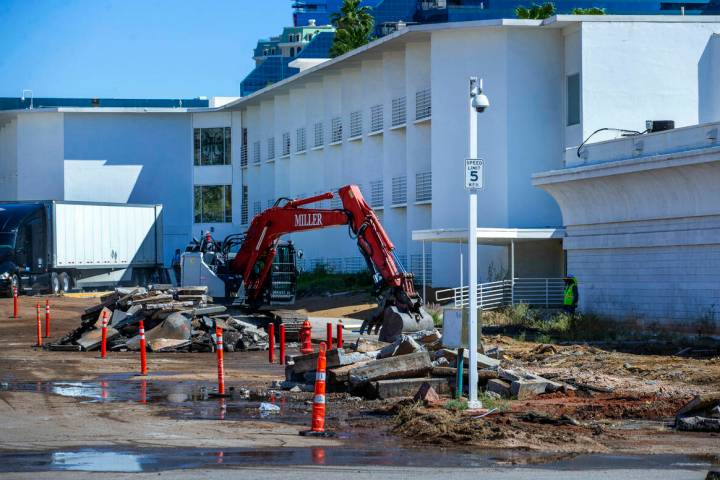
Construction continues Friday on the Solargenix solar energy plant in Boulder City. Officials from several unions have complained about hiring and pay for the project. Photo by Gary Thompson.
Solargenix Energy, the company building a giant solar-thermal power plant that will sell electricity to Nevada Power Co., has broken its promises by hiring workers from Central America and other states, rather than Nevada, union leaders say.
But it appears that two state agencies that worked with Solargenix have little or no authority to force Solargenix or the company's general contractor to hire local workers for the construction project.
Advertisement
The Nevada Commission on Economic Development, which granted Solargenix a tax rebate estimated to be worth $15 million, did not require the solar power company to hire local workers for construction.
The commission required Solargenix to employ 28 workers with an average wage of $19.61 an hour to run the power plant after construction finishes, said Tim Rubald, the development commission's executive director.
The development commission does not require that workers live in Nevada before they are hired, Rubald said.
The operational workers will have "to be in Nevada at some point in time," Rubald said. "They're not commuting on a daily basis from Nicaragua."
The Public Utilities Commission on Wednesday told union leaders that the utilities commission lacked authority to deal with the residency of workers and their pay scale. The utilities panel, however, decided to send letters to Solargenix and the development commission, underlining its concern about the issue.
"We should let Solargenix know we're concerned, and we should let the Commission of Economic Development know we're concerned," Public Utilities Commission Chairman Don Soderberg said.
Danny Thompson, executive secretary-treasurer of the Nevada state AFL-CIO, told the utilities commission that his organization intends to sue to seek changes in state law next year because of Solargenix's hiring practices. Thompson said the lawsuit will seek a court order that requires hiring local workers.
Thompson said the union group advocated laws requiring utilities to use renewable power, such as solar power, in part because it would diversify the state's economy which relies mainly on casino gambling and gold mines.
"This is not diversifying our economy," Thompson told the utilities commission. "This is a great deal for Solargenix. It is a rotten deal for the people of Nevada."
Solargenix Energy of Sanford, N.C., is building Nevada Solar One, a 64-megawatt solar thermal power plant in an undeveloped area of Boulder City. The generation plant is expected to start generating electricity early next year.
Solargenix benefited from a $15 million tax break granted by the development commission, Thompson said. Solargenix will get 16 cents a kilowatt hour from selling solar power to Nevada Power Co. and Sierra Pacific Power Co.
Union officials complained that Solargenix's construction company was paying a fraction of the wages earned by union workers in similar jobs.
The project isn't subject to the state's prevailing wage law, as are projects for cities, counties and the state, said Gail Maxwell, deputy labor commissioner. Under the prevailing wage law, construction companies often are required to pay wages similar to those of union workers for government projects, ranging from schools to highways.
During the utilities commission meeting, Thompson read from a statement made by Donny Grayman, an organizer for Ironworkers Local 416, who claimed that Solargenix employed a large number of workers from Mexico and El Salvador.
Solargenix general contractor Lauren Engineers & Constructors of Abilene, Texas, did not notify his union about jobs at the Solargenix project, Grayman said.
The Ironworkers local business agent Pete Robles was told that the union was incapable of providing enough workers, which is incorrect, Grayman said.
Grayman said one day last summer 80 percent the license plates of cars at the work site were from out-of-state. The International Brotherhood of Electrical Workers, local 357, has been providing training on photovoltaic solar power installations, local business manager David Jones said.
Bill Kockenmeister, an attorney for Solargenix, told the commission that Solargenix hired Nevadans for significantly more than 20 percent of its work force.
Kockenmeister said Solargenix had a collective bargaining agreement with the International Union of Petroleum and Industrial Workers, but Thompson said that union has no members in Nevada.
Solargenix believes that it complied with promises it made to state officials, Kockenmeister said.
In a related decision, the utilities commission voted 2-1 to approve an agreement between Nevada Power, Sierra Pacific Power and interested parties concerning utility compliance with the state renewable energy requirements for 2005. The utilities satisfied the state requirement for nonsolar power use but did not meet the requirement for use of solar power.
Soderberg, the panel's chairman, complained that the utilities agreed to buy solar power credits for more than the lowest price although the purchased solar credits still will not be enough to satisfy the law on solar power use.
Utility customers will pay the added costs but no more solar power will be produced as a result, Soderberg said.
Commissioner Jo Ann Kelly said Soderberg should have raised his concerns during the hearing before the utility reached the agreement with state officials and others on renewable power.
POWERLIGHT GETS TAX BREAK FOR NELLIS PLANT
PowerLight Corp. has persuaded state officials to grant it tax breaks for 10 years on a 15-megawatt solar power plant at Nellis Air Force Base, but the Berkley, Calif.-based solar power company is not willing to discuss the project.
The plant would use photovoltaic panels that convert sunlight directly into electricity.
The Nevada Commission on Economic Development in October approved a 50 percent tax break on real and personal property taxes for 10 years. The equipment was valued at $97.5 million and the leasehold on federal land was valued at $8.4 million. The commission doesn't try to estimate tax savings because of variables, said Tim Rubald, the commission's executive director.
"It's a project that's under development but not buttoned up yet," Susan DeVico, a spokeswoman for PowerLight, said Thursday. In November, SunPower Corp. fo San Jose, Calif., agreed to acquire PowerLight.
Spokesmen for Nellis Air Force Base and Nevada Power Co. said they did not have any additional information they could provide about the project.
Another company made a similar proposal for solar power plant at Nellis earlier this year. Powered by Renewables of Las Vegas and SunEdison of Maryland proposed to build an 18 megawatt, photovoltaic plant for $105 million.
The economic development commission approved the tax incentives for the PBR project in February. In March, before a contract was signed, the Air Force decided to issue a request for proposals for competing offers.