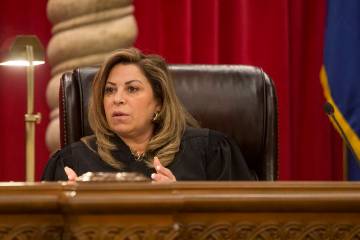
Among Bishop Katharine Jefferts Schori's more unconventional credentials is a pilot's license, which proves useful in visiting congregations around her far-flung diocese. Photo by Ronda Churchill.
Nevada Episcopal Bishop Katharine Jefferts Schori visits with parishioners before a service at All Saints Episcopal Church. Photo by Ralph Fountain.
Bishop Katharine Jefferts Schori's pastoral duties include officiating at Confirmation Masses, such as this one at All Saints Episcopal. Photo by Ralph Fountain.
Katharine Jefferts Schori is not your typical Episcopal bishop.
For one thing, female bishops are rare. She entered ministry later in life, seeking ordination only after forging a successful career as -- how odd is this, given the societal tension between science and religion nowadays? -- an oceanographer. As a licensed pilot, Jefferts Schori uses a private plane to visit outlying congregations in Nevada.
Advertisement
This week, Jefferts Schori, 52, adds a high-profile first to her ministerial resume by becoming the first woman to be nominated for election as presiding bishop of the Episcopal Church in the United States.
The election will take place during the church's general convention, which begins Tuesday in Columbus, Ohio. And, exactly one week from today, Jefferts Schori and Anglicans throughout the world will learn whether American bishops think not-quite-typical is what their beleaguered church needs at this moment in its history.
The Rev. Eldwin Lovelady, rector of All Saints Episcopal Church in Las Vegas, calls Jefferts Schori a "very capable leader."
One of her strengths is that she "came into the ordained ministry after another career," he says. "She brings refreshing insight into leadership."
The Rev. Dale Augustin, parish administrator of Christ Episcopal Church in Las Vegas, also likes Jefferts Schori's preaching style.
"She's captivating," he says. "You find yourself hanging onto, 'What is she going to say next?' "
But her stay in Nevada has been bumpy at times. When she became bishop in 2001, Jefferts Schori made staff and organizational changes that, she admits, didn't please everybody, and there were "relationships with parishes that were fractured and needed to be healed."
While open to the possibility of becoming the U.S. church's next presiding bishop, Jefferts Schori says she has come to love Nevada and has "a lot of wonderful, challenging work here."
Jefferts Schori is a friendly, informal woman who wears the garb of her office but none of the pretensions that can come with it. She tends to spend as much time during a conversation listening as she does speaking.
In their melding of intellectual rigor and real-world theology, Jefferts Schori's comments and sermons offer hints of her previous life as a scientist. In them are found her concern for social justice and an empathy for people who are, as she puts it, "in the margins."
It grows, in part, out of her own time spent on the margins.
"I dealt with that in oceanography," she explains. "The first time I was chief scientist on a cruise, the captain wouldn't talk to me because I was a female. And that was in the '70s, not that long ago."
Jefferts Schori says "progressive" is an apt description of her ministerial philosophy. How does she define the word?
"Willingness to use all of one's faculties to examine the faith rigorously and to advocate justice for everyone," she says.
One of the most controversial issues the Episcopal Church's new presiding bishop will face is continuing fallout over the consecration of the church's first openly gay bishop. The move prompted outrage in some parts of this country and strained relations between the American church and other churches in the Anglican Communion. Yet, Jefferts Schori says, it has turned out to be "not a big deal" in the Nevada diocese and much of the West.
Chalk it up to a "kind of pioneer spirit" here, Jefferts Schori says, even as she acknowledges that "for some people it's an incredibly sensitive issue."
The ordination of gay ministers and the blessing of same-sex unions are controversial, she says. "So was women's ordination and so, for us, was the changing of the prayer book in 1979, and so was including people of color in the full life of the church."
At its best, Jefferts Schori says, the Episcopal Church "has the capacity to say, 'This is where we feel called in terms of justice and theology. We can live with diversity of opinion, but this is where we feel the heart of the Gospel is calling us.' "
The articulate way in which her reasoned opinions are expressed confirm Jefferts Schori's recollection that her parents -- her father is a Navy pilot turned physicist, her late mother held degrees in literature, microbiology and virology -- placed a high value on education.
Jefferts Schori, the oldest of four children, excelled academically while growing up in Seattle. She has warm memories of the convent school she attended as a child.
"It was a very strict environment, and I remember we got numerical grades in things like diction and deportment," she says. "But, at the same time, it was a very gracious place."
When Jefferts Schori was in the fifth grade, the family moved to New Jersey. There, she had to adjust to both the less rigorous rhythms of public school and her parents' decision to leave Catholicism and join the Episcopal Church.
She recalls no explanation for the latter. "As I've put it together since, I think it was their own frustration about (a) lack of change in the Roman tradition," she says.
Not that it mattered. Jefferts Schori didn't think much about religion as a child. But, by the age of 7, she developed a keen interest in nature, finding, she now realizes, "a sense of mystery and the presence of God in the natural order of creation."
Jefferts Schori pursued her interest in science as a biology and marine sciences major at Stanford University and Oregon State University. But, throughout college, on a parallel intellectual track, she wrestled with issues of faith.
A turning point came during grad school, after a friend and his family died in a private plane crash. Jefferts Schori was taking a course about the philosophy of science at the time, reading "physicists who talked about the mystery (of the universe)," she says, "and that led me back to the church looking for answers."
After earning her doctorate, Jefferts Schori took a job with the National Marine Fisheries Service. She married -- her husband, Richard Miles Schori, is a retired mathematician -- and had a daughter, Kate Harris, now 24 and a pilot in the U.S. Air Force.
First in Seattle and then in Corvallis, Ore., Jefferts Schori joined Episcopal churches. To her surprise, about eight years after she had joined the church in Corvallis, "three different people in the congregation asked me if I ever thought about ordination."
"I was astounded. I laughed," Jefferts Schori says. "When I was growing up, little girls didn't think about things like that. And my husband thought it was an even crazier idea. But it was odd enough that I went and talked to the priest and thought about it, and came to the conclusion that, at the very least, the time wasn't right."
Five years later, after preaching a sermon at the same church at the invitation of another priest, Jefferts Schori's calling came.
"That experience, and what I heard from people afterward, finally let me say yes," she says. "And I was in seminary the next fall."
After her ordination in 1994, Jefferts Schori served for several years as assistant rector at her church in Corvallis. In 2000, while on sabbatical interviewing Episcopalians throughout the West, Jefferts Schori visited a friend in Sparks.
Nevada Bishop Stewart Zabriskie had died about six months earlier, Jefferts Schori recalls. "As I'm getting ready to leave, she said, 'You know, what you've done here is a lot like what a bishop does when a bishop visits. Can I put your name in for the election?'
"It was just laughable to me. I hadn't been rector of a big-city congregation for years and years and years. It just didn't make any sense at all."
Yet, she agreed. Seven months later, Jefferts Schori was elected bishop of the Episcopal Diocese of Nevada.
"It was a grand surprise," she says, laughing. "I think I said to people after I came here, the learning curve wasn't steep, it was overhanging. But it was a wonderful, wonderful challenge."
The Nevada diocese covers the entire state plus Bullhead City, Ariz. Scattered around it are about 6,000 people and 37 congregations.
Jefferts Schori says she's losing no sleep over the prospect of either winning or losing the presiding bishop's post.
Buddhists and Christians, she notes, share the notion of nonattachment, the ability to "be able to embrace what is in the now."
She smiles. "And I think that's been one of the gifts of this process for me, remembering how to do that."
SPONSORED LINKS
Experts say
What will Episcopal bishops be thinking about when they cast their ballots for a new presiding bishop?
"I would say uppermost in their minds will be (selecting) a person who is a good pastor, a good theologian, a proven leader," says the Very Rev. Canon Mary June Nestler, dean of the Episcopal Theological School at Claremont in Claremont, Calif.
Delegates also are apt to choose someone they already respect, she says, and who "would have a presence on the international scene" both as presiding bishop here and U.S. representative to the Anglican Communion.
But Nestler doesn't expect bishops to cast ballots solely on the basis of a nominee's stand for or against the blessing of same-sex unions and the ordination of gay clergy.
Both have been hot-button issues in the U.S. Episcopal Church during the past few years. "My guess would be that our bishops are going to focus on much broader issues. They know the church is not a single-issue church," Nestler says.
And while Jefferts Schori is the first woman to be nominated for the position of presiding bishop, Nestler says that "will figure, I think, far less in the minds of our own bishops" than in the bishops from other parts of the world.
Bob Kinney, communications director of the Episcopal Seminary of the Southwest in Austin, Texas, was impressed with Jefferts Schori after hearing her preach during a visit a few years ago.
"Personally, I would say she's a qualified person and very deserving of becoming presiding bishop," he says. "She's got a good shot."
Nestler agrees. Jefferts Schori is, she says, "a brilliant, insightful, thoughtful woman."
Based on conversations with bishops over the past few weeks, Nestler adds, "my sense is she will run well."