A 'short, friendly, middle-aged man, full of energy and a geniune devotion to conservatism' who won an upset victory in the 1982 race for U.S. Senate
By MIKE MILLER SPECIAL TO THE REVIEW-JOURNAL
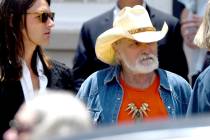
Chic Hecht, right, didn't have much luck securing a good photo opportunity with President Reagan during Reagan's Oct. 28, 1982, visit to Las Vegas to boost Hecht's bid for the U.S. Senate. After Reagan staffers bungled Hecht's plan to give the president a pair of boots, Reagan was more interested in pointing out entertainer Wayne Newton than looking into the same lens as Hecht. Photo by The Associated Press.
Editor's note: Former Nevada Sen. Chic Hecht died of complications from prostate cancer on May 15. In this excerpt from the book "How High Can a Guy Stoop?" Mike Miller, the former press secretary to Sen. Hecht, details the final weeks before the Republican's historic 1982 upset election victory over Democratic Sen. Howard Cannon.
Advertisement
My new candidate was a dark horse, but at least I was in Las Vegas, where gambling is the major industry. And if I could help Chic Hecht win a U.S. Senate seat in Nevada, we'd both hit the jackpot.
I had met Hecht previously in Washington at a National Republican Senatorial Campaign function, where 1982 GOP Senate candidates showed off their television commercials. I had spent 24 non-stop hours editing and narrating the presentation, and the Hecht campaign was one of the few that declined to provide material.
Chic Hecht was a short, friendly, middle-aged man, full of energy and a genuine devotion to conservatism. A proud businessman born in Missouri, he owned a women's clothing store in downtown Las Vegas and managed the Western Emporium, a highly successful store at Sam's Town.
Hecht had a diverse resume. He was a former military intelligence agent. He had operated a bank and served as minority leader in the Nevada State Senate, genuflecting before the revered Gov. Paul Laxalt, now a U.S. senator.
Although he had overcome a speech impediment, Hecht was by no means a polished public speaker. The National Republican Senatorial Campaign considered Hecht a viable candidate, nonetheless, because he had little political baggage and could personally finance a heavy media campaign.
California political consultant Ken Reitz produced his TV ads and flew in from time to time. Glen Mauldin, a CPA, raised money and ran the campaign from Hecht's Las Vegas headquarters. The NRSC booked me into a grungy motel, which catered mostly to down-on-their-luck guests, but Mauldin made a phone call and moved me to the Sands, where the Rat Pack once prowled. I was assigned to travel with the candidate during the last six weeks of what would become a bitter battle with 24-year incumbent Sen. Howard Cannon.
"Keep him from sticking his foot in his mouth," my boss, Bob Pipkin, instructed from Washington. "We can win this one if Chic doesn't make any mistakes."
A stumbling incumbent
Victory would prove more difficult than passively avoiding errors. Ronald Reagan was popular in conservative Nevada and agreed to help. We hoped the "Great Communicator" could articulate why voters should replace Cannon, a liberal Democrat, with the conservative Hecht. One reason was that Cannon repeatedly canceled Laxalt's pro-Reagan votes.
The campaign, however, paid a heavy price to land a presidential visit. When I arrived, there were only a few, inexperienced workers at Hecht's headquarters. The White House advance team completely monopolized them. The small staff had to deal with Secret Service agents and White House personnel regarding every small detail of an overnight presidential stay. I called Pipkin. "There's no way Chic's staff can handle the White House advance team and perform their regular campaign duties, Bob. They're overwhelmed."
The NRSC dispatched three experienced political operatives to Las Vegas the next day. They handled the planned Reagan visit, permitting the Hecht staffers to resume their normal tasks. While the headquarters braced for the big event, Chic and I traveled between Las Vegas and Reno, appearing on radio talk shows and at various scheduled campaign events. The Nevada news media were nowhere to be found.
Although a powerful Democratic fixture in Washington, Howard Cannon was starting to wear out his Nevada welcome. Cannon's name kept surfacing in a highly publicized Teamsters union bribery trial. Image-conscious Nevadans were embarrassed. Momentum seemed to be shifting. Some speculated the senior senator might soon face indictment. The small Hecht campaign moved ahead smoothly, while the Cannon camp appeared overconfident and prone to mistakes.
In fact, at times, our opponent became a rather "loose Cannon." The incumbent bobbled a softball question during a joint appearance before a Jewish group in Reno. Hecht, who is Jewish, felt relaxed at the kosher grilling. The question concerned abortion, and Cannon tried to sidestep the issue, certain to displease somebody in the crowd. The senator responded by saying, "I think that's a private matter between a woman and her priest." The Jewish crowd gasped, cringing at the response. The moderator leaned to the microphone and asked, "Could you make that 'rabbi,' senator?" Cannon squirmed, but should have known better, considering his non-Catholic audience.
Money, or more precisely, a lack of it, dooms many politicians, especially as Election Day approaches. In this area, Chic Hecht had a distinct advantage. A heavy television schedule, financed largely through a personal loan for $500,000, helped tighten the race. I fully expected the planned visit by President Reagan, a few days before the election, to add another boost.
Reagan visit
The White House wanted Chic to introduce the president without making any additional remarks. This didn't sit well with political consultant Ken Reitz or me. I told Chic, during a meeting at his home, "The media ignores you now. If you don't say anything, they will have an excuse to continue ignoring you."
Reitz agreed. "You must say a few words at least."
Hecht was reluctant to disobey the White House. However, I drafted a short, 40-second speech in which Chic would thank Reagan for spending the night in Las Vegas, thus giving the tourism industry a boost.
Chic Hecht was ambivalent. He was grateful that his screen and political idol was coming to Las Vegas to help him. And he wanted to follow orders from Washington officials. But at the same time, his two closest political advisers demanded he defy the White House and make a short speech. Chic was wavering. "It's essential," I said. "If you don't say something, I'm through. I'll get on the next plane for Washington." It was a bluff worthy of a seasoned poker player. And it worked.
Chic wanted to give Reagan a pair of tuxedo boots from his Sam's Town store. I liked the idea of the boots, sensing it would make a good front-page photo. But when Chic handed me the boots as we pulled in front of the convention center, I objected. "Bring them to me, right before the program begins," he said. I suggested he keep the boots, concerned that presidential security might prevent anyone from approaching the speaker's platform.
"All you do is worry, Mike."
"Somebody has to."
As I entered the hall, a Secret Service agent spotted the boots and grabbed them.
"Chic Hecht plans to give these to the president," I explained. The agent shook his head and took me to a young, abrasive, White House advance man who was suffering from delusions of adequacy.
"These boots are not part of the planned program. They have been confiscated," he proclaimed. I was upset, but not surprised. After John Hinckley's assassination attempt, security had increased around Reagan.
"Will you, at least, let me inform Chic that I don't have his boots?" I asked.
"Stand right behind this rope, and don't move," the advance man ordered, doing his best impersonation of George Patton. He did an about-face and walked away. "You'll regret this," I yelled, accurately predicting the embarrassing scene about to unfold.
As Chic Hecht began to step up to the speaker's platform, a White House aide whispered in his ear, "Remember Chic, absolutely no remarks! You are only to say, 'Ladies and gentlemen, the president of the United States,' period!"
The candidate was very troubled now. Mustering enough courage to defy the White House, Hecht made his little speech, and it was the perfect touch. Although the speech went smoothly, Chic later confessed he had no recollection of giving it.
The boot presentation, however, was an unforgettable gaffe. As applause followed Chic's speech, he said, "Mr. President, as part of our appreciation for your visit to Las Vegas, I want to present you with a pair of tuxedo boots from my Western Emporium. Mike?" Hecht looked for me, his eyes searching desperately around the huge auditorium. Unfortunately, his trusted guardian of the snazzy presidential footwear was hidden behind a security rope at the rear of the hall, nowhere to be found. After a pause, Chic added, "Where are my boots?"
I glanced at the intractable White House aide, who had just booted a golden photo opportunity. The aide was red as a beet, kicking a foot into the air and swearing. Reagan shrugged. Hecht shrugged. I slowly shook my head in disgust. Instead of the thrill of victory, I suffered the agony of "de feet." (The boots remain missing. I hoped the advance man, who deserved to get the boot himself, wore them as he pounded the pavement, searching for a new job.)
Despite the boot fiasco, we judged the Reagan visit a tremendous success, although one newspaper edited Chic from the traditional front-page presidential picture. (Clipping Hecht from the photo, showing everyone else holding raised hands with the president, was among the more obvious examples of media bias.)
Still, Chic demonstrated he could speak under pressure. Considering he couldn't remember making his remarks, he performed well with an audience that included the president, top Nevada Republican officials and the national and local press corps.
Gaining ground
The race was so close, Washington sent in more troops. Vice President George Bush also campaigned for Hecht. During a cocktail party at the Imperial Palace, Chic invited an attractive waitress over to meet Bush. The young woman's bosom was bursting from her skimpy costume. Chic remarked, "I don't know if she wanted to meet you, Mr. Vice President. But I'm sure you are happy to meet her!"
I found myself killing time with Bush's Secret Service detail in an adjoining bedroom. "You know, I grew up with Tim McNamar, one of your bosses at Treasury." The agents suddenly perked up and pressed me for any negative information on the deputy director. I politely declined. Later, back in Washington, I informed McNamar that the Secret Service would love to dig up some dirt on him. It didn't surprise him. "If there is ever a government coup d'etat, the Secret Service will spearhead it," Tim predicted coldly, without elaborating.
With Election Day rapidly approaching, our polls showed Hecht had nearly pulled even with Cannon. And with the presidential and vice presidential visits out of the way, the Senatorial Committee breathed easier. All along, the committee's political staff was confident of a Hecht victory -- as long as he didn't stub his toe. The Nevada press made that especially easy because local newspapers diligently avoided interviewing him during the campaign.
Only one reporter tried and easily succeeded. Brit Hume, then of ABC News, tracked us down while Chic campaigned at a senior citizen home in Reno. Hume was anything but hostile. He was kind enough to let Chic stand on a curb during the interview while he stood in the street, equalizing their height. Except for Hume, other reporters wrote Hecht off as a political dark horse with chances ranging from zero to none.
Election Day
The night before the election, there was only one major worry. The phone in my hotel room rang. It was Chic.
"Paul Laxalt tells me they will try to steal the election, Mike. Cannon knows how to do it, and he's done it before." Chic was very concerned. "I want you to be in charge of making sure it doesn't happen tomorrow." Hecht gave me a list of about 10 mostly black precincts in northwest Las Vegas. I wasn't sure what I could do against Cannon's well-oiled political machinery, but I doggedly made the rounds when the polls opened.
What I saw was shocking. Precinct workers handed each arriving voter a "sample" ballot. Well, they were not quite official. The samples omitted all Republican candidates. Inside, officials declined to look up names in the register to confirm voters lived in the precinct. They never asked to see their registration cards. An "official" led each voter to a booth and pointed out whom to vote for.
While I was trying to lift my jaw off the ground, Sen. Cannon came by to thank the group in person. At each polling place, I confronted a similar scene. I also witnessed the same stocky black woman making the rounds, voting at several precincts. Not only had Laxalt's prediction been accurate, I had doubts anything could be done to derail this bold scheme. Already, tensions began to stir inside the polling place. I was told several times to go vote in my "honky" precinct.
I called the county election board to complain, and officials promptly arrived. They seized the "sample" Democratic ballots and ordered the polling place workers to check every name in the registration book. Unfortunately, when election board investigators left, the precinct returned to its pro-Cannon operation.
I called headquarters. "We need some help," I told Chic. "This election is too close to let them steal it from you."
Close elections invite fraud. Tall Paul knew only too well. Cannon was alleged to have used the same tactics to narrowly edge Laxalt in 1964 by a mere 48 votes. No wonder Cannon was thanking his troops individually -- he only had to thank a handful of supporters.
Within an hour, the Hecht campaign hired private security guards to be visible within the suspected precincts, prompting some Cannon workers to charge we were "intimidating voters." I responded by telling a reporter, "Law abiding citizens are not frightened. In a department store, security guards only intimidate shoplifters." Our guards tailed the ballot boxes on a trip to the courthouse for official counting. The guards reported one box nearly made its way into someone's garage, but the guards pulled up and stopped any shenanigans.
Howard Cannon's "vote for me often" rally ultimately failed. Sam's Town hosted the election night party, but Chic couldn't claim victory until late. I supplied the Senatorial Committee with regular phone reports throughout the night. "I've got five senators in my office, and they want to know if Chic has won," said the NRSC Executive Director Vince Broglio.
After a few more phone calls, the returns indicated a Hecht victory. "We've got it," I finally reported to Vince. After congratulating Chic and his staffers, I wearily headed back to my room at the Sands. The next morning, I caught an early flight back home.
The elections were over. Within a few weeks, the Senatorial Committee changed hands and cleaned house. To my relief, on Christmas Eve 1982, Glen Mauldin, who had been appointed administrative assistant, called to say Chic wanted me to be his communications director. Apparently, Sen. Laxalt had another press secretary in mind for Hecht, but Chic felt comfortable with me and stood firm. Laxalt eventually gave his approval.
Mike Miller lives in Tomball, Texas.
The public is invited to attend a Flag Day memorial service to honor Chic Hecht. The service will begin at 1 p.m. Wednesday at Temple Beth Sholom, 10700 Havenwood Lane, in Summerlin.