



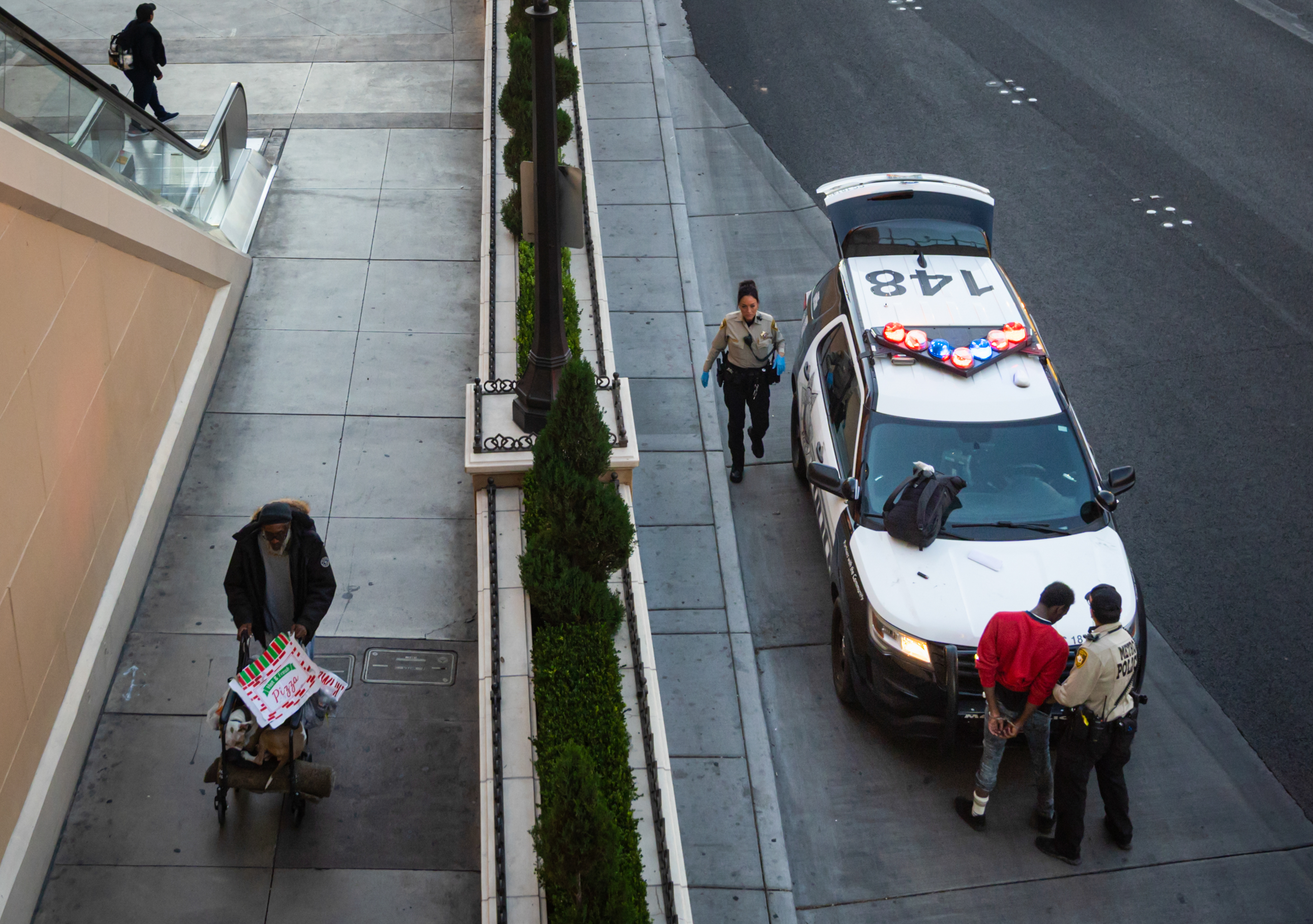


Shomari Hamlin was arrested for being on the wrong side of the street.
He was walking by a wash near the Las Vegas Strip in 2023 in an area that he and other homeless people frequented. A police officer asked to see his ID and found that Hamlin, as a result of a prior drug paraphernalia charge, had an active “order-out order” banning him from being on or near the Strip.
Hamlin had crossed the boundary that makes up the resort corridor, thereby violating the court order and committing a misdemeanor.
So-called “order-out orders,” issued by judges, peaked when the Resort Corridor Court operated in 2023 and 2024. The court was a controversial program that entailed one judge overseeing most criminal cases originating from the Strip. The orders previously existed for certain crimes, but a 2022 Clark County ordinance allowed judges to issue the orders in all cases originating from the Strip, banishing defendants from the tourist area for up to a year.
Hamlin is one of more than 4,100 people who were issued such orders in recent years, according to Las Vegas Justice Court data obtained by the Las Vegas Review-Journal. About 88 percent of those people received their orders in a criminal case filed during the years the Resort Corridor Court operated.
“I did not know a single homeless person who did not get an order-out,” Hamlin said in a recent interview.
The Resort Corridor Court ended when the majority of the Justice Court judges voted to stop the program in late 2024, multiple sources with knowledge of the court’s administration told the Review-Journal. Although judges are still able to issue the order-out orders, the number of orders has significantly decreased in 2025.
Despite the judges’ decision, a new political push could revive the specialized court.
Gov. Joe Lombardo announced in early October that he intended to call the Legislature back for a special session in the coming months to finish what it “left unfinished.” His office said the agenda has not been finalized, but multiple officials interviewed for this story said they expect it to include legislation addressing the court program.
RELATED: Failed legislation addressing Strip court program could come back in special session
The Review-Journal found that for years, casino executives and the Nevada Resort Association, which represents a coalition of casinos, have used their political power to advocate for the court program in an effort to maintain the resorts’ reputation. The lifeblood of Nevada’s economy flows from the Strip, and executives want visitors to feel safe from crime. The casinos also want a solution to the problem of people who are told dozens or even hundreds of times to leave their businesses.
Clark County prosecutors and the Nevada Resort Association want the court to return. They contend that the program worked by reducing recidivism among repeat offenders who commit crimes on the Strip.
Those opposed to the program question the need to bring back a system that — in their view — targeted homeless people, violated defendants’ civil rights, did little to address the root causes of crime on the Strip, gave the casinos special treatment and overloaded the court with an influx of minor cases.

Assistant Public Defender John Piro, a lobbyist for the Clark County public defender’s office, said the court “is like creating a justice system just for the resorts.”
“We have equal justice under the law. I don’t understand how the wealthy and powerful can direct the court to do their bidding,” he said.
Currently, all judges hear cases originating from the Strip. Those in favor of bringing back the Resort Corridor Court argue that having one or two judges overseeing all cases is more efficient and allows for repeat offenders to be quickly identified.
Critics question the need for a program overseen by specific judges.
“It’s judge buying,” argued Christopher Peterson, the legal director of the American Civil Liberties Union of Nevada. “They want to pick and choose which judge they have in their court.”
Virginia Valentine, president of the Nevada Resort Association, said the chief judge determined who oversaw the Resort Corridor Court, and the association believes “defendants should receive equal treatment regardless of which judge they appear before.”
‘Disorder crimes’
The idea for the Resort Corridor Court came from meetings organized by Todd Fasulo, a former Metropolitan Police Department assistant sheriff who is now vice president of security at the Wynn Las Vegas. Fasulo called together representatives from law enforcement agencies, Clark County, Las Vegas Justice Court and casino properties for the meetings.
A goal of the court program was to reduce trespassing cases and what Fasulo called “disorder crimes,” which he defined as minor offenses that can lead to violent crime.
But opponents said that in practice, an increased emphasis on order-out orders targeted the homeless population on the Strip.
“What the court really did good at was prosecuting homeless people for homeless-type offenses and putting them in jail at taxpayer expense,” Piro asserted.
“Where do they live? I don’t know,” she said. “Are they homeless? I don’t know that, either, but if they have committed a crime and they have trespassed … they may wind up in the court.”
Meanwhile, some opponents have questioned the constitutionality of the county ordinance. The ACLU of Nevada has repeatedly argued that the order-out orders violate defendants’ First Amendment right to assemble on public land and infringe on people’s 14th Amendment right to travel.
Critics and proponents of the program agree that there is a lack of data surrounding the Resort Corridor Court. Until the Review-Journal requested data from Las Vegas Justice Court and analyzed it, limited information had been reported publicly on the types of cases that involve order-out orders.
The news organization obtained data from Justice Court on every case involving an order-out order filed through mid-July 2025, plus information on every case involving a violation of such an order.
From my vantage point, the court and the order-out provision is, simply put, used to target a specific subset of people: those that the resorts may find undesirable.
Data shows that the most common offense in an order-out case was not battery, theft or property destruction. It was trespassing. About 30 percent of order-out cases involved the offense. The second most common offense was violating an existing order-out order.
About 75 percent of defendants with an order-out order only received an order in one criminal case. Valentine said this shows that the program worked for those people. If they didn’t receive a subsequent order, she argued, maybe they didn’t go back to the Strip.
In a recent interview, Justice of the Peace Melisa De La Garza, the court’s chief judge, said judges chose to end the court program for reasons that included hefty caseloads and concerns over the sustainability of the program. She also questioned the availability of social services for defendants.
“I just see that there was a lack of resources then and there’s a lack of resources now,” she said.
When the court was established, proponents stated that the program would connect defendants with social services, such as the Community Court overseen by De La Garza, which helps provide housing assistance, mental health care and addiction treatment to criminal defendants.

But attorneys who worked in the Resort Corridor Court said diversion programs could not handle the influx of cases.
“We never got a lot of these folks the help that they needed to address these systemic kind of issues that they were facing: being unhoused, being mentally ill, being addicted to drugs or some combination of all of the above,” said Deputy Public Defender Olivia Miller, one of the attorneys assigned to the Resort Corridor Court when it was operational.
Both De La Garza and Clark County District Attorney Steve Wolfson, who is in favor of the court program returning, said a significant number of the defendants appeared to be homeless.
In a “perfect world,” Wolfson said, the court would return with additional resources.
“There’s an expense associated with doing the Resort Corridor Court the right way,” Wolfson said.
Trespassing offenses
Security officers trying to remove someone from a property will typically start with giving a warning. Refusing to leave is a misdemeanor offense, and so is later returning to the property. Police are not called for every trespassing incident, so someone could be ejected from a casino hundreds of times without facing hundreds of criminal cases.
The most common order-out case in the Justice Court data involved a single trespassing offense where the defendant was not accused of another crime.
Marcellus Brower, a 59-year-old homeless man, was labeled a prolific trespasser and “habitual sleeper” in court documents. Court records show that he has 54 cases dating back to 2003. The majority are trespassing cases, but he also had domestic violence, vagrancy and petit larceny cases.
Where do they live? I don’t know. Are they homeless? I don’t know that, either, but if they have committed a crime and they have trespassed … they may wind up in the court.
He was found sleeping in the Flamingo and outside The Venetian, and he was accused of stealing a hoodie from Treasure Island. He also has violated order-out orders multiple times, records show.
Brower told the Review-Journal he thinks authorities issued the orders to keep the Strip clean and prevent tourists from seeing homeless people.
“I get the marketing aspect of it, but it’s still wrong,” he said.
Metro crime data shows that reported trespassing crimes increased on the Strip while the Resort Corridor Court functioned. During the first year of the court, reported trespassing offenses rose by about 45 percent in the area command encompassing the Strip, from about 2,800 to 4,000.
Links to violent crime
In emails to public officials and casino executives, Fasulo linked trespassing and misdemeanor offenses to violent crime on the Strip.
“In synopsis, the problem is an increase in misdemeanor crimes particularly around the trespass and prostitution related crimes,” Fasulo wrote in a 2022 email summarizing a meeting. “The smaller misdemeanor crimes roll into the increase in violent crime and robberies or larcenies committed by prostitutes.”
The meetings that led to the court were meant partly to “minimize the disorder that we were seeing,” Fasulo told the Review-Journal in a recent interview.
Meanwhile, data shows that 93 percent of cases with an order-out order did not involve a violent offense. And less than 2.5 percent of the 988 defendants accused of violating an order-out order also were accused of committing a violent offense in that same case.
When analyzing the data, the Review-Journal defined violent offenses as murder, battery, assault, robbery or sexual assault, and included attempted offenses.
Athar Haseebullah, executive director of the ACLU of Nevada, questioned whether the court program addressed a major public safety issue when the majority of order-out orders were not tied to a violent offense.
“From my vantage point, the court and the order-out provision is, simply put, used to target a specific subset of people: those that the resorts may find undesirable,” Haseebullah said.

FBI National Incident-Based Reporting System data, which Metro uses to report crime data to the federal government, shows that reported cases of violent crime decreased across the valley in recent years. In 2024, “crimes against persons” decreased across most area commands, falling by about 13 percent in the area command that covers the Strip.
Piro said it’s unclear if the area’s drop in violent crime can be definitively linked to the Resort Corridor Court.
“Metro’s increased enforcement, increased patrolling, increased numbers of patrol officers and doing a good job, that had the effects of reducing violent crime throughout the whole city, frankly,” he said.
Valentine said the Resort Corridor Court was not intended to decrease only violent crimes, and she acknowledged that not all repeat offenders become violent offenders.
“But if this prevents an escalation, even if it’s one escalation, I think that’s an improvement,” she said.
High caseloads, repeat violations
All 16 justices of the peace raised concerns about the sustainability of the Resort Corridor Court in a letter sent to county commissioners about nine months into the program.
The judges wrote that caseloads were “significantly higher than what was estimated” and questioned how effective the court was at deterring recidivism. They advocated for the court to continue another year to collect more data.
The month prior, the Nevada Resort Association had sent letters to each judge, asking for the program to continue. Valentine, who signed the letter, acknowledged the need for additional resources to “sustain the court,” while arguing that the program addressed “serious and often violent crimes” and created consequences for repeat trespassers.
The judges expanded the Resort Corridor Court to two departments, overseen by two judges, for less than a year before they elected to stop the program.
During and after the court program was in effect, some defendants continue to return to the Strip and violate order-out orders.
Jimmie Barr, a 67-year-old homeless man, has had at least seven cases involving violations of an order-out order. Court records show that he’s faced more than 300 criminal cases in Las Vegas Justice Court in the past three decades.
The majority are trespassing cases, although he’s also been charged with public nuisance, sleeping in public, obstructing a sidewalk and petit larceny offenses. He has faced battery or assault charges 14 times, most recently in 2010.
Barr was at the Clark County Detention Center this month after he was again accused of violating an order-out order. During a recent court hearing, Barr was accepted into an addiction treatment program through Community Court, which he unsuccessfully attempted to complete last year, with a plea from De La Garza to “take this seriously.”
In a jailhouse interview, Barr told the Review-Journal he held food service jobs at casinos when he was younger and sees the Strip as his home.
Although he’s confused about some aspects of his cases, he was clear that a court order would not keep him from the Strip.
“Doesn’t stop me,” Barr said. “I’ll go again.”
Contact Katelyn Newberg at knewberg@reviewjournal.com or 702-383-0240. Contact Noble Brigham at nbrigham@reviewjournal.com.