Q&A: Raiders new special teams coach discusses how to correct issues
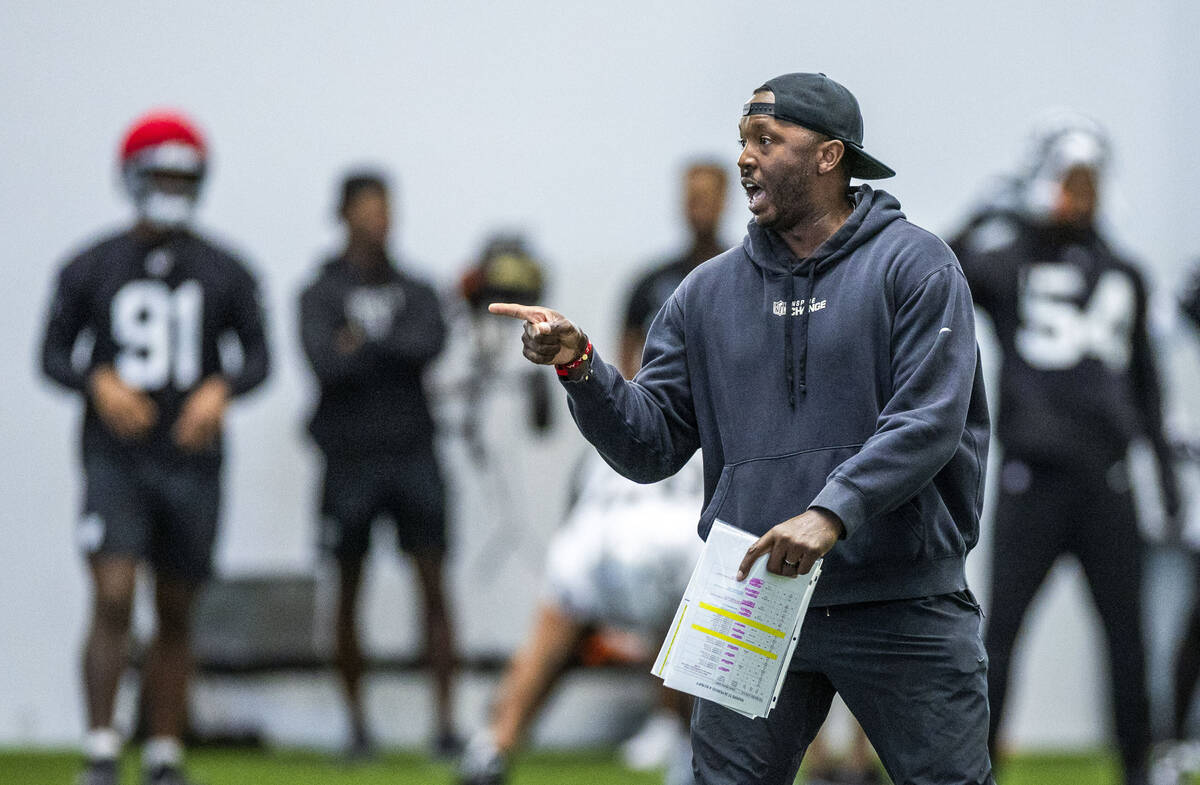


Derius Swinton II was thrust into a difficult position when he was named interim special teams coordinator by the Raiders in November after the firing of one of his mentors, Tom McMahon.
Swinton has been a coordinator in the NFL on two occasions, with the 49ers and Chargers, but never had been elevated to that role in the middle of a season.
The challenge was a tall order.
Swinton was tasked with cleaning up a unit that had made several crucial mistakes in the first half of the season with coverage breakdowns overshadowed by protection issues that had led to punt and field-goal blocks.
The 40-year-old former two-sport athlete at Hampton has welcomed the challenge.
He has used his time with nine teams and serving under countless coaches to put his own stamp on the Raiders’ special teams.
Swinton’s tenure has included a viral moment when the Raiders nearly pulled off one of the rarest imaginable plays in the NFL with an onside punt after a safety that had a chance of being recovered by the Raiders.
Swinton sat down with the Review-Journal to discuss how much he has been able to change since taking over the job, among other topics.
RJ: You’ve been a coordinator before, but how different is it when you move into that role in the middle of the season?
Swinton: You don’t have time to install your own thing. You’re coming in and just as quickly as possible trying to get the culture going the way you want in a positive way. But at the end of day, it’s about the guys, so I try to make it about them. Take those guys who are on the field and put them in a position to succeed. It’s far more about that than making any drastic changes.
RJ: So how much can you actually do?
Swinton: You can certainly make tweaks. I think we just try to remain constant in our fundamentals, like making sure fundamentals are clean. Scheme-wise,we tried to change a few things, but not a wholesale change because you just can’t do that in middle of a season. Maybe it’s some terminology, maybe it’s little things scheme-wise or return-wise, but there’s really not an opportunity for a massive overhaul.
RJ: You were obviously on the staff early in the season when the unit was having issues. What did you see as being some of the major issues?
Swinton: We were hurting ourselves and shooting ourselves in the foot with some of the penalties and what we would call turnovers, like the blocked punts and things like that. We just had to focus on getting back to the fundamentals.
RJ: How much coaching can you really do with a player such as AJ Cole, one of the game’s elite punters?
Swinton: I compare it to being a caddie for the top golfer in the world. You really don’t do much. You give recommendations, but you really aren’t telling him how to do anything. You’re just saying, ‘This club might be good here.’ But if he sees something or he feels something, he’s done it at such a high level, you hold back.
RJ: Kicker Daniel Carlson has been at that level at times in his career, but there have been a few misses this season. How much is operational that you can help work on, and how much of it is a kicker just having to make kicks?
Swinton: I think it’s a matter of situationally just making sure the confidence is there and making sure he knows who he is and how good he is. Just go out there and kick it and let it rip and have confidence. He’s been at the top, and he still is at the top. He just has to get back to it.
RJ: I know we’ve talked about the new kickoff rule in the past, and you liked it. Are you still a fan of it?
Swinton: One hundred percent. If you look at it, it’s doing what everyone wants it to do. If you look at two weeks ago in the overtime games, you get long returns, and people are staying in their seats and staying tuned in because you never know. You get a one-possession game and decide to kick it to somebody, that one play could flip the field in seven seconds, and now you’re in field-goal range. So I think from the player safety standpoint, which the league wanted, you see the concussions go down, the injuries go down. I think it’s done everything we wanted from it, and it’s an exciting play. If you have a dynamic player and you can’t tackle him, it changes the game.
RJ: How do you balance the line between letting your kicker get creative with the kickoffs that could pin a team deep, but also has the risk of a harsh penalty with telling him to play it safe and just get the ball in the landing zone?
Swinton: I think it’s week to week. Who is back there returning? Who do you have covering? Weather also plays a factor. Then, it’s can your guy do it? People have seen Daniel do it, and I say all the time, ‘What’s better than a punter who can force fair catches?’ A kicker who can get a minor (25-yard line) touchback and put the ball on the ground and be a one-man kickoff team. Our guys would love it if we never have to cover a kick because he’s hitting it and guys can’t catch it. It’s all those factors, and when you have a guy like that, it really helps you.
RJ: You almost pulled off one of the special teams plays of the century with the onside punt after a safety that could have been recovered. You did everything but finish the play. How frustrating was it to be that close but not quite get the end result you wanted?
Swinton: I think that’s just part of it. I think I heard an old pastor say, ‘When your neighbor gets blessed, that means (God) is in the neighborhood.’ And I think when those things happen, you know it’s coming. I tried to emphasize to the guys, ‘Listen, when things like that happen, you didn’t do anything special. Just keep doing what you’re doing, and it’s going to turn your way at some point.’
RJ: But in your world, nobody notices when you do your job well. It’s only blame when things go poorly, or in rare circumstances, credit when you pull off an amazing play. How tough is that as a coach?
Swinton: I have an uncle who’s an NBA referee, and he says the same thing, that when you’re really good at your job, nobody notices you. But everyone knows when you’re bad. So you kind of like to go unnoticed, because that means you’re doing something right. Then when good things happen, people say, ‘OK, that’s standard.’ So you just want to go unnoticed and do our jobs to the best of our ability.
RJ: You’ve been a part of several organizations and worked with some great coaches in your career. Who have you learned the most from along the way?
Swinton: I think the two guys you put at the top for me would be John Fox and Pete Carroll. Those two guys have just been legends in this league with their success and the things they’ve done. Learning from them and how they’re able to be the same person every day in spite of the ups and downs and then just how they lead the players is really where that comes from. Special teams-wise, Jeff Rodgers and then obviously I’ve been working with Tom McMahon for years. Those are guys I look back on in my career along with Sylvester Croom and Romeo Crennel and guys like that.
RJ: You played defense in college. You started your coaching career on the defensive side.
Swinton: I was one year as a graduate assistant on defense and then one year on offense.
RJ: OK, so both sides of the ball. How did you find your niche on special teams?
Swinton: It’s actually funny. When I interviewed with (then-head coach Steve Spagnuolo) in St. Louis with the Rams, (offensive coordinator) Pat Shurmur and (special teams coach) Tom McMahon both wanted to hire me. I don’t know if they did rock, paper, scissors or whatever, but I was 22 years old. I wasn’t going to say no to anything. Next thing I know, (Spagnuolo) calls me and says I’ll be working on special teams. It was kind of just the path it went.
RJ: Similar to that, your dad was a pretty good basketball player in college, and I read that you were pretty good in high school. Why did you choose football?
Swinton: Well, I played in college, too. My first two years, I was playing both, and I thought about and figured, ‘Well, I’m starting at safety my sophomore year, and there are a lot of 6-2 point guards out there. There’s not a lot of 6-2 safeties.’ At least at that time. So I chose football. Basketball is still my first love, and my wife works in basketball, so I’m still in it, and we have family in basketball. But the path took me to football, and I guess I made a business decision to take that path.
Contact Adam Hill at ahill@reviewjournal.com. Follow @AdamHillLVRJ on X.