Planting in cold part of winter could cause damage

Q: We are redoing our front yard and finishing up the drip lines. Is it too late in the season to put in new plants now? We are planning on lantana, society garlic, red yucca, Mexican bird of paradise and some deer grass.
A: We have entered the coldest part of the winter. All of the plants you mention, except red yucca, could be damaged if you plant now. Larger, cold-hardy trees and shrubs would still be OK to plant.
After you plant, you should consider applying mulch to the soil surface surrounding them for a bit more protection. Whenever you plant trees and shrubs into residential soils, you want to mix good-quality compost in the backfill surrounding plant roots. Use an equal amount mixed with the backfill surrounding plant roots.
Q: Which varieties of pomegranate are good to grow in the Las Vegas Valley?
A: This is a good pomegranate climate, similar to the climates in which pomegranates originated in south central Asia, Persia, Pakistan, Afghanistan and India.
In the United States, we have a wide selection of pomegranates available to us that have been collected from throughout the world. Some of the newer selections may be cold-sensitive in parts of the valley. I’d stay away from unknown varieties unless you want to experiment
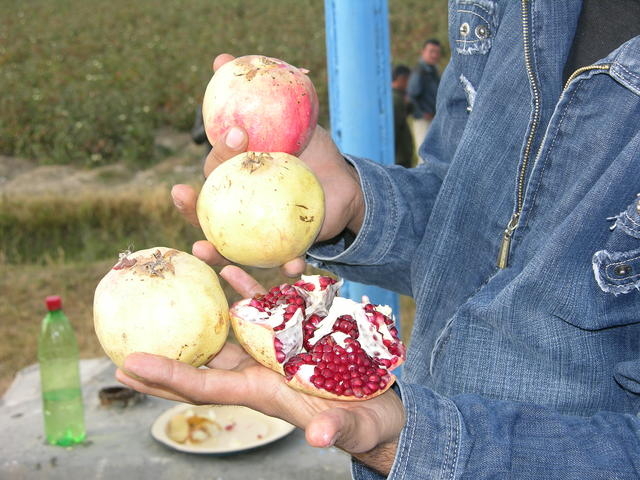
For the most part, all of the pomegranates available commercially do well. The flagship pomegranate variety is Wonderful with its beautiful outer and inner ruby red color. But pomegranates come in a wide range of colors from dark purple to nearly black all the way to lemon yellow and off-white.
You won’t go wrong with such varieties as Sweet or Eversweet. A local favorite, sometimes referred to as seedless, is Utah Sweet, a selection from Sweet. A variety from the former Soviet Union receiving rave reviews is Parfianka.
Other varieties I have liked include Sharps Velvet, Red Silk, Pink Satin and Grenada. One variety I have been less than thrilled about is Ambrosia, an early producer that has no flavor. I have seen no winter damage on any of the varieties I mentioned.
Q: Since late September, my 5-foot lilac planted on the house’s west side has been showing signs of stress. The lilac made it through the summer fine and all green. But it has recently shown browning of the leaves despite continuing to bud. I read that fertilizers are not recommended or necessary, but I’m tempted to try.
A: Both common and Persian lilac grow in our climate. They won’t do well in a rock landscape. They prefer soils higher in organic matter.
If they’re surrounded by rock, they’ll begin to decline in about three to five years. You may see scorched leaves, some branch dieback, leaf drop and reduced flowering or no flowering at all.
Some lilac varieties perform better here than others. An old reliable common lilac is Lavender Lady hybrid. This variety requires less chilling and blooms well here.
This could be a location problem. A western exposure is too hot for it. Lilacs like sunlight but not combined with intense heat. It is best to have your lilac in a location protected from late-afternoon sun.
But I totally disagree that lilacs don’t require fertilizer. They not only require fertilizer once a year in the spring, but benefit from compost or organic amendments to the soil. Lilacs like a rich soil, compost, wood chips as a surface mulch and fertilizer.
Q: My kids sent me a hydrangea for the holidays. I know I have to keep it as a houseplant. When I lived in New York, mine were huge outdoors. What do I need to do keep them alive and thriving?
A: Hydrangeas aren’t meant for planting in our climate and soils. Hydrangeas given as gifts are like poinsettias, intended to be grown in greenhouses for a one-time gift event. But what the heck, give it a shot.
Some varieties of hydrangeas are more suitable for growing outdoors than others. “Western Sunset Garden Book” has recommended varieties you can try. If you are lucky enough to have gotten one of these varieties as a gift, you may have a fighting chance of keeping it alive.
Hydrangeas need a bright location on the north or east side with filtered light. Add compost to the soil at the time of planting. The plants need an organic surface mulch that decomposes to enrich the soil, such as wood chips. Hydrangeas should be fertilized with an acid fertilizer every six to eight weeks.
If you want to go whole hog on this plant, get some aluminum sulfate and apply it to the soil when you plant and in early spring. Aluminum sulfate does a better job acidifying the soil than sulfur. Acidifying the soil helps keep the flowers a vibrant blue.
You are fighting an uphill battle on this one. But if you really want it to work, you must spend time and money on this plant with soil preparation, mulch and specialized fertilizers such as aluminum sulfate.
Otherwise, I wouldn’t bother and enjoy it for what it was intended: a gift on a special occasion from loved ones.
Q: What is causing the leaves on my lemon tree to turn yellow? This has been happening gradually all year.
A: Without more information I’m guessing it is a combination of high light intensity, micronutrient deficiency and possibly salts. If the yellowing was more of a bronze appearance then I would say it was due to winter cold.
Flush salts from the soil. Apply a large volume of water to the irrigated area under the tree to flush salts that might be causing a problem. Do this two or three times over a period of a few days then revert back to normal irrigations.
Water no more than every 10 days right now. Make sure the water volume is sufficient to wet the soil 18 inches deep. When new growth resumes, irrigate more often. But this time of the year, irrigating 10 days apart should be adequate.
If rock surrounds this tree, pull the rock 3 feet away from the trunk. If wood mulch surrounds the tree, you don’t need to pull it back. Make sure wood mulch does not touch the trunk of young trees; keep wood mulch 6 inches away from the trunk.
Next, apply iron chelate containing EDDHA beneath the tree near a water source. Cover the iron chelate with wood mulch to keep it out of the sun or make sure it is placed beneath the soil surface.
In February or after fruit set, apply a normal amount of fertilizer. Organic fertilizers are best. You should see a change in the color of the new leaves this spring during growth.
Bob Morris is a horticulture expert living in Las Vegas and professor emeritus for the University of Nevada. Visit his blog at xtremehorticulture.blogspot.com. Send questions to Extremehort@aol.com.