



Chambliss lives a lifestyle full of adrenaline
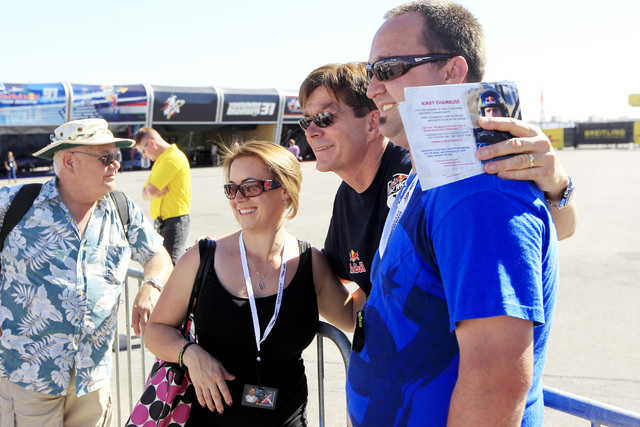
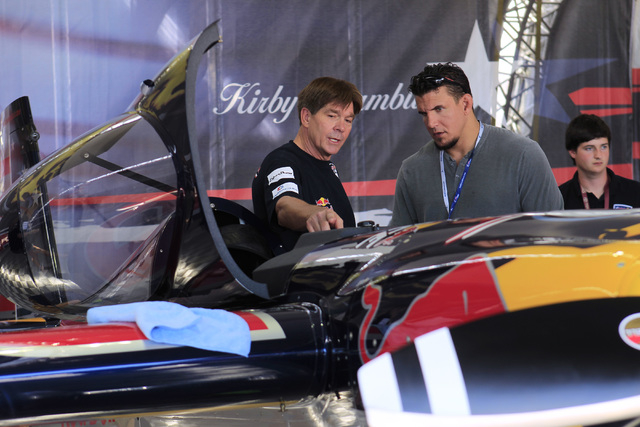
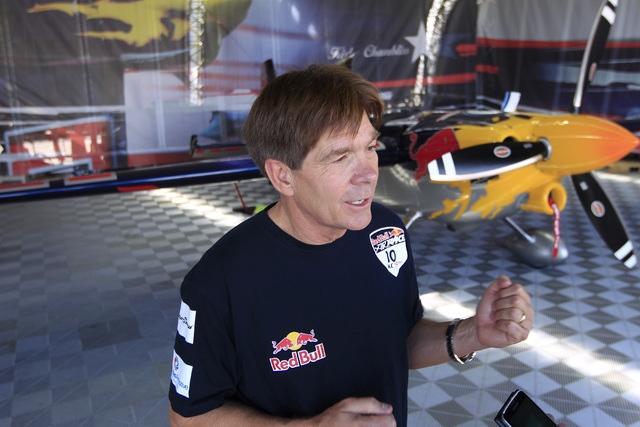


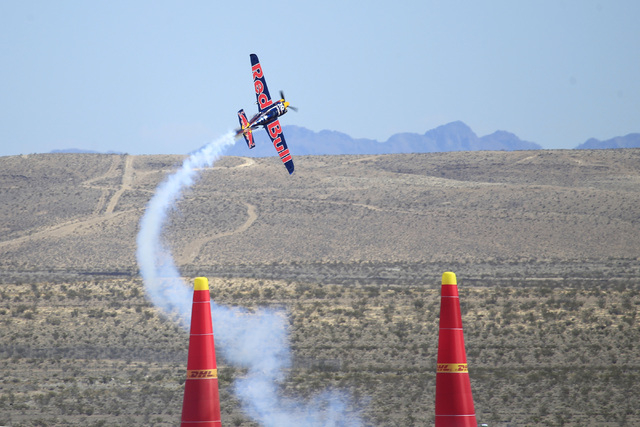
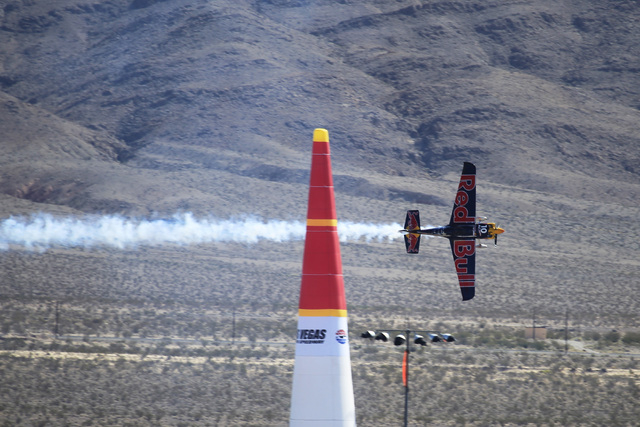
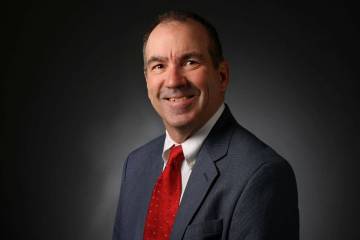




Kirby Chambliss stands 11th in points among the 12 adrenaline junkies who will race airplanes through pylons at speeds approaching 230 mph today in Round 7 of the Red Bull Air Race World Championship at Las Vegas Motor Speedway. So it hasn’t been the greatest of years for one of the world’s foremost air racers.
He did, however, recently go off into the wild blue yonder with Amelia Earhart as his co-pilot.
This would have been Amelia Rose Earhart, namesake of Amelia Mary Earhart, the famous aviation pioneer whose plane disappeared over the Pacific Ocean in 1937 when she was attempting to fly around the world.
Though they are not related, the two Earharts grew up in the same neck of the Kansas woods. Amelia Rose Earhart is a pilot, too (as well as a former TV traffic reporter in Denver), and in July she recreated the circumnavigational loop of the globe her famous namesake was not able to complete.
So for a guy who likes to fly airplanes through pylons and upside down and stuff, that had to be pretty cool.
“Back then, it was something,” Chambliss, a two-time Red Bull series champion, said of flying around the world in one giant swoop.
“With autopilot, GPS, you pretty much sit there and drink a Coke (today). But I think it’s cool that she did it, because of her name and everything.”
When you are zipping through pylons 80 feet tall at speeds approaching 230 mph, as these magnificent men in their flying machines do, it’s pretty much impossible to drink a Coke, or even an 8.4-oz. can of sugar-free Red Bull.
Chambliss, 54, grew up in Corpus Christi, Texas, the son of a skydiver. He started flying when he was 13. He now lives on a ranch in Arizona with his wife, Kellie, and his daughter, Karly; they have their own landing strip on the Flying Crown Ranch, a la Sky King, if you remember the old TV series.
Karly Chambliss is 9. She’s already flying. On Saturday morning, when I was talking to her dad, she was applying polish to the fuselage of the No. 10 Red Bull-sponsored flying machine.
“She can’t land it yet. She does really well with the pedals,” her old man says. “The other day we were chasing ducks and coyotes over the Salt River.”
This was in a smaller plane, not in her dad’s air racing plane. No need to alert Sheriff Joe Arpaio or the authorities.
The air racing plane is an Edge 540 V3. It is purpose-built for air racing. Its top speed is 265 mph, and it is more nimble than Mikhail Baryshnikov.
It is so nimble that even if you put machine-gun turrets in front, it would still fly circles around the British Spitfires used in World War II. Those Luftwaffe Messerschmitts wouldn’t stand a chance. But at least in air racing, you don’t have to worry about synchronized machine guns.
Statistically, the Red Bull series is one of the safest forms of motor sports — there has been only one crash since series inception in 2003, and nary a serious injury. Plus, it’s pretty hard to drive a tractor onto the track, which is what happened in that brutal Formula One accident in Japan last weekend.
Still, there’s little room for error, and when you make one, or your engine just up and quits, there is little time to react. Or to call Jake from State Farm.
Chambliss, who was 24 when he became the youngest commercial pilot in Southwest Airlines history, also is an aerobatics pilot of some repute; he has won five U.S. championships in that flying discipline and 13 world championship medals.
But last year, while attempting a maneuver called a high Alpha pass during an airshow in El Salvador, his engine just up and quit.
Uh-oh.
Right after he had cleared this 250-foot ravine.
Double uh-oh.
There was no soft spot on which to put his plane down, so Chambliss pointed it at a tree on a rocky ledge and pushed the ejector button. He escaped with minor injuries to his arms and shoulders. The plane was destroyed.
Chambliss counted many lucky stars. He said it took him a while before he got back in the air.
It must have taken a whole week that time.
“It’s about as safe as it can be,” he said of the globetrotting series now in its second incarnation after a three-year respite to reorganize and readdress safety. “It’s like auto racing or anything else. It can’t be 100 percent (safe).”
To me, it seems like its only about 98 percent safe when your landing gear seems to be clipping the billboards in Turn 2 of the racetrack, and when you’re flying vertical through the pylons near Turn 3, and when you climb and loop and dive after the start-finish pylons, like James Bond with Dr. No’s guys on your tail.
Plus, you have to trail smoke for two laps, as if you are dusting soybeans in the Heartland. If you don’t trail smoke, they penalize you. You also can be penalized for exceeding 10Gs, which gives pilots headaches in multiple ways.
Yeah, you are up there alone, racing only against the clock, and against your own inhibitions. But from where I was sitting Saturday, there didn’t seem to be a lot of inhibitions. Chambliss posted the 11th-fastest qualifying time; Pete McLeod of Canada was fastest. Only 3.362 seconds separated the fastest qualifier from the slowest after penalties.
As they say when the planes are entering the track, smoke on!
“The things that I do, if something breaks, you’re probably going to die,” Kirby Chambliss says only as a matter of fact, not to come off as a daredevil with an adrenaline rush and a death wish. “It’s not a perfect world.”
Las Vegas Review-Journal sports columnist Ron Kantowski can be reached at rkantowski@reviewjournal.com or 702-383-0352. Follow him on Twitter: @ronkantowski.
Today’s Red Bull Air Race World Championship schedule at Las Vegas Motor Speedway:
Noon: Master Class racing starts.
12:20-12:50 p.m.: Top 12 round.
1:20-1:40 p.m: Super 8 round.
2:08 p.m.-2:20 pm.: Final 4 round.