



China, US militaries work together for disaster training
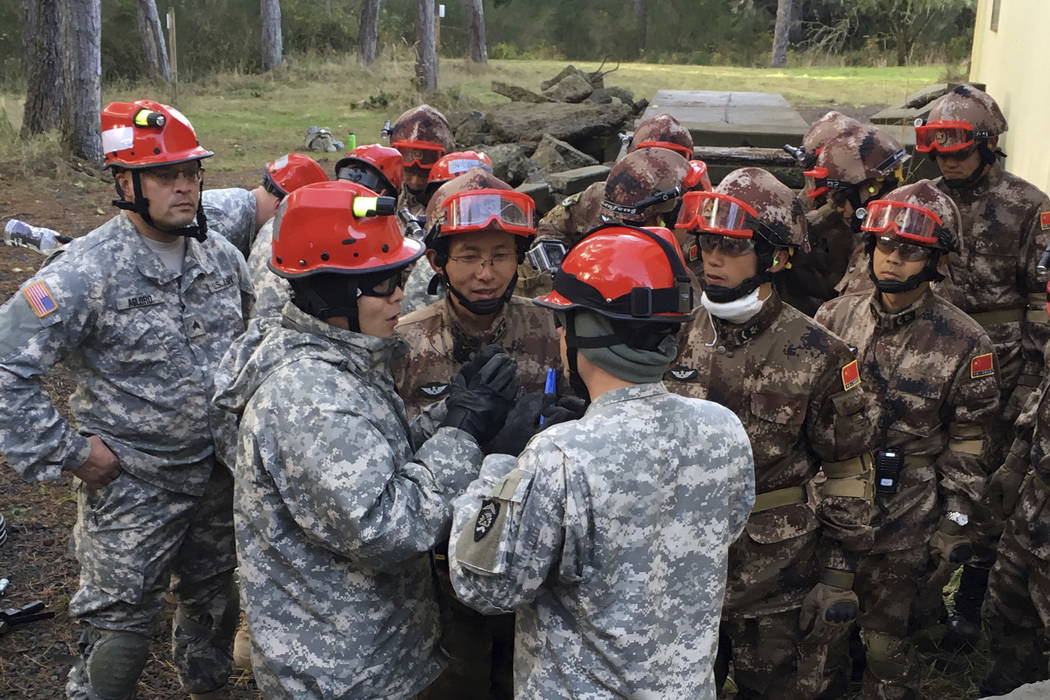


CAMP RILEA ARMED FORCES TRAINING CENTER, Ore. — A man lay on the grass, shivering beneath his bloodstained T-shirt as Chinese military doctors and U.S. Army medics hovered over him, applying a splint and an IV. Troops nearby prepared to evacuate the injured.
On a pine-studded base along the Oregon coast, military units from two seemingly unlikely partners were carrying out a joint response to a natural disaster. It was only a drill, but the roughly 100 soldiers from China and the U.S. and their top commanders are ready to use what they learned in a real disaster, no matter the state of relations between the nations.
“The tensions that happen really don’t impact this, because we’ve found an area of common interest: that’s saving lives and disaster response and humanitarian assistance,” Gen. Robert Brown, commander of Hawaii-based U.S. Army Pacific, told reporters Sunday, the closing day of the exercise.
Washington and Beijing are striving to foster military ties to avoid a confrontation and potentially work together where their interests don’t collide. That’s despite a growing strategic rivalry between the two world powers and frictions over North Korea and China’s island building in the disputed South China Sea.
Maj. Gen. Zhang Jian, a senior commander who visited Oregon, said U.S. President Donald Trump and Chinese President Xi Jinping expressed hope during Trump’s visit to China this month that military relations can be a stabilizing factor. Zhang said the disaster exercises, which the U.S. and China host in alternate years, evolved from academic discussions to boots on the ground in the last few years.
“I think it is very positive in the fact that it can enhance mutual understanding, it can reduce the risk of miscalculation and misperception, and will definitely help to build a more secure and stable regional situation,” Zhang said through an interpreter, as Brown nodded.
U.S. and Chinese forces have not collaborated yet on disaster response, but Brown said he expects them to.
In the recent drill, the soldiers practiced responding to a massive flood. The skills also could help in an earthquake as they used a large drill to practice extricating survivors from a collapsed building, or in a tsunami.
It was the first time in the United States for most of the Chinese soldiers, who wore red flag shoulder patches on their uniforms. The Americans tried to make the Chinese feel at home as they carried out their mission.
“Cook in dining hall here tries to make what he thinks is Chinese food, even though it tastes not like the same in China,” said Lt. Mo Si Hua, one of the few Chinese soldiers who spoke some English. “But that make us comfortable and feel like home.”
Among the unusual sights for the Chinese was a herd of elk that emerged in the morning mist. An American soldier described what they were, spelling “elk” for a Chinese journalist.
A main difference in how the Chinese soldiers operate from the Americans is “they have more patience,” U.S. Army Maj. Adam Charles said.
“We want to rush in. They study things,” Charles said as a team nearby broke apart a concrete slab in rubble near several crushed cars.
He said taking time to assess is beneficial, because hasty rescuers could wind up in need of rescue themselves.
With only a couple of interpreters, language was an impediment. But not many words were needed when medical teams jump into action, because they use similar approaches, said Tian Jing, a People’s Liberation Army doctor.
A team of four Chinese and American medics worked on a U.S. soldier lying in the grass. One medic prepared a splint as a nurse inserted an IV needle into the man’s forearm. With a gesture from a Chinese medic, one of his American counterparts helped steady a leg while the splint was attached.
Soldiers stretched ropes across a waterway, affixed the injured in stretchers to the ropes, then pulled them across. Chinese medics said they usually practice on mannequins and that using people added realism.
Participants also gained experience in organizing and deploying assets, said U.S. Army Maj. Valente Perry, who assisted in the aftermath of Haiti’s 2010 earthquake.
“We’ve got to figure out a way to come together, to pool our resources so we’re not just butting heads the whole time,” Perry said. “And so you try to get through that stuff and work through the kinks in exchanges like this.”
Bonnie Glaser, senior adviser for Asia at the Center for Strategic and International Studies in Washington, said that while the U.S. hopes the exercises pave the way for cooperation in a natural disaster, she doesn’t believe there were expectations they would ease bilateral tensions.
“That’s a bridge too far,” she said in an email.


