



Background checks for privileged licenses create bureaucratic burden


Anyone who thinks modern Las Vegas has washed away all its mob-era roots hasn't tried getting a privileged license.
The background checks on people seeking tavern and other privileged licenses delve into the finances of the applicant and details about his or her spouse, parents, siblings and even their spouses, a process that might make it harder to set up a money-laundering outfit but is also considered by some to be a relic from the past.
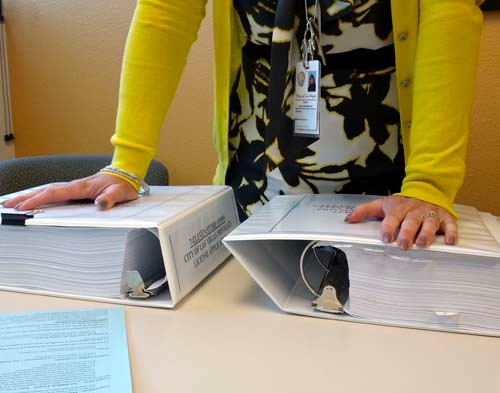
Karen Duddlesten, the city's business license director, makes the level of bureaucratic burden painfully clear when she drops two massive binders onto a tabletop.
The binders, each about
4 inches thick, land with a thud. They represent responses from just two applicants seeking beer and wine licenses.
"If we have a mature applicant, we could be asking them for 40 years of every hourly wage," Duddlesten says. "I think we can make that easier."
She is working to make a proposal to streamline Las Vegas' notoriously thorough background investigations and hopes to reduce the amount of paperwork as much as
75 percent.
The idea, Duddlesten says, is to acknowledge there are better ways to maintain the integrity of the city's privileged licenses than the kinds of background investigations local officials once used to make sure applicants weren't using the facade of legitimate business as a front for organized crime.
"We find that the system here in Southern Nevada is very unique, and I'm sure it is because of our unique history," Duddlesten says. Investigating "the personal and financial backgrounds of every single owner does not seem to be the norm out there among other jurisdictions."
For many years, intensive background checks have been considered the norm for privileged licenses in Nevada. The state thoroughly investigates people seeking to get into the gambling businesses. And local governments, such as Las Vegas, Henderson and Clark County, require investigations for people seeking licenses for taverns, nightclubs, locksmiths, massage therapy, pawnshops and strip clubs, among others.
"Nevada was always concerned about its image, the idea (the state was) all mobbed up and the criminals were running the place," former state archivist and historian Guy Rocha says about the notion that state and local governments should delve deeply into the finances and personal history of people looking to get into gambling and other privileged businesses. "Do we still need to do that today? That is the question people need to ask."
Ironically, the lack of an investigation for an applicant brought the issue to the fore recently in Las Vegas.
In June, an application for a permanent tavern license for the Heart Attack Grill was delayed after the Metropolitan Police Department objected because some of the investors, a group that includes Zappos CEO Tony Hsieh, had not gone through suitability investigations.
Duddlesten says she waived the process for some of the investors, which she has the power to do, but the police's objection was enough to sidetrack the application.
In particular, Councilman Ricki Barlow, whose Ward 5 includes Heart Attack Grill, cited the importance of verifying applicants' sources of income as a reason for maintaining scrutiny, though sources of Hsieh's wealth are widely known and documented in media reports and through the Securities and Exchange Commission.
"We still have a level of responsibility to protect the city," Barlow said at the time. "I can have a lot of money and you can be a criminal with a lot of dirty money, and you can use my name to clean your money."
Others at the time said the delay looked like a case of bureaucratic overkill.
"This isn't SUVs of cash being driven out of the basement of the Stardust," Councilman Bob Beers said, referring to Las Vegas' mob days when financial checks were meant to thwart organized crime. "This is a hamburger stand that wants to sell a beer with their hamburgers on Fremont Street."
Beers, himself an investor in a restaurant that sells beer, wine and liquor, has said the process could be limited to ensuring applicants won't sell alcohol to minors or commit other infractions.
On Aug. 1, the council, on a motion by Barlow, reversed the decision and granted the permanent license.
Barlow's motion also directed Duddlesten to review the application process for ways to make it simpler.
That is what led to Duddlesten poring over the process to identify potentially redundant or otherwise irrelevant requirements. She expects to report back to the council in October.
"What we have been tasked with is looking at what are we asking for and do we truly need it as a base for filling out an application," she says.
Separately, the council is expected to consider a different streamlining proposal from Mayor Carolyn Goodman and Mayor Pro Tem Stavros Anthony. That proposal would reduce the number of privileged licenses the city requires.
Locally many nongaming licensing investigations, which can include personal and financial background checks, are outsourced to the Metropolitan Police Department, which reports results back to the jurisdictions.
Las Vegas police didn't provide investigation data by jurisdiction but reported that since 2006, it has conducted more than 8,100 investigations.
The department also declined to state how much revenue it receives annually through licenses applications, saying the information "is not available at this time."
Duddlesten says that in the past year in Las Vegas she can't recall any of the hundreds of applicants being denied for unsuitability because of financial investigation results and that just one was denied because of violations the applicant racked up under a previous license. There were several licenses issued with restrictions related to applicants' criminal histories, she says.
"I think that over time we have just asked for more and more," Duddlesten says. "My concern at this point is we have developed a system for the 1 percent versus the majority of applications."
For example, Duddlesten says city code requires investigations to go back only 10 years, but the questionnaires provided to applicants ask for personal information beginning at age 18, including what high school the applicant attended.
The questionnaires also ask about the applicants' entire financial lives though many jurisdictions outside Southern Nevada limit financial questions to identifying the source of money for the business that needs a license.
"It is difficult, it is time consuming, it is expensive, and it is really redundant," says Michael Cornthwaite, owner of the Downtown Cocktail Room, who has gone through multiple investigations. "It is for a liquor license for a tavern or a restaurant. You are not selling nuclear arms."
Duddlesten says one way to reduce paperwork would be to ask applicants fewer questions upfront and ask for more information only if there are any red flags.
Another potential streamlining step would be to independently research applicants using online tools and databases already available to city workers.
She says the police department is the appropriate agency for criminal background research, but there are city workers who are qualified to scrutinize financial data.
Whether Duddlesten can achieve the 75 percent reduction in paperwork she says is possible remains to be seen.
It will depend largely on the results of behind-the-scenes discussions with the department and what a majority of City Council members want.
"I think we are having a lively debate on what information that we need," Duddlesten says, adding the department has been "very cooperative" in the discussions.
"They have some very different philosophies on the financial investigation and how far we need to go into personal finances versus the source of funding for the business," Duddlesten says.
Contact reporter Benjamin Spillman at
bspillman@reviewjournal.com or 702-383-0285.


