County won’t allow North Las Vegas to pour treated sewage into flood control channel




North Las Vegas may have just found itself up sewage creek without a paddle.
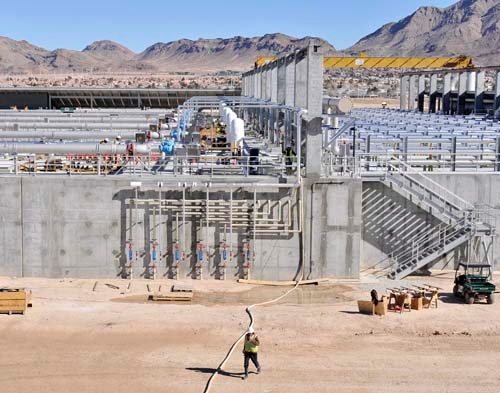
The Clark County Commission on Tuesday voted against allowing the city to flush treated sewage from its new $240 million wastewater treatment facility into an open, county-owned flood control channel. Without the channel, wastewater from the plant has no place to go.
The move has the potential to delay or derail the opening of the plant, which was supposed to be in May.
The vote came after a contentious meeting during which several commissioners criticized the city for its lack of cooperation and for not doing enough to educate the public about the plan.
"Cooperation has been almost nonexistent, and it's a shame," Commissioner Tom Collins said.
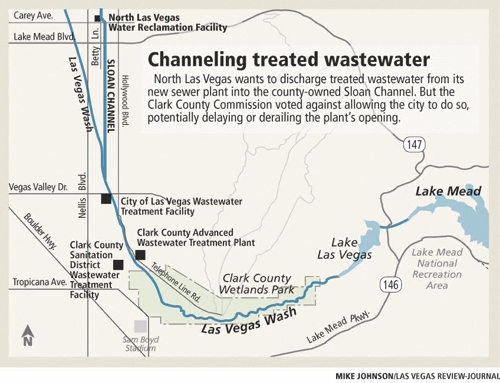
He and Commissioner Chris Giunchigliani, whose districts include parts of Sloan Channel, have long fought the city's plan to discharge about 25 million gallons of effluent a day from the new plant into the channel, where it would flow several miles into the Las Vegas Wash, then downstream to Lake Mead. Constituents walk and bike in the channel, they said, adding that the city should not have built the plant in the first place.
"I haven't spoken to anyone outside of North Las Vegas staff or officials that felt that the direction (the city) took in building this facility was even reasonable, let alone necessary," Collins said.
Several commissioners also said they were concerned that the city may be planning to eventually take over the treatment of sewage from Nellis Air Force Base, which would cost the county about $1.25 million a year in revenue.
The new plant is located outside North Las Vegas on land leased from the Air Force at Carey Avenue, south of the base. The agreement between Nellis and the city contains a "vague reference to the potential for North Las Vegas to treat their wastewater," said Maryann Ustick, acting city manager.
Giunchigliani said she was upset that commissioners had only recently learned about the possibility.
"Why was it not brought up?" she asked. "That tells me there's something else going on here."
North Las Vegas, which now contracts with Las Vegas for wastewater services, decided to build its own plant about seven years ago so it could control its own sewer rates.
City officials originally planned to discharge the effluent via an $860 million regional pipeline, but that project was put on hold because declining growth and advances in sewage treatment had reduced the need for it.
"You're left without a drain," Collins said.
North Las Vegas officials have defended their plan to use the Sloan Channel, saying treated wastewater will be cleaner than storm water and other runoff that already flows through the channel.
They also have said releasing effluent into the channel is no different than sending it into the Las Vegas Wash, which the valley's other wastewater treatment facilities already do.
As part of the agreement, the city would pay the county $50,000 a year to maintain the channel.
Mary Beth Scow, the third commissioner whose district includes a portion of the channel, was the only commissioner who did not vote against allowing the city to use it.
Blocking the plant's opening isn't fair to North Las Vegas taxpayers, she said.
"When you impact one group of taxpayers, you impact them all," she said Tuesday evening. "It came down to an issue of fairness for me."
Scow said she would have preferred that the item be continued so a resolution could be reached.
After the meeting, Ustick said she was disappointed with the commissioners' decision and that the city will be "exploring our options."
Those options include bringing the matter back before the commission, delaying the plant's opening until an agreement can be reached or shelving the plant indefinitely. The city also could construct a pipeline to carry the treated effluent along the same route, or take the county to court.
City and county officials continue to squabble over whether North Las Vegas has the right to discharge into Sloan Channel without the county's permission. The city has received authorization to discharge into the channel from the state's Division of Environmental Protection.
"We certainly maintain that we have the right to discharge based on" that authorization, Ustick said.
The county disagrees, and the division has said its permission "doesn't supersede local authority" over use of the channel for discharge.
"All it does is regulate the quality of water once it's discharged into the channel," Vinson Guthreau, a spokesman for the division, said in February. "We will be interested to see how the county and city work this out."
Cash-strapped North Las Vegas can't afford to build its own pipeline, Councilwoman Anita Wood said. Nor will the city shelve the plant it has spent so much money building. The facility will open soon, but "certainly we cannot guarantee on time," she said.
Wood also disagreed with what Collins said about lack of cooperation. City officials had been communicating with commissioners about the matter, she said.
"I think we really have tried to do the right thing," she said.
The commission made its vote "without prejudice," which means the city can bring the matter back later.
North Las Vegas will have to continue paying Las Vegas to treat its wastewater until the plant opens. The smaller city pays "roughly $15 million a year" for the service, Ustick said.
In addition, the city must pay the bond debt on the plant. If the facility doesn't open, the city will be stuck with both bills, a "model that does not work," Ustick said.
Giunchigliani responded, "That is the lousiest business decision I've ever heard."
Review-Journal reporter Henry Brean contributed to this report. Contact reporter Lynnette Curtis at lcurtis@reviewjournal.com or 702-383-0285.