School chiefs make plea
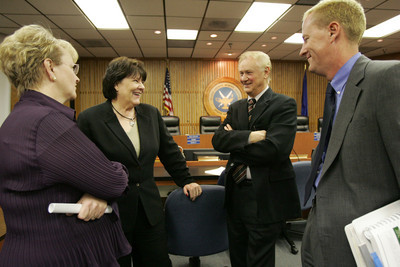



CARSON CITY -- Nevada's top school officials asked and Gov. Jim Gibbons agreed Thursday to provide as much flexibility as possible to make a $96 million cut in public education needed to get the state through an economic slowdown.
Superintendents from around the state, including Clark County School District Superintendant Walt Rulffes, met with Gibbons at the Capitol to learn more about the 4.5 percent per year cuts announced Dec. 14.
School officials, who were told earlier this year that public education would be exempted from any cuts, expressed surprise after that announcement. Since then, Gibbons has come in for criticism for including public education in meeting a $284 million spending reduction target over the next two years.
At the hourlong meeting, Rulffes said hitting the 4.5 percent reduction this year would be difficult because teachers already have been hired and half of the school year is over.
If districts were given some flexibility to do more of the required cutting in the second year, the $96 million target statewide for schools would be easier to achieve, he said.
"We hope that we can be held whole this year and have some kind of an orderly process for whatever cuts might be mandated for next year," Rulffes said. "In the second year we won't have a lot of the contractual obligations that are in place right now."
But reducing spending by the $96 million will not be easy, he said. The cuts will harm education, Rulffes said.
"We had been led to believe all along that we would be held harmless in K-12 education, and then all of a sudden, not just a cut but a whopping $96 million," he said. "That's quite a quantum leap from nothing to $96 million."
Later, at a news conference in Las Vegas, he said budget cuts would equate to larger class sizes, fewer supplies purchased for students, less school maintenance and an inability to buy new buses.
One of the reasons given by Gibbons for spreading the cuts across nearly all agencies and budgets was to eliminate any need for layoffs. But comments at the meeting from some superintendents made clear that if 4.5 percent cuts must be done this year, there will be layoffs.
Lander County School District Superintendant Curtis Jordan told Gibbons at the meeting that if he has to cut 4.5 percent from this year's budget, he will have to lay off 10 percent of his staff, most of whom would be teachers.
"In the middle of the year that is going to be a disaster for our kids," he said.
Rulffes said that cuts to the district budget probably will not cause layoffs for teachers or administrators in Southern Nevada, but hiring freezes probably will occur.
Gibbons said after the meeting he will work with school officials to cause as little harm to students as possible.
"We're not cruel, heartless individuals sitting in this room," he said.
But the state has to live within its means and keep a balanced budget, Gibbons said.
"We have to deal with what we have," he said. "We're here not because we want to be."
Sharla Hales, president of the Nevada Association of School Boards, asked Gibbons to give public education the same consideration he gave other state agencies before deciding where to cut.
She said that Gibbons decided against 8 percent budget cuts on selected agencies, such as Health and Human Services, after hearing what the effect of the reductions would mean.
"I think K-12 deserves that same process," Hales said.
State Budget Director Andrew Clinger said the cuts proposed for public education are less severe than for many state agencies because schools receive local tax support too.
When all sources of funding for public education are counted, the 4.5 percent reduction in state support equates to a 1.45 percent cut in the overall schools budget in the first year and a 1.32 percent cut in the second year, he said.
Rulffes countered Clinger by saying that if the 4.5 percent cuts were made, Clark County students next school year might have less money allocated to them by the state than they do during the current school year.
Rulffes said the cuts are greater than the 3.27 percent increase in state allocation per student from the 2007-08 school year to the 2008-09 school year. The district receives $4,891 per student for the current school year and will receive $5,051 per student for the 2008-09 school year, Rulffes said.
Clark County School Board President Ruth Johnson said cuts would hinder a district that is already underfunded. But, she added, the district will not make any final determinations without consulting the public.
"Cuts are never good for an educational system that is years behind where its budget should be," Johnson said. "If these cuts become a reality, we will bring these discussions to the public."
Clinger said a chance might exist to provide flexibility, by making the cuts larger in the second year and by making larger cuts in some budget categories and smaller cuts in others.
But no indication exists that cutting the targeted amounts can be avoided, he said.
Even with the cut, state spending on public education will grow by 15 percent, $294 million, in the current two-year budget. Much of it will be to pay for growth in student enrollment.
Gibbons also points to per pupil expenditures from all sources of revenue for evidence that public education is not being unduly harmed by the cuts.
Under that calculation, students are getting a 9.2 percent increase in spending this year and will see a 5.4 percent increase in the second year of the budget.
The total shortfall in state revenues over two years is estimated at $440 million. The difference between that figure and the $284 million in cuts is expected to be made up by delaying construction projects and one-time expenditures and by using a big chunk of the state's rainy day fund.
Review-Journal writer Antonio Planas contributed to this report. Contact Capital Bureau writer Sean Whaley at (775) 687-3900 or swhaley@reviewjournal.com
By SEAN WHALEY
REVIEW-JOURNAL CAPITAL BUREAU
CARSON CITY -- Nevada's top school officials asked and Gov. Jim Gibbons agreed Thursday to provide as much flexibility as possible to implement a $96 million cut in public education needed to get the state through an economic slowdown.
Superintendents from around the state, including Clark County School District Superintendant Walt Rulffes, met with Gibbons at the capitol to learn more about the 4.5 percent per year cuts announced Dec. 14.
School officials, who were told earlier this year public education would be exempted from any cuts, expressed surprise following that announcement. Since then Gibbons has come in for criticism for including public education in meeting a $284 million spending reduction target over the next two years.
At the hour-long meeting Rulffes said it would be difficult to hit the 4.5 percent reduction this year because teachers have already been hired and half the school year is over.
If districts were given some flexibility to do more of the required cutting in the second year, the $96 million target statewide for schools would be easier to achieve, he said.
"We hope that we can be held whole this year and have some kind of an orderly process for whatever cuts might be mandated for next year," Rulffes said. "In the second year we won't have a lot of the contractual obligations that are in place right now."
But reducing spending by the $96 million won't be easy, he said. The cuts will harm education, Rulffes said.
"We had been led to believe all along that we would be held harmless in K-12 education and then all of a sudden, not just a cut but a whopping $96 million," he said. "That's quite a quantum leap from nothing to $96 million."
Later, at a news conference in Las Vegas, he said budgets cuts would equate to larger class sizes, fewer supplies purchased for students, less school maintenance and an inability to purchase new buses.
One of the reasons given by Gibbons for spreading the cuts across virtually all agencies and budgets was to eliminate any need for layoffs. But comments at the meeting from some superintendents made it clear that if 4.5 percent cuts must be implemented this year, there will be layoffs.
Lander County School District Superintendant Curtis Jordan told Gibbons at the meeting that if he has to cut 4.5 percent from this year's budget, he will have to lay off 10 percent of his staff, most of whom would be teachers.
"In the middle of the year that is going to be a disaster for our kids," he said.
Rulffes added that cuts to the district budget probably won't result in layoffs for teachers or administrators in Southern Nevada, but there will probably be hiring freezes.
Gibbons said after the meeting he will work with school officials to cause as little harm to students as possible.
"We're not cruel, heartless individuals sitting in this room," he said.
But the state has to live within its means and keep a balanced budget, Gibbons said.
"We have to deal with what we have," he said. "We're here not because we want to be."
Sharla Hales, president of the Nevada Association of School Boards, asked Gibbons to give public education the same consideration he gave other state agencies before deciding where to cut.
She noted that Gibbons decided not to implement 8 percent budget cuts on just selected agencies, such as Health and Human Services, after hearing what the effect of those reductions would mean.
"I think K-12 deserves that same process," Hales said.
State Budget Director Andrew Clinger said the cuts proposed for public education are less severe than for many state agencies because they receive local tax support as well. When all sources of funding for public education are counted, the 4.5 percent reduction in state support equates to a 1.45 percent cut in the overall schools budget in the first year, and a 1.32 percent cut in the second year, he said.
Rulffes countered Clinger's claim by saying that if 4.5 percent cuts are implemented, Clark County students next school year might actually have less money allocated to them by the state than they do during the current school year. Rulffes said the cuts are greater than the 3.27 percent increase in state allocation per student from the 2007-08 school year to the 2008-09 school year. The district receives $4,891 per student for the current school year, and will receive $5,051 per student for the 2008-09 school year, Rulffes said.
Clark County School Board President Ruth Johnson said cuts would hinder a district that is already underfunded. But, she added, the district won't make any final determinations without consulting with the public.
"Cuts are never good for an educational system that is years behind where its budget should be," Johnson said. "If these cuts become a reality, we will bring these discussions to the public."
Clinger said there may be the opportunity to provide flexibility, both in making the cuts larger in the second year and by making larger cuts in some budget categories and smaller cuts in others.
But there has been no indication yet that the targeted amounts won't be required to be cut, he said.
Even with the cut, state spending on public education will grow by 15 percent, or $294 million, in the current two-year budget. Much of it will be to pay for growth in student enrollment.
Gibbons also points to per pupil expenditures from all sources of revenue for evidence that public education is not being unduly harmed by the cuts. Under that calculation, students are getting a 9.2 percent increase in spending this year and will see a 5.4 percent increase in the second year of the budget.
The total shortfall in state revenues over two years is actually estimated at $440 million. The difference between the $284 million in cuts is expected to be made up delaying construction projects and one-time expenditures and by using a big chunk of the state's rainy day fund.
Review-Journal writer Antonio Planas contributed to this report.
Contact Capital Bureau writer Sean Whaley at (775) 687-3900 or swhaley@reviewjournal.com