



Arm workers, regent proposes
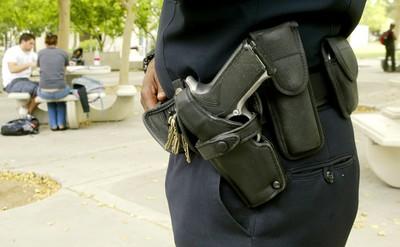


A university system regent is proposing arming and deputizing employees within the higher education system so they could respond with force should a Virginia Tech-like incident occur on a campus.
Regent Stavros Anthony, a Las Vegas police captain, said he will propose to regents in June allowing any employee, "whether it's the president, a faculty member (or) the maintenance guy," to become reserve police officers within their respective police departments.
"From my standpoint, I see this as kind of a win-win," Anthony said. "You're allowing institution employees to step up to the plate and say, 'I'm for standing up and defending our institution.'"
The proposal is receiving support from leaders within the Nevada System of Higher Education. Chancellor Jim Rogers endorsed the proposal, and Anthony said University of Nevada, Las Vegas Police Chief Jose Elique was enthusiastic about it.
Anthony, chairman of the regents' Cultural Diversity and Security Committee, said he would add an agenda item at the next Board of Regents' meeting that would require the institutions to devise plans to allow employees to get Peace Officers' Standards and Training certification.
The training is the same that every police officer in the state receives, and graduates of the program would be able, in plain clothes, to carry a firearm and make arrests.
Anthony said the reserve officers would not carry radios and respond to typical incidents on campus. Rather, they would respond only to incidents they see.
State law prohibits anyone other than a police officer from carrying a gun on university system property.
Anthony said he will ask each of the system's police departments to present plans on how they would handle a Virginia Tech-like incident on their respective campuses.
The proposal to give employees police powers, he said, is a reaction to last month's shootings at Virginia Tech, in which a gunman killed 32 people.
"One of the problems with these mass shootings is that nobody else has a weapon to defend themselves," Anthony said. "If they (gunmen) know there are folks around trained to use a firearm and can defend themselves, maybe they'll think twice before coming on campus."
The proposal goes a step further than that of state Sen. Bob Beers, who proposed arming school district teachers by requiring they seek weapons training.
Beers' bill was killed by a Senate committee last month.
Anthony said he did not think Beers' bill gave teachers appropriate weapons training.
POST-certified training is more rigorous and lasts between 3 1/2 and 5 1/2 months, said Community College of Southern Nevada police Chief Sandy Seda.
Prospective reserve officers would have to pass background checks and psychological exams like other officers and undergo annual training, he said.
Seda is executive director of the Southern Desert Regional Police Academy, which trains local university police and officers from the Henderson and North Las Vegas police departments.
He said he would not have an opinion on the proposal until he knew more details, but he said it could become an effective program.
Drawing up a curriculum for the reserve officers would be easy, Seda said, and the costs could be relatively low.
He estimated tuition for the program would run between $1,200 and $1,500 per person, and the gun and equipment would add another $1,000 per person.
Rogers said he thought the university system should pay for employee training.
"I think it's the system's investment to take care of the safety of the people on campus," Rogers said.
Though Anthony and Rogers said the proposal would bring reserve officers onto campus without having to pay for additional officers, faculty leaders at UNLV and CCSN were surprised and less than enthusiastic.
"I think most of my faculty would like to come and teach, and I feel that CCSN administration does enough to keep the campus safe," CCSN Faculty Senate Chairman Alok Pandey said. "I do not think it should come to the point where we need to protect ourselves. We just want to teach."
Pandey's counterpart at UNLV, Bryan Spangelo, said he did not know of any faculty who would want to participate in the program.
"I did talk to a couple of my colleagues, and they had quite a reaction to it, to the negative," Spangelo said. "We view the campus as being a place that's a little different, that we're here for the betterment of mankind, for the higher things in life, and not worrying about things like this."
He said he realized the potential threat of people wishing to do harm to people on campus but suggested the money be spent on more police officers instead of training faculty and staff.
Having faculty double as reserve officers would change the relationship between the student and the professor, Pandey said.
"Will they (students) be able to come and open up to us, if they know this person also has a law enforcement responsibility?" Pandey said. "I want my students to come to me and talk to me as a student and teacher, and not as a student and a police officer."
Regent Steve Sisolak said he respected Anthony's position but said arming faculty "opens up a whole can of worms."
"I think we definitely need to address safety issues," Sisolak said. "But we don't want a militia on campus."
Anthony said that he predicts there will be resistance to the idea by some people but that he looks forward to an open discussion on the issue in June.


