



Change only thing certain when predicting future


What, no Golden Gate Bridge leading into a casino?
Trying to predict what the Strip will look like in 2020 can be risky in a place as fast-changing and whimsical as Las Vegas. Could high rollers in the early 1980s have foreseen the Leggo castle or the pyramid 12 years into their future?
It's easier to say what won't be part of the mix, and all current signs lead well away from such movie-set specifics as Paris Las Vegas, or a similar San Francisco treatment once floated for the recently demolished New Frontier hotel site.
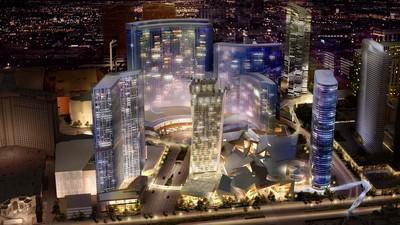
The easy part of trying to envision the next 12 years is to go to www.citycenter.com or www.echelonresort.com. MGM Mirage's CityCenter will fill 76 acres with a 60-story hotel and casino, surrounded by retail, entertainment venues, nongaming hotels and condos. Boyd Gaming's Echelon brings the same mixed-use concept to 87 acres on the former Stardust hotel site.
Alan Hess is the author of the Strip's definitive architectural history, "Viva Las Vegas: After-Hours Architecture." The book follows the Strip from the 1950s era of "signs that were the size of skyscrapers. That evolved into actual skyscrapers that are also signs," such as New York-New York and the Palms.
Now, he says, "the Strip will become more of a multifaceted neighborhood. Housing and shopping alongside the casinos are the natural direction it's been taking since the '60s. In 10 years, it will come to a full fruition."
Eric Strain, a Las Vegas architect whose Assemblage Studio is behind the new UNLV Student Services complex opening next June, sees currently popular references to the 1950s "modern" style continued with CityCenter and other influential projects.
"It's almost like you could say design is the new theme," Strain says of the heavy use of multistory glass curtain walls and the like. "Modern design worked really well in lounges and restaurants. It was just a matter of time before you started to see it on the outside of buildings."
Joel Bergman, the veteran architect whose career spans from the Las Vegas Hilton to The Mirage, Treasure Island and Paris Las Vegas, is now on the team designing the Fontainebleau on the old El Rancho land north of the Riviera. "It's a serious point of departure; it doesn't look like anything else that's in Vegas," he says, compared to the "mannered" design of buildings as new as the Palazzo. "And you're going to see more of that edginess."
A third large-scale, mixed-use project should come when Harrah's Entertainment either razes or ties together the block of casinos it has running from Paris Las Vegas north to Harrah's Las Vegas, on land that stretches east to Koval Lane. That new development will almost certainly tie in to the new sports arena planned for the east side of Bally's.
Beyond that, says Bergman, CityCenter and Echelon "might be an anomaly for some time to come. Some of that mixed use (in the future) might be in one or two towers, not in seven towers."
The price of land around the Strip has so skyrocketed that whatever the future holds, "it's going to be denser," Bergman says.
Hess says he hopes the Strip will find a way to protect its views, surrounding its towers with low-rise development to prevent a "Manhattanization."
Some relief along those lines could come in an extended definition of the Strip, as growth continues east and west. Already the "Harmon corridor" is taking shape from the Palms to the Hard Rock Hotel. Projects such as the Panorama condominiums suggest Interstate 15 is no longer a barrier.
Hess also would love to see the Strip "regain its leadership in the area of signage. Las Vegas just for the most part hasn't been as adventurous as it was," partly because the dawn of LED technology turned signs into square outdoor movie screens.
He sees hope at Planet Hollywood, where outdoor signs break free of the flat screen and become three-dimensional forms. "They go around corners. They're producing images specifically for the sign and its placement."
As density increases, sustainability and transportation will be two key issues for the future. Already, CityCenter is striving to attain Leadership In Energy and Environmental Design (LEED) certification. "Certainly by 2020, Vegas will be more respectful of electrical energy usage, in fact of all natural resource usage," Bergman says. "I know we're being asked by all of our clients to be more sensitive to the green environment."
Bergman hopes the future won't include the current monorail. "If a monorail needs to be, it goes right down the center of the Strip where it belongs."
Strain believes the existing monorail could remain useful, but agrees that if civic planners really want usage, "they have to bite the bullet and run something down the center of the Strip. That's where people who are here want to be."
Some things don't change. Or shouldn't. "I love the coziness. I love the proximity. Almost like people touching people," says Bergman. "People like to walk on the Strip with other people. They like to be in contact."
Contact reporter Mike Weatherford at mweatherford@reviewjournal.com or (702) 383-0288.
Best of Las Vegas 2008View the results


