Deadly pitfalls waiting off-road
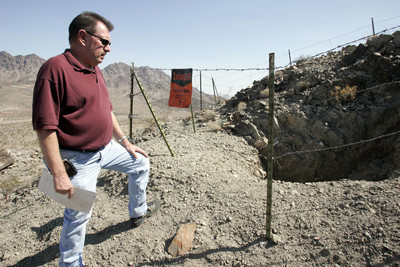



Until early June, one wrong turn could have spelled doom for those dirt bike and all-terrain vehicle riders who traverse this steep, rocky trail in the McCollough mountain range south of Henderson.
Awaiting them, just off the side of the trail and out of sight was CL1470, a then-unrestricted, gaping abandoned mine large enough to swallow most small vehicles.
The 10-foot deep, 5-foot wide jagged-edged hole is just one of hundreds of thousands of mines in Nevada, and a tool for officials such as Nevada Division of Minerals geologist Bill Durbin to caution against reckless behavior.
"It's going to do you some serious damage" if you fall in, Durbin said Thursday as he peered into the hole over the barbed-wire surrounding it.
The Sept. 1 accident involving two young girls who careened into a deep Arizona mine on a three-wheeler ATV has state and federal officials again warning about the dangers in Nevada.
The potential for a similar tragedy is high in Nevada, they say, which has more abandoned mines than any Western state, and some of the most lax ATV laws in the nation.
People in Nevada may just be lucky.
The only known incident involving a motorist and a mine was in 1974, when two boys were killed when their motorcycles fell into a shaft near Searchlight. There have been no reports of riders being injured or trapped in mines.
By comparison, nine people in California have been killed, injured or trapped when their vehicles plunged into mines between 2003 and 2006, according to the California Department of Conservation Office of Mine Reclamation.
But the potential for ATV and dirt bike riders to fall into Nevada mines is "phenomenal," and has only been prevented by state agencies sealing off those mines, according to Chris Ross, head of the Nevada Bureau of Land Management's abandoned mines program.
Between 225,000 and 310,000 abandoned mines are estimated to exist in the state. That's far more than in any other state, and probably more than in all of the Western states combined, Ross said.
About 50,000 are believed to be dangerous -- so dangerous, he said, "they scare the crap out of me."
"And we work with them every day. We're terrified of them."
The BLM and Nevada Division of Minerals have worked to fence off or fill in more than 9,000 sites, concentrating on those around population centers and recreation areas.
But in Nevada, dirt bikers and ATV riders have virtual free reign on BLM land outside of restricted areas such as the Las Vegas Valley and protected areas. That leaves thousands of mines throughout the state that aren't secured, according to Ross.
Bob Brown, secretary for the Las Vegas-based Dunes and Trails ATV Club, said Nevada is better at closing off its sites than others.
"I have yet to run across an open (unprotected) mine in Nevada," Brown said. "I have in California, have in Arizona and Utah, but not in Nevada."
Brown, 64, who has logged more than 15,000 miles on his ATV in the last three years, said riders generally are safe if they stay on designated trails.
But the situation that resulted in a 13-year-old girl being killed and her 10-year-old sister being injured in Arizona was hazardous to begin with, said Scott Wolfson, spokesman for the Consumer Product and Safety Commission, which regulates ATV products.
The two girls were riding a notoriously unstable three-wheeler ATV, which, contrary to popular belief, are not outlawed in the United States. Domestic manufacturers have just agreed to stop making them, Wolfson said.
And the two girls were most likely riding a vehicle meant for only one person, he said.
On ATVs, much of the steering relies on the driver leaning his body into the turns to stabilize the vehicle. If a person is riding behind the driver on a one-person ATV and leans in the wrong direction, or not at all, the chances to roll over increase dramatically, Wolfson said.
Arizona, like Nevada, has no laws governing the use of ATVs, which can contribute to injuries and death for their riders, leaving it up to manufacturers and dealers to regulate themselves.
"The state doesn't help us at all," said Dan Findlay, manager of Las Vegas Motorsports, on Craig Road near Lamb Boulevard.
Per manufacturer's orders, dealers aren't allowed to sell an ATV meant for an adult to, say, a 7-year-old. Unlike almost all states, Nevada also doesn't require owners to register or title their ATVs.
Nor are there restrictions on who can ride them, how many people can ride one at a time or whether riders have to wear helmets -- laws that several other states have adopted.
Manufacturers voluntarily make ATVs for children in age ranges of 6 to 12, 12 to 16, and 16 and older, and almost all of the manufacturers offer free training, Findlay said.
Despite the lack of regulations, however, ATV deaths in Nevada are low compared to other states, with only 32 reported deaths between 1982 and 2001, according to the Consumer Product and Safety Commission. Twelve of those were children.
Last month, 30 people died nationwide, and more than 700 people die each year from ATV-related accidents, according to Wolfson. More than 100,000 people have emergency-room treated injuries each year out of the more than 7 million ATVs estimated to be in use.
At the end of Horizon Ridge Parkway in Henderson, the road turns to dirt and an expanse of dirt bike and off-road trails spin off into the distance.
On weekends, Durbin estimates 500 ATV and dirt bike riders traverse the landscape, riding around 10 hard-to-see mines, marked only by the barbed wire and orange "danger" signs.
Vandals tore down the fences surrounding CL1470 and a 60-foot long shaft below it months ago. A Boy Scout group volunteered and helped replace the fences in June.
But Durbin, whose task is to keep the mines secured, said it's lucky nobody has been hurt by the area's early 1900s-era mines.
"It's a constant vigil," he says.
RULES FOR ALL-TERRAIN VEHICLE RIDERS
Nevada has few regulations for all-terrain vehicle (ATV) use. Other states require riders who are minors to undergo a safety training class or take a test before they operate an ATV. Some states have age limits on riders, require riders to wear helmets, and restrict additional passengers on one-person ATVs. Below are some of the regulations in Western states:
NEVADA:
Minimum age: None.
Helmet law: None.
Registration: None.
Titling: None.
Passenger prohibition: None.
CALIFORNIA:
Minimum age: Fourteen on public lands, unless riders have a safety certificate and are under the supervision of an adult a with safety certificate; 18 on public lands, unless they have a safety certificate or are under the supervision of an adult with a safety certificate.
Helmet law: Helmet required on public lands.
Registration: Required.
Titling: Required.
Passenger prohibition: On public lands, only one person allowed on one-person ATVs.
ARIZONA:
Minimum age: None.
Helmet law: None.
Registration: None.
Titling: Required.
Passenger prohibition: None.
UTAH:
Minimum age: Eight on public lands; 16 if riders do not have a safety certificate.
Helmet law: Helmet required for those 18 and under.
Registration: Required for use on public lands.
Titling: Required.
Passenger prohibition: None.
NEW MEXICO:
Minimum age: Six on public lands. Riders under 10 must operate age-appropriate vehicles. Riders under 18 must have a safety certificate and must be under supervision unless specific circumstances apply.
Helmet law: Required for those under 18.
Registration: Required.
Titling: Required.
Passenger prohibition: No one under 18 can carry passengers.
Sources: Consumer Product and Safety Commission, Specialty Vehicle Institute of America, state laws