Engelstad facility is new theater in war on cancer
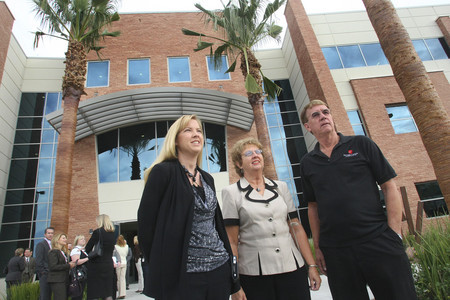





Nearly an hour before a new cancer research building was dedicated early Tuesday at the Nevada Cancer Institute, one car sat in front of the huge three-story structure.
The driver rolled down the Chevrolet Malibu's window, shared a few pleasantries with a stranger about the howling, chilly wind, and then said it wouldn't be long before his daughter, a cancer researcher, showed up for the ceremony.
If Dave Holmen had been even a tad prouder, his smile wouldn't have fit through a doorway.
"Sheri (Holmen, his daughter) decided to become a cancer researcher because her mother had breast cancer and then she saved her mother's life," said the smiling father, who came from Michigan for the ceremony. "We're here to support her and her work."
In a country where nearly 1,500 people die each day of cancer and another 1.5 million people are diagnosed each year with malignancies, the story told by Dave and Faye Holmen and their daughter Sheri is a reminder that the news from the battlefront in the war on cancer isn't always grim.
Kris Engelstad McGarry, the daughter of Ralph and Betty Engelstad, for whom the new $50 million research building is named, told those gathered for the dedication ceremony in Summerlin that she is convinced that it won't be long before people are regularly hearing about major breakthroughs in the search for cancer treatments and cures.
To that end, the Engelstad Family Foundation of Las Vegas committed a $20 million gift to what is now the largest dedicated research building in the state, a 184,000-square-foot facility that can house up to 40 individual laboratories.
In 2002 the foundation was formed in the memory of Ralph Engelstad, the former owner and operator of the Imperial Palace who died of lung cancer that year. In 2006, the foundation donated $15 million to the institute for the advancement of research, screening and treatment in the field of lung cancer.
"What the Engelstad foundation is doing is giving us a chance to do our best work," said Sheri Holmen, who earned her Ph.D. in tumor biology at the Mayo Clinic College of Medicine. She now works at the institute to develop more targeted drug therapies that wipe out cancer cells.
Standing with her visiting parents outside the new research building, the third building on the institute's growing campus near Town Center Drive and Twain Avenue, Holmen recalled that she was a freshman at Western Michigan University when her mother was diagnosed with breast cancer in April 1993.
She wasn't told of her mother's condition, diagnosed on her mother's 48th birthday, until two months after the diagnosis.
"I didn't want to interrupt her finals," said Faye Holmen, who was convinced she would soon die.
Now 64, Faye Holmen underwent a lumpectomy in Muskegon, Mich., before she told her daughter about the cancer found in her left breast. "She was angry at me for not telling her at first, but her schoolwork was so important."
The mother of two -- her son is a small-business owner in Michigan -- also needed radiation and chemotherapy treatments. As she accompanied her mother to her chemotherapy, Sheri Holmen decided to devote herself to cancer research.
"Biology is a big field and what my mother was going through made me focus," she said.
After more than six years without a recurrence, Faye Holmen found another lump in her left breast in 1999. A mastectomy and six months of chemotherapy followed. She and her husband, a retired community college administrator who went to all of his wife's treatments, often would cry themselves to sleep in each other's arms.
"Chemotherapy can be tough," Sheri Holmen said. "I watched her get sick and her hair fall out. That's why I am working so hard to have targeted drug therapies, so good cells along with the bad don't have to die from the therapies."
In 2003, when cancer was found to have spread to her mother's left lung, Sheri Holmen did more than just accompany her father and mother to the doctor.
Then finished with her training at the Mayo Clinic and working as a researcher at a Grand Rapids, Mich., cancer center, she disagreed when her mother's Muskegon oncologist said her mother could undergo chemotherapy, but still would have only six months to live.
Sheri Holmen had read studies about a new surgery that had been done on patients with her mother's condition at the M.D. Anderson Cancer Center in Houston. When she called cancer specialists at the University of Michigan, Ann Arbor, it turned out they were aware of the procedure and soon performed it on Faye Holmen.
Six years after her lung surgery, Faye Holmen now travels around the country with her husband in an RV towing a Chevy Malibu. Their goal is to sleep in the RV in each of the contiguous states.
"If it hadn't been for my daughter, I'd be dead now instead of living out my dream of traveling," she said. "I didn't know any better."
To Sheri Holmen, who came to the Nevada Cancer Institute in 2007, what happened to her mother proves one thing. "You have to have cancer centers like the Nevada Cancer Institute," said Holmen, a mother of two children. Her husband, Matt Van Brocklin, is also a cancer researcher at the institute.
"You can't rely on doctors who are just going on what they learned years ago in medical school. You need places that are doing cutting edge things, where the doctors and researchers are talking about the latest treatments and research findings. That's how you save lives."
Contact reporter Paul Harasim at pharasim@reviewjournal.com or 702-387-2908.