‘Nobody’s the enemy’: Ex-Nevada water chief on Colorado River deadlock


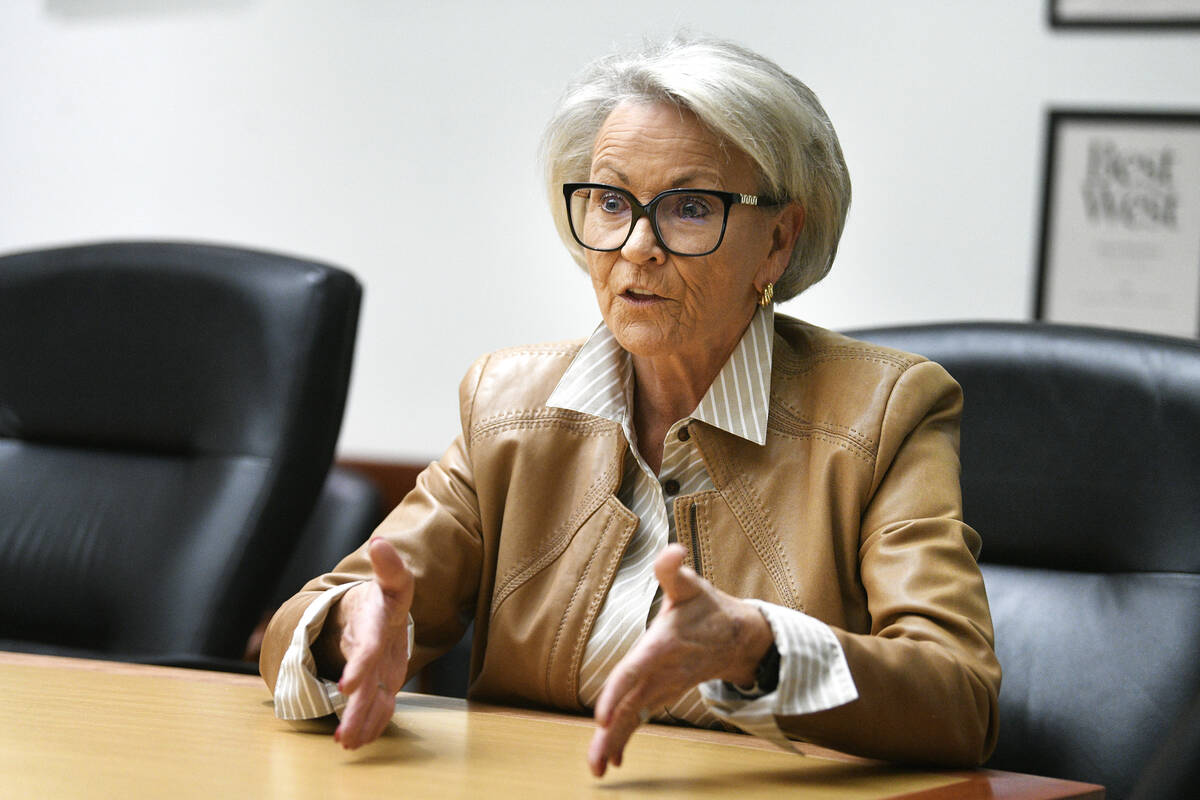





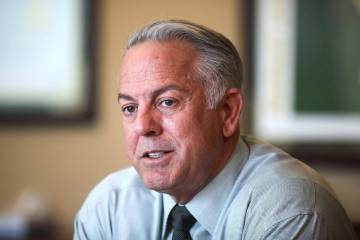



From the birth of the agency that took on Southern Nevada’s water crisis to the installation of a third straw at Lake Mead, a small but mighty woman has been there through it all: Pat Mulroy.
And today, as an outsider to the stalemate between the seven Colorado River states that are running out of time to strike a deal that will last two decades, Mulroy isn’t thrilled with the progress.
“What I see missing is they have not figured out the one thing that really allowed a lot of the other discussions to move forward, which is that they enjoy a common fate,” she told the Las Vegas Review-Journal on Tuesday. “The notion that one part of this river system will be better off than another part of the river system is ridiculous.”
But she understands the nuanced challenges in a way few ever will.
Mulroy, 72, was the first general manager of the Southern Nevada Water Authority, serving in the role from 1991 until her retirement in 2014. That makes her one of two agency chiefs who has been at the interstate negotiating table making a case for Nevada, the state afforded the least amount of water by far under the 1922 compact that divvied up the Colorado River.
And as she tells it, being at the table isn’t exactly a party for those involved.
“There were any number of us in the room that reached that point where we could make everybody else’s argument as well as they could,” Mulroy said. “We understood what the motivators were. They weren’t arbitrary. They weren’t capricious. They were real-life motivators with real-life consequences.”
A fight between north and south
The decisions made in closed rooms have big implications for Southern Nevada, which sources about 90 percent of its water supply from Lake Mead. Without it, the Las Vegas Valley could not have enjoyed its explosive growth over the years.
Updating the guidelines that expire at the end of 2026 is a regional issue, as well, as about 40 million people in the West rely on the Colorado River across seven states, 30 Native American tribes and parts of Mexico.
Nevada, so far, has been aligned on policy with the rest of the Lower Basin, which includes California and Arizona.
The Upper Basin states of Colorado, Utah, Wyoming and New Mexico have argued they cannot bear the brunt of any more cuts to their allocations, as they already have been experiencing extreme shortages due to sharply reduced snow seasons and do not have massive reservoirs at their disposal.
All seven states’ negotiators will speak on a panel next week at the Colorado River Water Users Association conference in Las Vegas.
Some politicians on both sides of the aisle, including the likes of Democratic Arizona Gov. Katie Hobbs and Republican Utah Gov. Spencer Cox, have put a great emphasis on the basin divide. Instead of placing blame on any basin or industry sector like agriculture, Mulroy acknowledges that all parties are in a tough spot.
“First, the farmer was the enemy,” Mulroy said. “Now, the Upper Basin is the enemy. Guess what? Nobody’s the enemy.”
Don’t rely on the courts
The alternative to a seven-state agreement is taking the fight to the halls of a courtroom. That undesirable reality has come into clearer focus as of late.
It’s established in law that the secretary of the Interior Department is the so-called “water master” of the Lower Basin states, meaning the official has final say over allocation and management of water. That role is less clear when it comes to the Upper Basin — and a water master is something Mulroy says the Upper Basin might want to avoid.
“If you think going to court is a panacea, first of all, it’s going to take 25 years to get through it,” Mulroy said. “And during that 25-year period you will have a water master, no if, ands, or buts about it.”
In a phone interview on Wednesday, Nevada’s current negotiator, John Entsminger — who worked under Mulroy for about a decade and a half — said the interstate meetings have been constant, though he doesn’t expect much to be made public until the Bureau of Reclamation releases a final environmental impact statement on Feb. 14.
“The components are there,” Entsminger said. “We have just got to keep working.”
Entsminger said the often painful conservation legwork he and Mulroy have done has positioned Southern Nevada as a leader in the face of intense shortages.
Over the years, the water authority has led the way on initiatives such as grass removal, mass recycling of indoor water, a moratorium on new golf courses and more.
“Nevada has walked the walk in the face of climate change,” Entsminger said. “We walk into that room with a lot of credibility and an ability to help mediate and cajole other people into living with the river that we have in the 21st century, not the river that was promised to us in the 20th century.”
Add more water to the system?
Mulroy said that while she “feels like a broken record” on the subject, she remains a staunch advocate for augmentation projects in the Colorado River Basin. That is, conservation alone can’t be enough to pull the basin out of crisis.
When asked about the more controversial conservation measures the water authority has taken on under Entsminger, such as punitive excessive use fees and the Nevada Legislature’s ban on so-called “non-functional turf,” Mulroy said Entsminger “had no choice.”
Mulroy told the Review-Journal in March that she was charged an excessive use fee for water use on her property that made her monthly bill skyrocket to $1,100 at one point.
“There wasn’t enough momentum behind any augmentation project, and he had to protect Nevada against incoming bullets from the the other states,” Mulroy said. “It was ugly; it was difficult, but he had no choice.”
Water augmentation projects, such as desalination and large-scale water recycling, would add water to the system and are crucial for any semblance of long-term sustainability, Mulroy said.
An April study of water recycling in the basin found that Nevada reuses about 85 percent of its wastewater, and the other six states are far behind. Some state-to-state collaboration in this area could be possible, Mulroy said, such as when the water authority committed $750 million in 2021 to a water recycling plant in Southern California.
Despite a failed effort Mulroy oversaw to build a groundwater pipeline from White Pine County to Las Vegas, groundwater rights in other parts of rural Nevada are a part of the Southern Nevada Water Authority’s long-term portfolio.
And desalination projects can cost billions. To Mulroy, that shouldn’t matter.
“You’re going to tell me that protecting the water resources, the livelihood and the economies in the Lower Basin isn’t worth several billion dollars?” Mulroy said. “That is insanity.”
Under the second Trump administration, much of the federal funding pools used for recent water infrastructure projects have dried up, and officials have indicated that tightening the government’s purse strings is a priority.
When the inevitable pressure of declining reservoirs catches up to cities in a more tangible way, Mulroy said, she expects everyone to step up with money.
“If I told the hotels on the Strip that they had to pay their proportionate share of billions for desalination and, in exchange, they wouldn’t have to get rid of evaporative cooling, they’d say, ‘Where do I sign the check?’” Mulroy said.
Contact Alan Halaly at ahalaly@reviewjournal.com. Follow @AlanHalaly on X.