



Exemption requests up in county
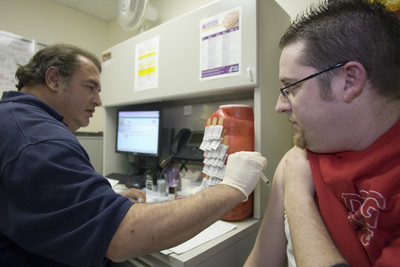


The number of Clark County residents requesting exemptions for immunizations is increasing, and public health officials worry that unfounded fears of a link between autism and childhood vaccines might be fueling the petitions.
Between 10 and 30 exemption requests are being filed each month at the health district, said Bonnie Sorenson, director of clinic and nursing services.
Of those, about 10 are referred to Dr. Lawrence Sands' office for final consideration. Sands, the health district's public health officer, is granting roughly six exemptions each month.
Individual physicians can also grant immunization exemption requests, but the health district's figures do not take those into account so the number of exemptions is likely higher countywide, Sorenson said.
As a result of the influx of requests at the health district, the agency recently created a vaccine education program to ensure residents inquiring about exemptions are making informed decisions.
There are only two types of exemptions available in Nevada, Sands said. The first is for medical purposes, which must be verified by a physician; the second is for religious beliefs, which does not require documentation.
Sorenson said the majority of exemptions in Clark County are sought based on religious beliefs.
"We were starting to see a trend -- a lot of people are starting to ask for exemptions -- and we just thought it would be better to provide more information to families,'' said Sorenson, who recently attended a national immunization meeting where the increase in exemptions was discussed.
Sorenson said there continues to be a belief among parents that certain childhood immunizations may contribute to autism, a brain developmental disorder that impairs social interaction and communications. It is typically diagnosed before age 6, and its cause is currently unknown.
Most of the autism debate has occurred in recent years. For example, a 1998 study of autistic children raised the question of a connection between the MMR -- measles, mumps and rubella -- vaccine and the developmental disorder. However, according to the federal Centers for Disease Control and Prevention, 10 of the 13 authors of the report retracted their findings, saying they didn't believe there was a causal link between the MMR vaccine and autism.
Other medical groups, such as the American Academy of Pediatrics, agree that the MMR vaccine is not responsible for recent increases in the number of children with autism. Also, a 2004 report by the national Institute of Medicine concluded that there is no association between autism and MMR vaccine, or vaccines that contain mercury as a preservative.
Sorenson said the health district does not deny anyone the opportunity to seek an exemption.
According to the CDC, parents may apply for an exemption from the state's immunization requirements for enrolling their children in school if they have religious objections.
States also offer exemptions based on medical reasons. For example, an applicant may have a compromised immune system, allergic reactions to the vaccine's contents or moderate to severe illnesses.
Still, there is concern that exemptions could affect the community's health. For instance, children who do not receive childhood vaccines are vulnerable themselves to vaccine-preventable diseases such as the measles, mumps, whooping cough, chicken pox and Hepatitis A and B.
"There's a social contract we have in this country and, unfortunately with any kind of medical intervention there is always some risk that something adverse might occur,'' Sands said. "If people start breaking that social contract then we can't ensure control of vaccine-preventable diseases.''
So far this year, the health district has granted 98 immunization exemptions, 13 of which were for children.
The remaining 85 exemptions were for adults who needed a Hepatitis A vaccine, Sorenson said. Hepatitis A vaccines are a requirement in Nevada to obtain a Health/Food handler's card, Sorenson said.
Last year, the health district granted 73 immunization exemptions; in 2005, 70 were approved.
The health district's immunization education program, which is optional, includes a class on vaccines and their benefits as well a packet of information about both adult and childhood vaccines required in Nevada. Residents also have the option of watching an informational video that highlights chicken pox.
Veronica Morata-Nichols, health district immunization manager, said chicken pox was highlighted in the video because it is one that young people can relate to.
It is widely known that immunizations, especially those given during early childhood, protect against acute and chronic infectious disease. Newer vaccinations, such as hepatitis B and Gardasil, or Human Papilomavirus vaccine, prevent certain types of cancer.
There are about 13 vaccines required for children. Most must be obtained by the time children enter child or day care facilities and grade school.
Sorenson said children exempted from childhood vaccines are excused from school during outbreaks of a vaccine-prevented disease for at least until the incubation period or outbreak is over. In recent months, Clark County has experienced this on a small scale, Sorenson said.
A few months ago there was a chicken pox outbreak at a local school and several children who attended were exempted from childhood vaccines, she said. Those children were sent home until the outbreak was over.
Sands and Sorenson said vaccine education is not exclusive to those seeking exemptions. Anyone receiving a vaccine will also have this information made available to them, including any potential risks a particular vaccine might have.
The health district plans to keep statistics to see how many clients participate in the classes and make different decisions regarding exemptions.
Martha Framsted, a spokeswoman for the state's Health Division, said the agency doesn't track the number of immunization exemptions or requests for them.
For more information on immunizations, call the health district at 759-1000.
Contact reporter Annette Wells at awells@reviewjournal.com or (702) 383-0283.


