



Federal miscalculation costs schools
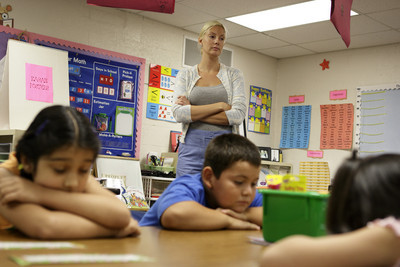


The Clark County School District lost $2 million in anticipated funding because a federal survey underestimated the number of Nevada students whose primary language isn't English, local and state education officials said.
Superintendent Walt Rulffes said the federal government's miscalculation will ultimately erode the quality of education for a large segment of Hispanic students.
It also might cause the district's scores in high-stakes' tests to dip because Hispanics make up a majority of students in the school system.
Rulffes said a firm grasp of the English language is vital for students because the tests are given in English.
"Our Hispanic population should be highly offended," Rulffes said. "The (federal) formula does not align with our need for services. ... It will affect the overall performance of the district because we have such a large population that needs those services."
A district official said because of the loss in anticipated funding, specialists who work for the English Language Learner program, or ELL, will have to train more teachers at schools with a staffing level that is the same as last year's.
During the 2006-07 school year, 157 specialists trained about 13,000 of the district's 18,000 teachers, said Nancy Alamo, the district's ELL director.
Specialists instruct classroom teachers in the latest scientific teaching techniques. Some techniques could include teaching classroom instructors to properly enunciate in order to help ELL students, or having ELL students focus on small concepts when learning to read.
Alamo said ELL students are not separated from their peers; rather, they are taught with the general population of students at each school, and they are taught in English.
Since the district began receiving federal funding in the 2003-04 school year, its staff of specialists has increased to 157 from 58.
Alamo said the district most likely will be unable to purchase some instructional materials for students because of the cutback. The materials could include textbooks or software programs to supplement the students' core curriculum.
"Teachers will have to make do with getting their own material or being creative with materials they do have," Alamo said.
The U.S. Department of Education relied on the American Community Survey taken by the U.S. Census Bureau in 2005 to determine the amount of funding Nevada should receive for ELL students.
The survey concluded that Nevada's population of students whose primary language isn't English is decreasing.
But the Clark County School District and Nevada dispute the survey's findings.
The district accounts for about 70 percent of Nevada's students. It has a population of non-English speaking students that is more than 60,000 strong and has grown by an average of 10 percent each year during the past decade, Alamo said.
According to the Nevada Department of Education, the total number of ELL students in Nevada is about 75,000.
The Clark County School District will receive slightly more than $4.4 million from the federal government this school year, down from $6.4 million last school year.
The state as a whole will lose an additional $800,000 in anticipated funds for ELL students, or $2.8 million total, state Superintendent Keith Rheault said.
Kathleen Leos, assistant deputy secretary of the U.S. Department of Education Title III, said the federal No Child Left Behind Act requires that states receive funding for ELL students based on the Census Bureau survey.
Leos said she realizes the federal government's system in this case is not perfect. But the government can verify information from the survey and can't do that with information that is reported from each state, she said.
"There is a process in place; it is validated by the American Census Bureau," Leos said.
Leos said she did not know how many ELL students the survey concluded Nevada has, and an official with the Census Bureau wasn't able to pinpoint how the survey arrived at its conclusion that Nevada's ELL population was decreasing.
Fernando Romero, president of the nonprofit Hispanics in Politics, said the federal government has "hoodwinked" Clark County and Nevada because it's inconceivable that the ELL population is decreasing.
"Anybody with any sense knows the community is growing," Romero said.
He said the district's ELL program was already struggling to properly educate Hispanic students.
"For them (the federal government) to curtail the budget that much more puts us deeper in a hole of educational attainment," he said.
The district's ELL program has students who speak 92 languages and are from 132 countries, but 94 percent of students in the program speak Spanish as their primary language.
During the 2006-07 school year, Hispanics surpassed white students as the majority in the district, making up 38.8 percent of the student population, with 117,496 students, according to district figures.
White students accounted for 37.5 percent of the district's population last school year with slightly more than 113,000 students.
The district's final enrollment figures for 2007-08 won't be determined until later this month. Its budget for the current school year won't be finalized until October, Rulffes said.
Alamo said the district doesn't track its students for purposes of determining their citizenship, but about 75 percent of the students in the ELL program are American citizens.
That figure was obtained by the district because parents are asked to provide a birth certificate of their children when they are enrolling students in school.
A 1982 U.S. Supreme Court ruling in the case of Plyler v. Doe dictates that all children in the United States have the same right as citizens to a public education under the equal protection clause of the 14th Amendment of the Constitution.
Rulffes suspects that the Census Bureau's survey might have been at least partially flawed because some Hispanics might have been afraid to answer all questions truthfully, because they might have been in the country illegally.
Rheault, the state superintendent, said it would be more accurate if the federal government allowed states to report the number of ELL students to them.
Rheault doesn't buy Leos' explanation that the government can verify the survey's results but can't do that with information provided by states.
"We have an accurate count, as most states do," Rheault said.
Rheault said trying to regain the federal ELL funds for the current school year is a lost cause. But the state will lobby against the portion of the No Child Left Behind law that calls for ELL funding to be determined through the Census Bureau's survey.
The federal law is up for reauthorization this year.
Marcie McDonald, principal of Squires Elementary School, said she expects the cuts to the district's federal ELL budget will affect her school, but she is not sure exactly how. About 65 percent of Squires' 800 students are ELL students.
Despite that high number, Squires was one of the highest performing elementary schools last school year and met all federal No Child Left Behind Act standards.
McDonald said she expects teachers will compensate even with a reduction in ELL funding.
"Teachers step up to the plate when those things happen. We'll have to adjust to the situation."


