



Fernley’s growth made flooding worse
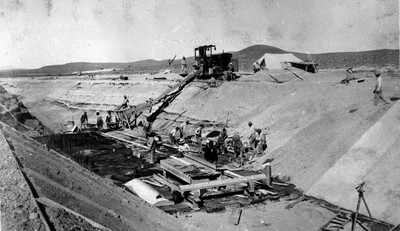


FERNLEY -- In 1903, when a 31-mile canal was dug to move water from the Truckee River to the melon and alfalfa fields around Fallon, earthen embankments made sense.
The dirt canal construction was cheaper than lining the entire route with concrete, and no one in Northern Nevada much minded if it and other canals like it in the Newlands Reclamation Project occasionally failed. Floodwaters would flow into pastures and surrounding desert and soak back into the water table.
Today, what once was the agricultural town of Fernley is a growing bedroom community of about 20,000 residents. It has been declared a disaster area after storm-swollen water tore a hole in the 50-foot-wide, 9-foot-deep canal and inundated hundreds of homes.
"The vast majority are new homes," said Sen. Harry Reid, D-Nev., who toured the area by helicopter after the flood. "This certainly is not comparable to Katrina, but it's an event we'll remember in Nevada. We have so little water."
As cleanup operations continued, Gov. Jim Gibbons put initial damage estimates at $4 million and growing. The area was declared a disaster area by state and federal officials.
The Truckee-Carson Irrigation District, which operates the aging canal under a contract with the U.S. Bureau of Reclamation, was slapped with its first lawsuit by a homeowner on Thursday.
Both the irrigation district and Bureau of Reclamation are unsure what caused the earthen berms to give way as Northern Nevada was lashed with a powerful winter storm. An investigation continues into the cause.
Engineers were working to fortify the dirt and rock walls to make it stronger, but a long-term solution would be costly.
"The canal is 100-plus years old. It has been a concern and will continue to be somewhat of a concern as long as population keeps building on its banks," said Ernie Schank, president of the irrigation district.
"It would be wonderful if there could be more reinforcement done through the Fernley area ... but that is going to cost millions and millions of dollars," he said.
Lining the canal with cement, probably the safest alternative, would cost "hundreds of millions, if not billions," Schank said.
There are hundreds of miles of ditches and canals in Nevada. The irrigation district manages more than 370 miles of canals within its boundaries.
While Fernley averages only 5 inches of precipitation a year, floods are nothing new to the area.
Schank said he's aware of at least six past breaks of this particular canal. At least three occurred before 1926, when the federal government operated the canal, and three have taken place since, he said.
"Historically, this canal and others have flooded; but the fundamental difference is nobody has lived by the canal," said Guy Rocha, state archivist and respected Nevada historian who described the flood as "the worst catastrophic event in the history of Fernley."
"This city has grown so fast. It's not pasture anymore. It's not horses or cattle. It's a residential area with literally thousands of people," he said.
Just 30 miles east of Reno along the interstate, Fernley is home to Amazon.com's Western regional distribution center with more than 700 employees, the large printing company Quebecor, two golf courses and casinos. It's a far cry from the days when agriculture dominated.
In 1960, Fernley's population stood at only 654, and the community didn't get its first stoplight until about 20 years ago, Rocha said.
"If this flood would have happened more than 20 years ago, you would not have had this kind of impact," Rocha said.
The cold water that poured out of the breached canal last weekend comes from the Truckee River, which originates in Lake Tahoe. The natural river runs down the rugged canyon in the Sierra, through Reno along I-80 before it turns sharply to the north and empties into Pyramid Lake, a trip of about 100 miles.
About 15 miles east of Reno, the Derby Dam diverts some water into the Truckee Canal, which carries it to Fernley and farther south for another 20 miles to the Lahontan Valley Reservoir east of Fallon.
The canal is a key component of the nation's first federal reclamation project, started in 1903.
During a normal year, the irrigation district delivers water to about 2,500 users and delivers 215,000 acre-feet of water primarily for agricultural use.
(An acre-foot equals about 326,000 gallons, which is enough water to supply two average households for one year.)
The water would have been a welcome relief in the mid-1800s to pioneers, whose wagon ruts are etched in the desert north of the flood area.
Many settlers' diaries note the struggles in crossing the Forty-Mile Desert around Fernley, regarded as one of the most difficult stretches of the California Trail because of its lack of water.
Lt. John Fremont led a party for the U.S. Bureau of Topographical Engineers in 1844 and became the first white settler to see Pyramid Lake. His party camped along the Truckee River near Fernley on the way to crossing the Sierra.
More than a century and a half later, much of that sagebrush-covered landscape has changed little, except now those encroaching on the desert aren't pioneers but housing tracts around towns such as Fernley, Dayton and Gardnerville.
Few of the flood victims in the arid region had flood insurance, one of the reasons President Bush declared Lyon County a national disaster area. That makes federal funding and low-interest loans available to residents and business owners.
ON THE WEB • City of Fernley • Truckee-Carson Irrigation District • Bureau of Reclamation ADDITIONAL LAWSUIT FILEDYerington -- Three law firms have filed a class-action lawsuit on behalf of victims of last weekend's Fernley flood. In their lawsuit filed Friday in Lyon County District Court in Yerington, the Reno firms of Maddox & Associates, Leverty & Associates and Dunlap & Laxalt are seeking unspecified damages from the Truckee-Carson Irrigation District. The complaint came a day after Reno lawyer Robert Hagar filed a suit in Washoe County District Court on behalf of Judy Kroshus, whose home was among hundreds flooded after a storm-swollen irrigation canal ruptured jan. 5. That lawsuit, which also seeks class-action status, names the irrigation district, local governments and homebuilders as defendants. Both lawsuits allege that the irrigation district did not properly maintain the canal and failed to minimize damage once the breach occurred in the fast-growing town 30 miles east of reno. Ernie Schank, TCID president, said the district reacted as quickly as possible after learning about the rupture. Judges will have to certify the lawsuits as class actions, meaning that the lawsuits represent all plaintiffs affected by the flood. "It's unusual for two class actions to be certified," said Jeffrey Stempel, a law professor at the William S. Boyd School of Law at the University of Nevada, Las Vegas. "Filing first is always an advantage." The irrigation district operates the canal under a contract with the U.S. Bureau of Relcamation, which owns it.--The Associated Press


