



For a few writers, Nevada made quite a character


Editor’s Note: Nevada 150 is a yearlong series highlighting the people, places and things that make up the history of the state.
It’s where ranchers fight over water rights, demons prowl the Las Vegas Strip, Basque sheepherders reconnect with family back home and rural residents live out ordinary daily dramas. A place where storytellers with a bit of imagination can craft anything from a Western to a techno-thriller to a spy story against the backdrop of everything from wide-open desert to neon-filled urban clutter.
It’s Nevada, which, thanks to its demographic, geographic and cultural diversity, serves as the setting for stories in just about every genre of literature — even if its roster of homegrown authors with widespread literary acclaim is, frankly, a bit shorter than it ought to be.
Maybe, Sally Denton figures, it has something to do with the Eastern literary establishment’s jaundiced view of the American West.
“I’ve always been kind of struck by this kind of anti-Western bent in general,” said Denton, a fourth-generation Nevadan who grew up in Boulder City and whose works of narrative nonfiction include “The Money and the Power: The Making of Las Vegas and Its Hold on America.”
“It seems to me there was always this sense of the American West as kind of a poor relation to the Eastern literary elite,” Denton said. “And Nevada seems to be, even, the bastard child of the Western group. I never could understand why.”
Yet, “I cannot tell you how many times I’ve been contacted by Eastern fiction writers who want to write about Las Vegas,” Denton added. “But you can’t crack Las Vegas if you haven’t really lived it.”
The truth is, Nevada — the real Nevada — can serve as “a setting for some really evocative literature,” Denton said, “and I think that’s one of the things Mark Twain captured.”
WHERE SAM FOUND MARK
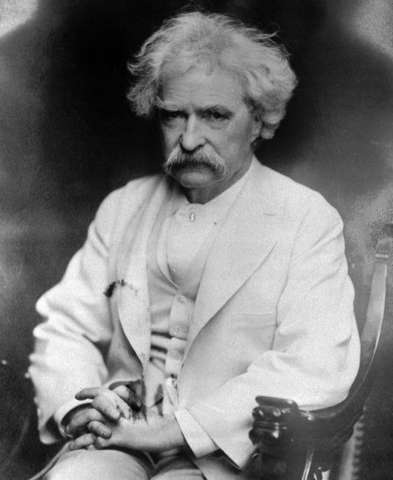
Ah, Twain. In any discussion of Nevada in literature, “you have to start with Mark Twain,” said Geoff Schumacher, a veteran Nevada journalist and author and director of content development for the Mob Museum in Las Vegas.
While writing for the Virginia City Territorial Enterprise, which he joined as a reporter in 1862, Samuel Clemens “was quite perceptive and entertaining, and I think reflected what was happening in Virginia City, and beyond, during that time,” Schumacher said.
It also was in Virginia City that “Mark Twain” — the pen name and the literary persona — was born.
“It’s not that Hannibal, Mo., didn’t shape Mark Twain,” said UNLV history professor Michael Green, but Samuel Clemens “became Mark Twain in Nevada.”
Twain and kindred Western writers on the Comstock Lode developed an unusual style of describing the Nevada of the time.
“When Twain talked about the wind, the Washoe Zephyr as it was called, it isn’t enough for it to be a wind. The thing knocks over countries,” Green said. “And I think the fact that this place historically attracted people from elsewhere who came here for a purpose — mining, to make a buck, gambling, to make a buck — that encouraged Mark Twain and others who came out here for similar reasons.”
Any list of Nevada’s seminal authors also would include Walter Van Tilburg Clark, who grew up in Reno and whose 1940 novel “The Ox-Bow Incident” was a serious-minded, realistic Western.
It’s “not necessarily based on anything in Nevada,” Green said, “but it had Nevada roots and the idea of a group of people in the Old West engaged in vigilantism. This is very much of a piece with how people viewed mining towns and old Western towns. But he also wrote a marvelous novel about Reno, ‘The City of Trembling Leaves,’ and other works.”
Then there’s Robert Laxalt, “whose fiction was connected mainly to Basque culture, which is not limited to Nevada in America but has been far more predominant in Nevada,” Green said.
Laxalt’s 1957 novel/memoir, “Sweet Promised Land,” “is about returning with his father to the Pyrenees, and it’s just a beautiful book,” Green said. “And in the process, Laxalt revitalized — or you could say he even vitalized; he got started in many ways — interest in Basque culture beyond Nevada.”
A LITERARY ‘LEAP FORWARD’
Then, Schumacher said, “take another leap forward,” and Nevada’s literary voices include such Nevada-born authors as Reno native Don Waters (whose work includes “Desert Gothic,” a short story collection published in 2007), Reno native Willy Vlautin, whose 2007 novel “The Motel Life” revolves around the lives of Reno down-and-outers, and Southern Nevada author H. Lee Barnes, whose 2003 novel “The Lucky” is a coming-of-age story set against the backdrop of Las Vegas’ postwar casino industry.
All are very different writers, Schumacher said, but all have in common “that they take Nevada seriously and they are trying to write meaningfully about the state.”
Among other Nevada authors who hew to the same standard, Schumacher added, are former Nevadan and Pahrump-raised Claire Vaye Watkins, author of the acclaimed short story collection “Battleborn,” and Las Vegan Laura McBride, whose debut novel, “We Are Called to Rise,” is “getting huge national attention.”
For other, drive-by authors who aren’t quite as serious about finding the real Nevada, Las Vegas, Reno or rural Nevada often serve as verbal shorthand for confirming whatever pre-existing viewpoints they already hold, whether about the dangers of material excess or the psychic cost of bathing in all of those bright lights in Las Vegas and Reno.
“There are people who never come to Nevada, the place, and if they did come in, it’s with a chip on their shoulders,” Green said, purporting “to tell Nevadans who they are or who we are and what we think and how we feel.”
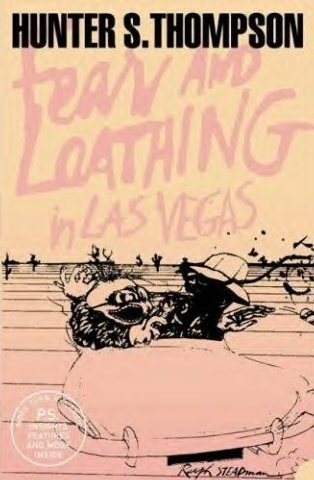
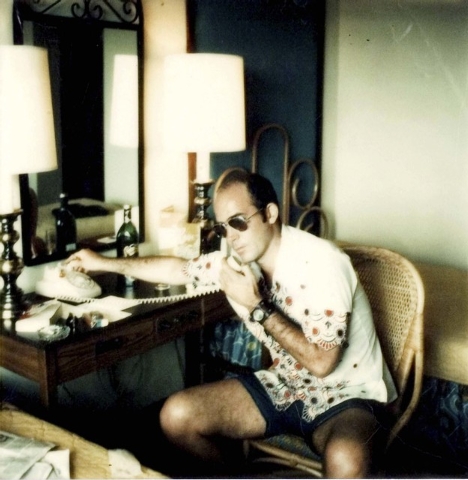
But, when used as metaphor, sometimes Nevada works. Consider: Would a book by Hunter S. Thompson called “Fear and Loathing in Omaha” been quite as effective?
“Thompson is important, I think, to this whole discussion,” Schumacher said, not necessarily because he accurately depicted Las Vegas, but because he so effectively captured the notion of Las Vegas as “sort of the rotten core of the American dream.”
“I think Thompson set that book here on purpose,” Schumacher said. “You really couldn’t have set that book anywhere else.”
IT’S NOTHING PERSONAL
Beyond fiction, Nevada has provided ample fodder for authors of nonfiction works ranging from memorable magazine pieces — a goodly chunk of Gay Talese’s now-famous “Frank Sinatra Has a Cold,” published in Esquire in April 1966, is set here — to books such as 1963’s “The Green Felt Jungle,” by Ovid Demaris and Ed Reid, that seek to explore the history of Nevada, be it shiny or tarnished.
The state’s cultural and topographic diversity — as well as its attractions both physical and human — likely will make it a prime setting for popular fiction of all sorts, from techno-thrillers to urban fantasies to mysteries.
Even if, sometimes, it’s not completely fair.
“If you think about ‘Leaving Las Vegas,’ the book and the movie, the man could go almost anywhere to drink himself to death,” Green said.
“Las Vegas, though, provides a backdrop that wasn’t necessarily what you’d find in Kansas City or Philadelphia.”
One man’s descent into oblivion wasn’t enough for Stephen King. He set Armageddon itself in Nevada — right, of course, in Las Vegas, which he also makes the devilish bad guys’ headquarters — in his apocalyptic opus “The Stand,” originally published in 1978.
It probably just comes with the territory when you have a single state that’s large and vivid and distinctive enough to almost be a literary character of its own.
“Las Vegas, and this is true for Reno, has a cachet,” Green said. “If you’re going to write a story, generally the surroundings have to be a character, too, and Las Vegas and Reno — and before that, places like Virginia City — are themselves characters in the way people might not think of Tuscaloosa and Des Moines.”
Contact reporter John Przybys at jprzybys@reviewjournal.com or 702-383-0280.


