For first time ever, Henderson council candidates buy TV time

If you've watched the local news lately, you might have noticed them during the commercial breaks.
They're easy enough to spot. They're the only ones not trying to sell you a car or get you the compensation you deserve.
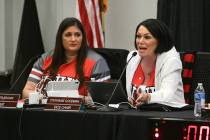
What Debra March and John Simmons want you to buy is them: their experience, their responsibility, their leadership.
For the first time, a pair of Henderson City Council candidates are paying for air time and taking their campaigns to local television viewers.
March's commercials landed on local stations last week, and Simmons retaliated with his own TV spots a few days later.
The apparent escalation has raised concerns over the amount of money being sunk into municipal races in Nevada's second-largest city.
Both candidates insist they had the TV idea first, and both say their ads show how serious they are about wanting to represent Ward 2 on the council.
"We're committed to running this race. We're out there aggressively doing what we need to do to win," March said of her campaign team.
"It was a decision we made very early on," Simmons said of his team. "We decided we would invest in this (race)."
March paid about $50,000 for a two-week run on local stations.
Simmons said March is spending about three times more than he is on television ads, but he referred detailed questions to his campaign manager, who could not be reached for comment.
The primary election will be April 5. Early voting is under way and lasts through April 1.
TV ads were unheard of in Henderson municipal elections until two years ago, when Andy Hafen and Steve Kirk slugged it out in the most expensive campaign for mayor the city has ever seen. Hafen and Kirk each ended up spending about as much on TV ads that year as the three other people in the race raised for their entire campaigns combined.
One political observer called it the first metropolitan-style election in a city where small-town campaigns once carried the day.
Now the trend has expanded to a city council contest for the first time.
The odd man out in the Ward 2 race is Kevinn Donovan, who said the bulk of his grass-roots campaign is self-funded so TV time is a luxury he can't afford.
Donovan worries that as campaigns grow ever more expensive, so does the influence of large donors and powerful political operatives.
"You have to wonder who's paying the bill," he said.
He questions the value of television advertising anyway.
"It doesn't seem like people want TV commercials. They want to hear from you directly," Donovan said. "If you want to go shoot TV, go shoot TV. I'm not in this to be a movie star."
Besides, he said, how can people tout themselves as a budget hawk or a fiscal conservative when they are "blowing all this money to get elected?"
"I'm not sure what message that sends," Donovan said.
March doesn't see a problem because she insists she's not on a spending spree. To pay for the TV ads, she cut back on spending in other areas, including yard signs.
"We set a budget, and we're living within that budget," she said.
Simmons said this is simply what it takes to run a successful campaign in a city of 275,000 where council members are elected at large.
"It costs more to run out here," he said.
Ron Hubel served on the Henderson City Council 25 years ago and is one of six candidates for the council seat in Ward 4. He claims he won in 1983 in part because he was the first candidate to raise more than $50,000 for a council race, but he has no plans to buy TV time during his current run.
Hubel thinks spending has gotten out of hand and the city has grown too large for candidates to knock on every door in every neighborhood.
The solution, he said, is to change the rules so that council members are elected only by the voters in their wards. The move would hold down campaign spending, encourage more people to run, and help residents feel more connected to their representatives and vice versa, Hubel said.
But Donovan isn't so sure. After all, candidates with money will still find something to spend it on.
"They're going to advertise outside their ward anyway to get that name recognition," he said. "I don't think that's going to decrease the signs on the side of the road."
One thing that might, Donovan said, is for the city to change its ordinance to restrict campaign signs to the ward in which the candidate lives.
March is a former Henderson planning commissioner who was appointed to the City Council in 2009, after then Ward 2 Councilman Hafen moved into the mayor's seat. Simmons worked for the city for 23 years, including 10 years as its construction manager.
The two candidates' commercials are being broadcast on local stations seen across Southern Nevada, but the percentage of viewers they are trying to reach is comparatively small.
Henderson is home to 125,000 active registered voters. Turnout for the last municipal primary, in 2009, was less than 13 percent, and that ballot featured the aforementioned race for mayor.
In 2007, when there was no mayoral race, fewer than 13,000 ballots were cast in the primary, a turnout of 11 percent.
Contact reporter Henry Brean at hbrean@review journal.com or 702-383-0350.
Early-voting locations and more information for all municipalities