



Gibbons sees prison bind
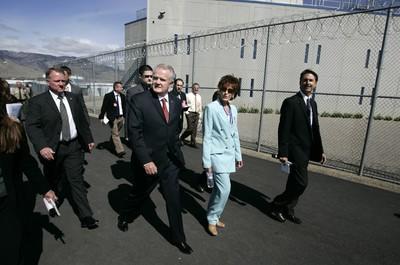


CARSON CITY -- After touring a minimum security correctional facility, where some inmates are housed four to a cell, Gov. Jim Gibbons said Thursday the state urgently needs to spend more money on new prison construction.
"Clearly you can tell the state of Nevada is growing and its prison system is burgeoning right along with that growth. ... We're literally busting at the seams."
A tour of Unit One of the Warm Springs Correctional Center showed 149 beds in an area that had previously housed 89 inmates. The 60 beds added to the unit, by adding two more bunks to many of the two-bunk cells, were expected to be full in the next few days.
Another area of the facility that had been used for prison programming was being occupied by 10 inmates and their bunks and meager belongings.
The same scenario is being played out in correctional facilities across the state, said Howard Skolnik, director of the Department of Corrections.
The system has 1,200 more inmates than it was budgeted for with no additional staff, he said.
The system had 13,113 inmates on Thursday.
Gibbons said after his tour: "It doesn't take much more than that to force the system into a meltdown. And we're right on that edge."
Failure to make critical and necessary investment in new prison construction could lead to federal court intervention, he said.
"Then we lose control," Gibbons said. "They come in, build the facility and hand us the bill whether we like it or not."
Lawmakers are looking at ways to reduce the prison population and slow its growth as well. One idea is to expand good-time credits to inmates to allow their early release.
But Skolnik said if such a measure was approved across the board, hundreds of inmates convicted of all types of crimes, including serious and violent offenses, would be released early.
Gibbons said he is willing to consider ways to release nonviolent offenders but would not support including those convicted of serious crimes in any such proposal.
Warden Stefanie Humphrey led the tour of the facility, which was in lockdown during the official visit.
Cells were opened in Unit One, however, so Gibbons could see the conditions. Humphrey said the institution's hardest working inmates were housed in the crowded unit, which the inmates now call the "ghetto."
Many of the inmates in the unit leave the facility during the day to work in the capital on various projects, she said.
One of those inmates was Randy Spoon, who said he now must adjust to living with three other men in cramped quarters instead of just one roommate.
And there aren't enough jobs for everybody, he said.
If you can't work and earn credits, you serve an extra 12 days for every month of your sentence, Spoon said.
Gibbons has proposed spending $300 million on prison construction over the next two years to handle the increasing inmate population, most of it on new beds.
His budget also proposes to spend $30 million for 337 new positions, most of them correctional officers.
Some lawmakers would like to divert some of that spending to other priorities.
But Skolnik said the need for new beds and more officers is critical.
Staff and inmate safety is a growing concern, he said.
Space is so tight that the agency is considering using tents for the least dangerous inmates if new facilities down come online fast enough, he said.
In large part because of the efforts of Supreme Court Justice James Hardesty, an effort is under way to release as many as 500 illegal residents serving time for nonviolent offenses in the Nevada prison system so they can be deported.
The Pardons Board just acted on 45 such cases, and another 186 are under review, Skolnik said.
But projections show the inmate population continuing to grow over the next decade, even with the release of those inmates, he said.


