



Governor gives speech to lawmakers, other attendees

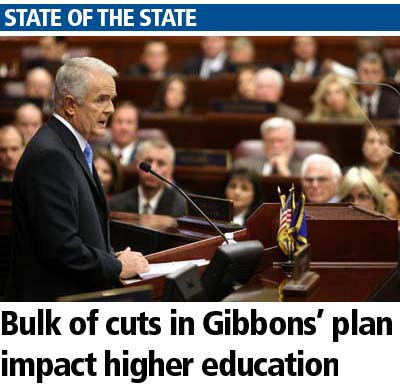


Gov. Jim Gibbons said Thursday evening that in these difficult times, government must avoid making people’s economic situations worse.
“These are extraordinary times,” Gibbons said in his State of the State speech. “As governor, I must, first and foremost, look at the economic situation of our people in order to determine that our state government does not pile on and make our citizens’ problems worse.”
The Republican Gibbons’ biennial address, delivered in the Assembly chambers in the state Capitol, sought to explain the difficult choices presented in his biennial budget, also unveiled Thursday.
The budget relies on a mix of massive cuts, especially to higher education, and new sources of revenue, including a tax increase on hotel rooms, to cope with a huge drop in state coffers.
The cuts will be painful and controversial, but they are necessary, Gibbons said, to avoid higher taxes that would burden the population.
“Nevada government should meet the needs of the people,” Gibbons said. “People should not meet the needs of Nevada government.”
In a 55-minute speech heavy on anti-tax rhetoric, Gibbons did not mention the tax increase contained in the budget. Nor did he discuss the tax money he would redirect from Clark and Washoe counties to help the state meet its obligations.
While defending the cuts in the budget, which Gibbons incorrectly described as $2.2 billion lower than his previous budget, the governor emphasized the state services that will be sustained.
(The budget is $2.4 billion less than the amount that would have been required to maintain current service levels, but only $633 million less than the budget Gibbons signed in 2007.)
Gibbons stressed that the budget he is presenting protects property tax rebates for seniors; juvenile justice and child welfare programs; the Millennium Scholarship; and all-day kindergarten in at-risk schools.
The massive cut to the state’s higher education system — $473 million, including salaries and benefits — “will bring challenges to the system,” Gibbons said. But 14 percent of the state’s budget would still go to higher education under his proposal, he said, while the national average is 11 percent.
The Democrats who control the state Legislature reacted angrily to Gibbons’ proposals, and vowed to chart a different course as they work from Gibbons’ proposals to craft a final state budget during the legislative session that begins Feb. 2.
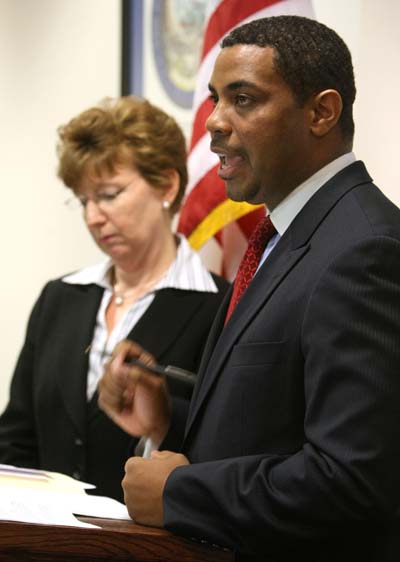
In her televised response to Gibbons’ speech, Assembly Speaker Barbara Buckley, D-Las Vegas, called the proposed cuts “drastic.”
In an economy such as today’s, she said, “We must focus on preserving our state’s services that are truly necessary.”
Gibbons, Buckley said, is talking about cutting per-pupil spending for grade-school students by 7 percent; potentially cutting the budgets of the state’s two major universities, UNLV and UNR, by half; cutting retired teachers off health insurance; and eliminating the state office that fights the proposed nuclear waste repository at Yucca Mountain.
“Is this the direction we want to go as a state?” Buckley asked. “... Does it make sense to cut education further? Does it make sense to close the doors of opportunity for our children to attend our universities? Do we want to overcrowd our emergency rooms with the mentally ill again because we shut mental health clinics? ... The answer is no.”
State of the State speech
Democratic Response
Gibbons' Letter to State Employees


