



Heller, Berkley see eye to eye on almost no issues



• IN-DEPTH: Votes define Heller, Berkley
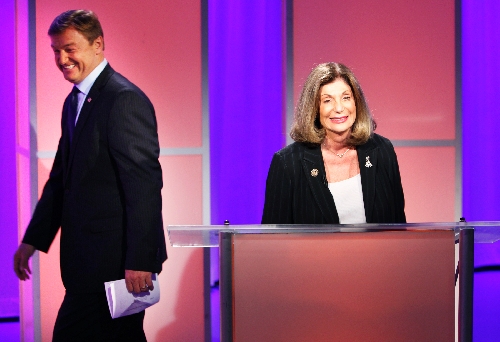
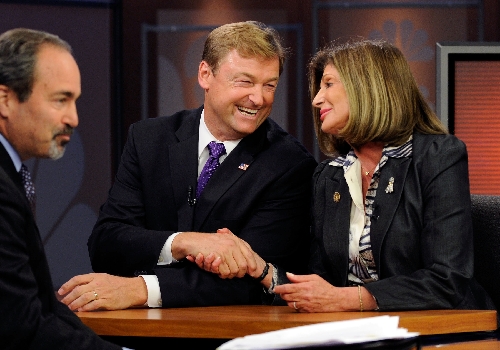
WASHINGTON - While serving side by side in Congress, Dean Heller and Shelley Berkley compiled mirror opposite voting records on most of the big issues facing the nation.
They staked out differing positions on the economy, many social matters and the role government should play when it comes to health care and the environment.
As Nevadans prepare to vote for a U.S. senator, their track records provide a seemingly distinct choice between Heller, 52, the appointed Republican incumbent senator and former congressman, and Berkley, 61, the Democratic challenger and seven-term House member.
They do not always disagree. They have been on the same page on home-state issues such as burying nuclear waste at Yucca Mountain (against), on easing international travel to Las Vegas and Reno (for), on national monument status for Tule Springs fossil beds (for), on federal legalization of Internet poker (for), and on continued support for Israel (for).
When Nevada's economy was tanking, both voted to extend unemployment payments to beleaguered job seekers. Both have sponsored bills to mitigate the home foreclosure crisis in Southern Nevada.
Each has reached across the aisle with regularity to sponsor or co-sponsor bills with members of the opposite party, and even each other.
"You have two very different views of how America works and what's good for America and what's going to move America forward," said Eric Herzik, political science professor at the University of Nevada, Reno.
For instance, Herzik said, "They will both say they want to promote small business and give you totally different answers on how to do it. With Dean Heller and Shelley Berkley, they just view the world differently."
On most broad issues they fall in line with their respective parties, though each shows sparks of independence.
Berkley in 2010 proposed reducing estate taxes by more than party leaders desired, and was one of 60 Democrats to cross the aisle to help Republicans kill a proposal to raise the tax rate.
"There are few things in this world that you can do to avoid paying taxes," Berkley said. "I think dying should be one of those things."
Two weeks after he took office, Heller in January 2007 parted ways with most GOP members to back more funding for embyronic stem cell research.
"It's not necessarily pro-choice or pro-stem cells," Heller told Congressional Quarterly at the time. "It's just, get the government out of the way."
Apart from occasional detours, Berkley, a 14-year House member, voted 90 percent or more with her party in all but her first four years in Congress, stronger support in each case than the Democratic average, according to statistics compiled by Congressional Quarterly.
Heller, who was elected to Congress in 1996, voted the GOP line at least 91 percent during his first four years, similarly more than the Republican average. In 2011, as an appointed senator preparing for a tough election, Heller's "party unity" votes dropped to 84 percent.
The duo cast roughly 3,800 votes while serving together in the House until Heller was appointed to the Senate on May 9, 2011. Here are significant votes that define their differences:
OCT. 3, 2008
HOUSE CREATES TARP
BERKLEY YES, HELLER NO
At the end of a dramatic week, the House passed a massive emergency rescue plan to stem a treacherous slide in U.S. financial markets.
The 263-171 vote came just days after rejection of an earlier version of the $700 billion rescue sent markets into near-panic. The Senate sweetened the bill with $150 billion in popular tax breaks and other riders to attract support, clearing the way for a House do-over.
Berkley initially voted against the bill, but in the intervening days "got an earful" from worried constituents.
"People were begging - not asking - for relief," she said at the time.
In the end, she framed her vote as favoring consumer tax breaks and renewable-energy incentives in the bill.
The rescue bill at its core established the Troubled Asset Relief Program, or TARP. It was to give the Treasury Department the ability to buy or insure failed assets that were clogging the markets, in order to free up capital.
Heller, who as a young man was a stockbroker and trader on the Pacific Stock Exchange, was from the outset skeptical at what came to be known as the Wall Street bailout. Billions of taxpayer dollars were put at risk, in his view, to reward bad decisions of wealthy financiers.
"That is Wall Street arrogance," Heller said at the time. "They created their problems and they want someone else to bail them out."
Heller maintained there were other choices short of taxpayer involvement, including a plan paid for by the financial institutions themselves.
APRIL 15, 2011
HOUSE PASSES RYAN BUDGET
HELLER YES, BERKLEY NO
Republicans reclaimed House control following the 2010 elections. The new-look Congress included 85 GOP freshmen elected on platforms to shake up Washington, some fairly vigorously.
The early signature bill of the GOP-controlled House was the $1.019 trillion fiscal 2012 budget resolution formed by Budget Committee Chairman Paul Ryan of Wisconsin and passed 235-193 with zero Democratic votes.
The document sought to repeal key elements of President Barack Obama's health care reform and contained deep budget cuts in an attempt, Republicans said, to regain control of federal spending and the skyrocketing deficit.
The most controversial provisions called for restructuring Medicare as a "premium support" voucher-style system to go into effect when today's 55-year-olds retire. Ryan and his allies argued the changes were necessary to save Medicare from eventual ruin.
Berkley rejected the budget as "extreme," and has made Heller's vote a centerpiece of her Senate campaign.
Heller said bold moves were necessary, and also voted for it in the Senate.
"The choices are clear. We can continue with the status quo, which leads to bigger government, higher taxes, less jobs, and rationed health care for our seniors, or we can decrease government spending, create jobs, and preserve Medicare for future generations while making no changes for current recipients," Heller said.
JAN. 9, 2009
HOUSE PASSES PAYCHECK FAIRNESS ACT
BERKLEY YES, HELLER NO
With Obama preparing to enter the White House and with majorities on both sides of Capitol Hill, the Democratic agenda early in 2009 included this bill, aimed at fighting wage discrimination.
While it passed the House 256-163, the Paycheck Fairness Act has failed to become law. Most recently, in June, a Senate version was blocked by Republicans and became fodder for election-year charges the GOP is waging a "war on women."
The bill, updating a 1963 equal pay law, would require an employer to pay men and women the same for the same job, or to justify why not.
"This is more than a woman's issue; this is a middle-income family issue," Berkley said in June. "This is not the 1950s. We're not talking about women who have a little job that at the end of the week they fill their cookie jar with extra money for the kids. These are the mainstay breadwinners."
The bill drew opposition from business interests that feared a flood of lawsuits.
Heller in June characterized the bill as a red herring.
"Let me be clear: Pay discrimination based upon gender is unacceptable," Heller said. "The only winners under this legislation would be trial lawyers, giving them a windfall, exposing employers to unlimited punitive damages.
"This legislation opens the door to frivolous lawsuits which already cost our economy billions of dollars every year.''
JUNE 30, 2010
HOUSE OVERHAULS FINANCIAL RULES
BERKLEY YES, HELLER NO
The near-collapse of the nation's financial sector set Congress to work on legislation to overhaul regulation of the financial service industry. The result was a sweeping bill that set out to change the face of Wall Street but also deepened the chasm between the two parties in the aftermath of the 2008 crisis.
The Dodd-Frank bill was described by the Wall Street Journal as touching "every corner of finance, from ATM cards to Wall Street bankers," and created a new federal watchdog agency, the Consumer Financial Protection Bureau.
"We are putting these common-sense rules in place to police Wall Street and the big banks and to prevent them from placing the savings of Nevada families at risk through predatory lending and reckless investment strategies," Berkley said after the 237-192 vote.
Republicans called it yet another "big government" strategy that would stifle business activity and private sector growth yet do little to reduce risk.
Heller, during a campaign debate this month, said: "The purpose of Dodd-Frank was to give cover for those who voted for the (TARP) bailout."
DEC. 10, 2008
HOUSE BACKS AUTO INDUSTRY RESCUE
BERKLEY YES, HELLER NO
Weeks after voting to rescue the financial services industry, the House voted to do the same with automakers.
The 237-170 tally for a $14 billion emergency loan package and industry restructuring was the final House vote of the 2008 lame-duck session.
The legislation failed in the Senate, but Presidents George W. Bush and Obama later extended TARP loans to General Motors and Chrysler.
"This was not a perfect package, but at the end of the day, I could not stand by and allow GM, Ford or Chrysler to go bankrupt or to close their factory doors forever," Berkley said at the time. "Our nation is still facing financial turmoil. Add to that the loss of the Big Three and the jobs that come along with the automobile industry - including those in Nevada - and it becomes clear why we must act to pass this loan package."
Heller, outspoken against the earlier financial services bill, looked no more kindly on this one.
"Another month, another bailout," he said. "This is nothing more than a Band-Aid that does not fix the much larger economic problems we have in our country."
FEB. 13, 2009
HOUSE FINALIZES ECONOMIC STIMULUS
BERKLEY YES, HELLER NO
The 246-183 vote finalized House action on the $787 billion package of federal grant spending, tax cuts and safety net payments aimed at jump-starting a reeling economy.
Democrats said it would create or save 3.5 million jobs. No Republican voted for it, protesting that borrowing and spending would cripple the nation with debt.
Heller and Berkley went head-to-head on the stimulus during a House debate on July 22, 2010.
Nevada's worst-in-the-nation jobless rate of 14.2 percent was proof, Heller said, that Obama's strategy failed to stem the recession while adding billions in debt.
"Who do we hold responsible?" Heller said. "The truth is the stimulus has failed the American people and the people of the great state of Nevada."
Minutes later, Berkley countered that, "For any Nevadan to condemn the stimulus bill is to ignore what's going on in the state of Nevada."
The stimulus, with $2.9 billion for Nevada to date, had paid teachers and kept schools open, and injected $500 billion into the state's Medicaid program, Berkley argued. Stimulus money helped build bus depots in downtown Las Vegas and on Boulder Highway.
"We welcomed this money. We needed this money. It kept us afloat," she said.
Heller's response:
"We've lost 2 million jobs in this country since the stimulus bill was passed. Since the stimulus, almost 50,000 people have lost their jobs in Las Vegas. Tell me that the stimulus has worked in my district. I will debate anybody on this, and I'll wait for my phone to ring."
JULY 31, 2009
HOUSE EXTENSION OF CASH FOR CLUNKERS
BERKLEY YES, HELLER NO
Reacting to a subsidized consumer rush into auto showrooms, this 316-109 vote added $2 billion to the "cash for clunkers" program that aimed to inject life into auto sales.
The program offered as much as $4,500 in cash to people who traded in cars, trucks and SUVs with poor fuel economy for newer models. The first $1 billion was gone in a week.
"It's good for our car and truck dealers, and it helps our goal of reducing emissions tied to global climate change," Berkley said after voting more money.
Critics, including Heller, said the government was "picking winners and losers" by goosing auto sales.
At a Rotary Club meeting in Carson City a few weeks later, he asked if anyone had taken advantage of "cash for clunkers."
According to the Nevada Appeal, Heller told a man who raised his hand, "Congratulations. Everyone else in the room paid for your car."
NOV. 7, 2009
HOUSE ON AFFORDABLE HEALTH CARE ACT
BERKLEY YES, HELLER NO
The landmark law known as "Obamacare" is the signature achievement of the president's term, altering the nation's health care landscape.
The 220-215 vote was the first measure of House support for the bill, which passed in final form in March 2010.
Democrats cheered its goal of making health coverage available to 32 million uninsured people, as well as consumer-friendly provisions on prescription drugs and coverage for people with medical conditions.
All but one Republican voted against what they considered a "government takeover" of health care including new taxes, mandates on business and a requirement that most Americans be insured by 2014.
The U.S. Supreme Court this summer upheld most of the law, yet it remains a defining issue in this year's presidential campaign and in Nevada's U.S. Senate race.
Heller, a critic, tried in the Ways and Means Committee to require the president and members of Congress to "walk the walk" and enroll in the program. He later complained Democrats would not let him offer further amendments.
"By choosing ideology over their constituency, Congress has empowered he federal government to take control of individual health care choices," he said.
Berkley called the bill "good for Nevada. Over 400,000 uninsured Nevadans will be able to get health insurance because of this bill."
JUNE 26, 2009
CAP AND TRADE CLIMATE BILL
BERKLEY YES, HELLER NO
Narrow 219-212 passage of this energy bill gave Obama a momentary victory, yet underscored the gulf between the parties on climate change.
The bill "capped" emissions of greenhouse gases that contribute to global warming and sought to reduce them up to 83 percent by 2050. In the meantime, it would have established a system for industries to buy and sell emissions credits to pollute within the caps.
Berkley hailed the strategy to speed transition to renewable energy sources, which Nevada has in abundance.
"It addresses climate change, promotes the development of clean energy sources, and brings us closer to our goal of securing America's energy independence," she said in a House speech.
All but eight Republicans voted no.
Like most other critics, Heller charged the system would prove too expensive.
"What does this bill do? Every time you flip on your light switch, you are taxed. Every time you drive your kids to school, you are taxed," Heller said during debate. "Every time you cook your family dinner, you are taxed. Air travel, food prices, electricity costs, gas prices, transportation cost, all will skyrocket under this bill."
The cap and trade bill died in the Senate.
Contact Stephens Washington Bureau Chief Steve Tetreault at stetreault@stephensmedia.com or 202-783-1760. Follow him on Twitter @STetreaultDC. Contact Stephens Washington Bureau reporter Peter Urban at purban@stephensmedia.com or at 202-783-1760.


