



Iceland’s ash unlikely to reach LV area
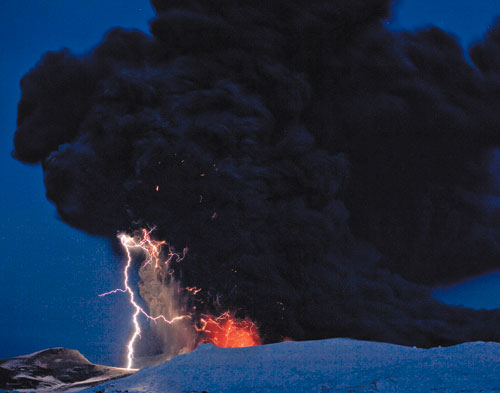


As the volcano in Iceland continued to inject ash into the air at a rate of 750 tons per second Monday, meteorologists said it appears unlikely the plume will affect Southern Nevada air quality, although it might be too early to tell.
"It's always possible, but it's way too soon to have any prediction if it will reach here or settle here," said Phillip Wiker, meteorologist for Clark County's Department of Air Quality and Environmental Management.
He said a more likely place for ash to wind up in the Western United States, given the volcano's northern latitude, would be over Washington state. That's typically where oscillating, atmospheric patterns crest that carry ash as it dissipates.
Likewise, National Weather Service meteorologist Stan Czyzyk said the current chances of ash circulating the globe's middle atmosphere and dimming Southern Nevada's sky is "pretty close to zero at least at this point. ... We're not expecting any impact."
"It looks like the closest place is Newfoundland and eastern Canada," where there's a western edge of the 250-mile plume that satellite photos show is heading southeasterly from Iceland.
With millions of tons of ash having spewed from Eyjafjallajokull since Wednesday, and with eruptions continuing, the question scientists are trying to answer is how long will this persist?
A glacier covers the volcano, which has a reputation for spewing ash for months or years over the past few centuries. One series of eruptions lasted from 1821 until 1823.
Another fear is that persistent activity from Eyjafjallajokull could melt glaciers capping another volcano, Katla. If that happens, Katla could inject enough ash to lower global temperatures.
When Mount Pinatubo erupted in 1991 in the Philippines, scientists estimated temperatures dropped nearly a full degree in a year's span.
Czyzyk said Eyjafjallajokull's main plume reaches four to seven miles high, which puts it in the upper troposphere and lowest part of the stratosphere.
During last week's eruption, scientists said the ash tower stretched up to 6.8 miles high. Monday's eruption sent ash up 1.2 miles.
Dust storms and fires in Asia and Europe have previously affected Southern Nevada's air quality.
In April 2001, dust from a Gobi Desert sandstorm cast a haze over the Las Vegas Valley after the slug of dingy air was carried 7,000 miles by high-altitude currents. This caused unhealthful levels of coarse dust particles and ozone for a few hours. Sunlight was diminished by 3 percent in parts of Nevada, about 10 days after the April 6, 2001, storm on the Mongolia-China border. Sulfur in the particles gave the haze a yellowish tinge.
A similar event occurred in April 1998 when dust from a Gobi Desert storm was lofted into the jet stream and carried over Southern Nevada.
Contact reporter Keith Rogers at krogers@reviewjournal.com or 702-383-0308.
RELATED STORIES
• MGM, other operators make room for stranded visitors
• Vegas vacation becomes survival epic


