



Increasing number avoid transfusions
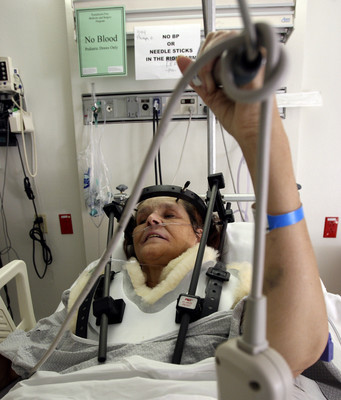


Dorothy Phillips is as anxious as anyone would be at the thought of surgery. It's just plain scary.
But as a Jehovah's Witness, which recognizes blood as sacred and has prohibitions on transfusions, Phillips carries around an additional worry: that if she needed emergency surgery, her body would require special attention.
After her vehicle hit a light pole in Southern Utah in late November, Phillips found herself in just that situation.
Though her scrapes and scratches were fixed with alcohol and bandages, her broken hip and foot required surgery.
After her accident, Phillips, 65, was taken to University Medical Center, the closest Level I Trauma Unit.
Despite UMC's expertise in treating trauma patients, Phillips requested a transfer to Valley Hospital Medical Center, where physicians practice techniques capable of conserving a patient's blood.
"I knew this was a bloodless center,'' Phillips said last month from her hospital bed, where a sign posted above her bed read "No Blood."
Valley is the only medical facility in Southern Nevada -- and is among 125 in the country -- that provides patients with what's known as transfusion-free medicine.
The program is not just available to Jehovah's Witnesses, said Jerry Montgomery, coordinator of Valley's Transfusion-Free Medicine and Surgery program.
"We're here for any patient wanting to avoid blood transfusions,'' Montgomery said. "Transfusion-free medicine, or blood conservation, is becoming a trend across the nation, with several of our prestigious medical institutions operating programs.''
According to medical experts, patients are turning to such programs because of the increasing costs of blood, a fear of contracting an infectious disease such as HIV or hepatitis, and fewer donors contributing to blood banks.
There also is a fear that a patient might be given the wrong blood during a transfusion, which could lead to further medical complications.
"The American Red Cross touts that it (blood) is the safest it's ever been, which is true," said Dr. Jonathan Waters, medical director of the University of Pittsburgh's blood management effort.
"But truth be told, blood has never been safe. The blood banking industry has done a wonderful job testing blood for HIV and hepatitis, but there's a whole slew of other things that could lead to problems.''
The biggest concern is blood storage methods, Waters said.
Stored blood undergoes changes which might not be helpful to patients, Montgomery and Waters said.
According to a study published in the New England Journal of Medicine, heart-surgery patients who had transfusions with blood stored more than 14 days do worse than those who receive newer blood. It found in-hospital death rates, incidence of complications and long-term death rates were higher for those who received older blood.
"It's been perceived as a huge threat, this storage effect," Waters said. "The average storage time for blood is 21 days. If you're taking the storage down to 14 days, as a general policy, you're going to castrate the ability of the blood bank to provide for patients that are in need.
"That's why there is an increasing focus on avoiding the need for blood transfusions.''
Robert Kopchinski, executive director of the Milwaukee-based Society for the Advancement of Blood Management, said there are 125 blood conservation programs in the United States.
The organization helps health care providers set up blood management programs or incorporate them into their clinical practices, Kopchinski said.
Waters, president of the society, said interest among health care providers to develop blood management programs has grown during the past five years.
The society's membership, which includes Valley Hospital, also has grown.
Waters said there is a difference between a bloodless program and a blood management program.
Bloodless programs typically focus on religious groups like Jehovah's Witnesses; blood management programs try to reduce blood use for all patients.
Valley Hospital, which started its transfusion-free medicine program in 2006, follows three guiding principles, Montgomery said.
They are to use drugs to build up a patient's red blood cell count before surgery, take precautions to avoid unnecessary blood loss, and use technology to recycle blood.
Because Phillips needed two operations, doctors decided to start with the one that would result in less blood loss: the foot surgery.
After that surgery, and to prepare her for the more invasive hip replacement, Phillips was given a number of drugs to replenish her red blood cell count. Because she was anemic, she had to wait a few weeks for the hip replacement.
That procedure took place successfully on Thursday.
As part of its program, Valley Hospital has invested in several Continuous AutoTransfusion Systems, or cell-savers, which collect blood at the surgery site so it can be recycled back into the body.
It works like this: When a surgeon makes an incision, a technician uses a small tube, similar to what dentists use to remove fluid from a mouth during dental procedures, to suck blood from the operation site.
That blood passes through the tubing and is mixed with a substance that prevents it from clotting.
The blood is collected in a bowl attached to the machine.
The blood is then filtered and spun in a centrifuge to separate the red blood cells from plasma.
The plasma is disposed of and the red blood cells are washed with a saline solution also used to remove debris. Clean red blood cells are then pumped into a transfusion bag, where they eventually are returned to the patient, health officials say.
"To me, putting blood that's not yours into your body is like putting in a foreign object,'' Phillips said. "When you have a foreign object in your body, the body automatically tries to fight it."
Montgomery and Waters say it's a matter of time before all of health care catches on to blood management programs.
Already the Joint Commission, a national organization that certifies medical care facilities, is looking at ways to develop performance measurements to ensure that patients aren't anemic when they enter hospitals for surgical procedures, Waters said.
"The United States is actually a little behind the rest of the world,'' he said. "There is a program in Ontario, Canada, where they've got 26 major facilities that have a unified blood management program. There's a program in Western Australia and programs scattered throughout Europe at different degrees."
In Southern Nevada, Montgomery and other health care professionals that are part of the Valley Health System hold public lectures about transfusion-free medicine. They discuss steps the general public can take to prevent blood transfusions.
"I knew it was possible to have surgeries without blood,'' said Phillips, whose Chitzu died in the accident. "A long time ago, a little boy in our congregation was taken to Texas where he had open-heart surgery. He survived. I knew I could survive with bloodless surgery.''
Contact reporter Annette Wells at awells @reviewjournal.com or 702-383-0283.


