Indigent defense, caseload limits are focus of hearing

As Clark and Washoe counties explore the need for caseload limits for public defenders, Nevada officials and national groups are calling on the Legislature to fund indigent defense services across the state.
The Nevada Supreme Court, which on Friday held its fourth and possibly final public hearing on indigent defense, will help determine if these things happen.
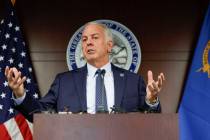
"We understand all the issues and how they affect counties," Chief Justice Mark Gibbons said at the hearing. "We'll take this all into consideration."
The more the Supreme Court discusses the findings of an indigent defense commission formed by the court last year, the more related issues emerge.
Over the past year, one of the most contentious debates has centered on whether large caseloads of public defenders in Nevada's urban counties have led to inadequate representation of indigent defendants.
Public defenders in Clark and Washoe counties say they can't aggressively defend clients because of crushing caseloads. But county officials, wary of the cost of increasing the size of these offices, question those claims.
To settle the dispute, both counties have contracted with the Massachusetts-based Spangenberg Group, a legal research organization, to conduct caseload studies that are set to be completed early next year.
The needs of Nevada's rural counties also got attention at Friday's hearing, which took place via teleconference in Carson City and Las Vegas.
The Nevada Association of Counties has filed a bill draft request with the Nevada Legislature asking that the state fully fund indigent defense, at least in rural areas. Currently, the state pays a small fraction of indigent defense costs in rural counties.
Citing a draft report of an indigent defense subcommittee that examined rural issues, Seventh Judicial District Court Judge Dan Papez said state help is overdue.
"It makes a powerful and persuasive argument that Gideon v. Wainwright requires the state, not counties, to fund indigent defense," he said at Friday's hearing. "That's something the state needs to consider."
Gideon v. Wainwright is the 1963 U.S. Supreme Court ruling that guaranteed legal counsel to criminal defendants who can't afford to hire lawyers.
Papez's view has gotten strong backing from local officials and national groups including the American Civil Liberties Union, the NAACP Legal Defense and Educational Fund, and the National Legal Aid and Defender Association.
"We are deeply concerned that Nevada's current statutory scheme, as implemented, fails to meet the state's constitutional obligations," the groups wrote in a letter to the justices this week.
Jeffrey Fontaine, executive director of the Nevada Association of Counties, echoed the belief that indigent defense is a state responsibility. That is the reason for his organization's bill draft request.
"We further agree that Nevada's counties have faced challenges in providing indigent defense services at constitutionally mandated levels," Fontaine wrote in a letter to the court.
Also at Friday's hearing, the court further discussed proposed performance standards for public defenders and private attorneys appointed to represent indigent defendants.
Clark and Washoe counties asked that implementation of those standards be delayed until May 2009.
The Supreme Court expects to issue an order on performance standards later this month, Gibbons said.
Contact reporter Alan Maimon at amaimon @reviewjournal.com or 702-383-0404.