Mexico, U.S. talk water deal




The powerful earthquake that rattled Mexicali, Mexico, on Easter Sunday also has stirred serious international talks over the future of the Colorado River, the Las Vegas Valley's primary water source.
Federal officials from the United States and Mexico met at the Southern Nevada Water Authority's office in downtown Las Vegas on Friday to discuss a shortage and water-sharing agreement between the two nations.
The talks have been ongoing since early 2008, but the
7.2 magnitude quake on April 4 seemed to create more urgency on the Mexican side because widespread infrastructure damage might prevent that nation from using its full Colorado River allocation.
Lorri Gray-Lee has been taking part in the discussions as director of the U.S. Bureau of Reclamation's Lower Colorado River region.
She said Mexico wants to be able to store a part of its annual river allocation in Lake Mead for future use once the earthquake damage has been repaired.
She hopes talks on that issue will lead to a broader agreement spelling out Mexico's share of any shortage that might be declared on the river and providing a framework for cross-border water exchanges.
Gray-Lee remains optimistic that the larger deal could be struck late this year or early next year. "There's just too much benefit to both sides for us not to get this done," she said.
Southern Nevada Water Authority chief Pat Mulroy is not as much of an optimist, but she said the talks do appear to have taken on a different tone since the earthquake.
"It created a situation in Mexico where they can't deliver water to their farms. The infrastructure is destroyed," she said. "I think they are a lot more serious to come to a conclusion."
Mulroy said Nevada one day could partner on the construction of an ocean desalting plant on the Mexican coast in exchange for a portion of the country's Colorado River water.
First, though, the United States and Mexico must agree on a legal framework that "doesn't exist right now" for such exchanges, she said.
Under a 1944 treaty, Mexico receives 1.5 million acre-feet of water a year from the Colorado River. That is five times more than Nevada's share but about one-third of what California gets and about half of what Arizona receives.
One acre-foot of water is enough to supply two average Las Vegas Valley homes for a year.
Depending on how much water is involved, Mulroy said, both Nevada and Lake Mead could benefit if Mexico is allowed to store part of its river allocation in the reservoir.
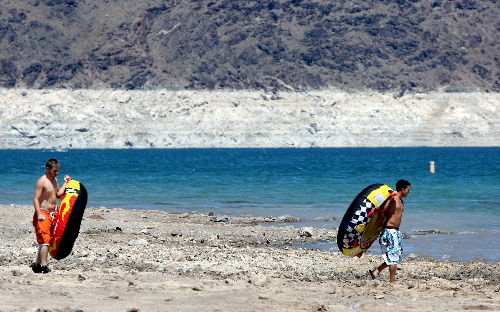
Every 100,000 acre-feet of water adds about one foot to Lake Mead, and even a single foot could prove crucial as the surface of the lake shrinks ever closer to the trigger point for a shortage declaration.
On Tuesday, the reservoir sat at 1,088 feet above sea level. If it drops another 13 feet, Nevada and Arizona will be forced to reduce their combined use by 400,000 acre-feet a year.
Nevada's share of those shortages would start at 13,000 acre-feet and increase to 17,000 acre-feet and then 20,000 acre-feet as Lake Mead continues to drop.
"How we stay above 1,075 is irrelevant as long as we stay above 1,075," Mulroy said.
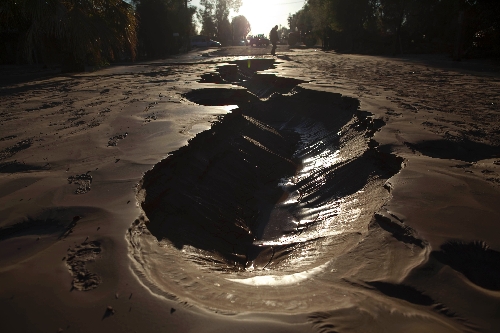
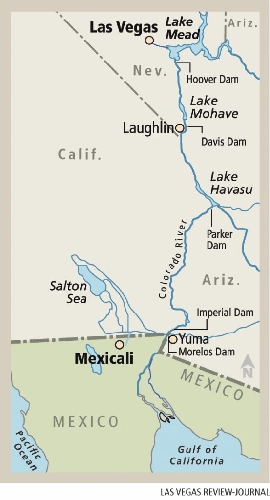
The April 4 earthquake buckled canals and destroyed irrigation pipelines in the vast agricultural area south of Mexicali, which is fed by water diverted from the Colorado River at the Morelos Dam west of Yuma, Ariz.
Roughly one-third of the Mexicali Valley suffered damage to its water infrastructure, said Jennifer McCloskey, area manager for the Bureau of Reclamation in Yuma. The bureau has seen "some decline but not a sharp decline" in water orders from Mexico, she said.
The recovery effort in northern Mexico has been hampered by road damage and several aftershocks "in the fives and sixes," she said. Some people have taken to living in tents because they lost their homes, or they are afraid to stay in them.
"It's a really, really tough situation," McCloskey said.
Friday's discussions in Las Vegas included Gray-Lee, Reclamation Commissioner Michael Connor, representatives from the U.S. State Department and their Mexican equivalents.
Also on hand were top officials from the International Boundary and Water Commission, a bilateral panel that administers the boundary and water treaties between the two nations.
Mulroy did not directly participate in Friday's meeting.
The next round of talks is slated for September, Gray-Lee said.
Contact reporter Henry Brean at hbrean@reviewjournal.com or 702-383-0350.