Mojave cross can stay, high court says



the Associated Press
WASHINGTON -- The Supreme Court's conservative majority on Wednesday signaled a greater willingness to allow religious symbols on public land, a stance that could have important implications for future church-state disputes.
By a 5-4 vote, the court refused to order the removal of a congressionally endorsed war memorial cross from its longtime home atop a remote outcropping in California's Mojave Desert.
The court directed a federal judge to look again at Congress' plan to transfer the patch of U.S. land beneath the 7-foot-tall cross made of metal pipe to private ownership.
Federal courts had rejected the land transfer as insufficient to eliminate constitutional concern about a religious symbol on public land -- in this case in the Mojave National Preserve.
While the holding Wednesday was narrow, the language of the justices in the majority, and particularly the opinion of Anthony Kennedy, suggested a more permissive view of religious symbols on public land in future cases.
Federal courts are weighing two other cases involving crosses, a 29-foot cross and war memorial on Mount Soledad in San Diego and Utah's use of 12-foot-high crosses on roadside memorials honoring fallen highway patrol troopers.
"The Constitution does not oblige government to avoid any public acknowledgment of religion's role in society," wrote Kennedy, who usually is in the court's center on church-state issues.
Speaking of the Christian cross in particular, Kennedy said it is wrong to view it merely as a religious symbol.
"Here one Latin cross in the desert evokes far more than religion. It evokes thousands of small crosses in foreign fields marking the graves of Americans who fell in battles, battles whose tragedies are compounded if the fallen are forgotten," he said.
In dissent, Justice John Paul Stevens agreed that soldiers who died in battle deserve a memorial to their service. But the government "cannot lawfully do so by continued endorsement of a starkly sectarian message," Stevens said.
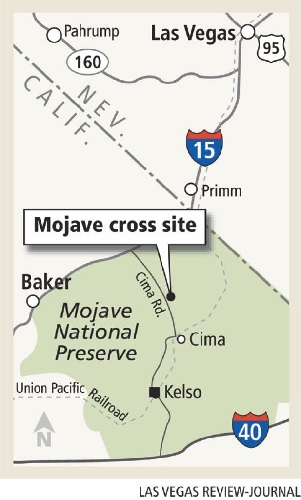
The cross has stood on Sunrise Rock in the 1.6 million-acre preserve since 1934, put there by the Veterans of Foreign Wars as a memorial to World War I dead. It has been covered with plywood for several years after the court rulings.
Justice Samuel Alito, part of Wednesday's majority, noted the site's remoteness.
"At least until this litigation, it is likely that the cross was seen by more rattlesnakes than humans," he said, although he pointed out that Easter services have long been held there.
The controversy began when a retired National Park Service employee, Frank Buono, filed a lawsuit complaining about the cross on public land. Federal courts sided with him and ordered its removal.
In 2003, Congress stepped in and transferred the land where the cross stands to private hands to address the court rulings. But the courts said the land transfer was, in effect, an unacceptable end run around the constitutional problem.
Supporters of the cross memorials were pleased with Kennedy's language, especially because Alito and Justices Antonin Scalia and Clarence Thomas would have gone further. Chief Justice John Roberts signed on to Kennedy's opinion.
"We know this is just the beginning. Until that box comes off that veterans' memorial, the veterans consider that a disgrace," said Kelly Shackelford, chief counsel at the conservative Liberty Legal Institute in Plano, Texas.
The Rev. Barry Lynn, executive director of Americans United for Separation of Church and State, called the court's reasoning "bogus."
"It's alarming that the high court continues to undermine the separation of church and state. Nothing good can come from this trend," Lynn said. "The court majority seems to think the cross is not always a Christian symbol. I think all Americans know better than that."