



Monster storms arrive


RENO -- A monster winter storm pounded the Sierra and Northern Nevada on Friday, creating treacherous driving conditions in the mountains and prompting state officials to warn truckers hundreds of miles to the east to park where they are and stay put.
With as much as 5 feet of snow expected at elevations above 7,000 feet by today, a blizzard warning remained in effect for the Sierra and Lake Tahoe region along the Nevada-California line, where heavy snow and hurricane-force winds reduced visibility to zero and avalanche warnings were raised to the highest level.
"The sleet is blowing sideways, and the trees are bending in the middle," said Misty Young, owner of the Squeeze Inn restaurant in downtown Truckee, Calif.
Up to 10 feet of snow was possible at the highest elevations by Sunday before the storm is forecast to make its way east.
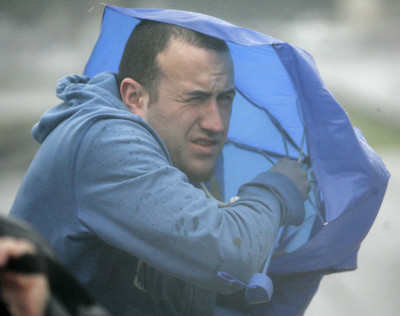
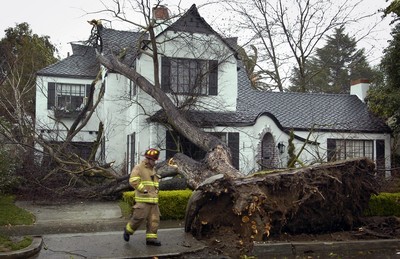
Howling winds, pelting rain and heavy snow also pummeled California on Friday, toppling trees, flipping big rigs, cutting power to more than a million people and forcing evacuations in mudslide-prone areas.
Flights were grounded and highways closed in Northern California as gusts reached 80 mph during the second wave of an arctic storm that sent trees crashing onto houses, cars and roads.
After searching for a missing Clovis family all afternoon, a search-and-rescue team found 64-year-old John Hopper and his 15-year-old twins, Matt and Sarah, near Fresno Dome, a popular hiking destination in the Sierra National Forest, just after night fell.
Madera County Sheriff's spokeswoman Erica Stuart said rescue crews found the family with three other people who were believed to have gotten trapped in the woods after the storm hit. Stuart said the Fresno Dome was the last known hiking area the rescue crew was scheduled to search Friday night. All six hikers were in good condition.
Highways from Sacramento to San Francisco were closed because of debris or toppled big rigs blocking lanes, and local roads were flooded.
"A huge tree, over 100 years old, just fell across the house. It just wrecked the whole thing," said Faye Reed, whose daughter Teenia owns the damaged home north of Sacramento. "They won't be able to live in it. The whole ceiling fell in, and now it's raining inside."
More than 1 million people from the Bay Area to the Central Valley were in the dark. Crews worked to restore power, but it could be days before all the lights are on, said Pacific Gas & Electric spokeswoman Darlene Chiu.
In Southern California, authorities in Orange County ordered an estimated 3,000 residents to evacuate homes in four canyons scarred by wildfires and therefore prone to mudslides.
A freeze in the eastern United States, meanwhile, subsided. Florida's citrus growers weathered the cold largely unscathed, but strawberry and tomato growers watched as some of their crops shriveled.
A serious freeze would have devastated Florida's citrus trees, already struggling from years of diseases and hurricanes.
A better picture of crop damage could come Monday, when the U.S. Department of Agriculture releases a weekly progress report.
At Bill Baggs Cape Florida State Park in Key Biscayne, iguanas fell out of trees Thursday. The cold-blooded reptiles go into a sort of hibernation when temperatures get too low, even if they are perched in branches. Most woke up when the weather warmed later in the day.
As the winter storm descended on Northern Nevada on Friday, U.S. Interstate 80 over Donner Summit west of Reno was closed periodically throughout the day because of jackknifed trucks, spinouts and blinding snow. It was closed in both directions again at the Nevada-California line about 5 p.m. because of poor visibility and state patrol officers said they did not know whether it would reopen overnight. Traffic on U.S. Highway 50 over Echo Summit also was backed up because of wrecks, authorities said.
One trucker who holed up at a truck stop in west Reno said it would be foolish to try to continue on into California.
"You're not getting over that mountain," Christopher Rhoudes said. "You get up there it's deadly and rescue is not coming after you."
The town of Truckee called in the American Red Cross to set up an emergency shelter for motorists stranded by the storm or anyone else in need of safe harbor.
Dozens of flights in and out of Reno-Tahoe International were canceled although the airport remained open.
High school athletic events also were canceled across much of Northern Nevada on Friday night and the University of Nevada, Reno -- for the first time in memory -- canceled tonight's basketball game against Utah State.
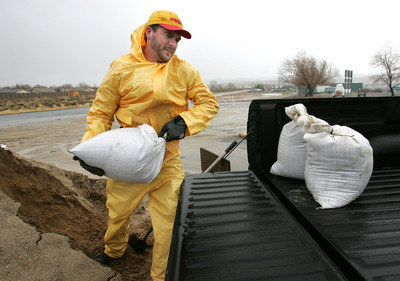
In addition to a winter storm warning and high wind warnings, flood warnings were posted into Friday evening for small stream and low-lying areas from north of Reno to Gardnerville 50 miles south, along the central Sierra and 60 miles east to Fallon.
"We don't have a tornado warning out there and that's just about the only kind of warning we don't have," said Mike Alger, chief meteorologist for KTVN-TV in Reno.
Up to 2 inches of rain was reported by Friday evening in parts of Reno, which averages only 8 inches of rainfall annually. Several local streets and intersections flooded, but no damage to homes was reported. In neighboring Sparks, an I-80 underpass was closed because it was under 4 feet of water. By 5:30 p.m., the rain had changed over to big fluffy snowflakes.
One gust of wind registered 125 mph over the ridge of the Sierra on Friday afternoon. The heaviest snowfall was expected late Friday and overnight, when snow could pile up at the rate of 6 inches an hour, the National Weather Service said.
"Attempting to travel in the Sierra will put your life at risk," the weather service warned on its Web site.
Neil Erasmus, manager of Ice Lake Lodge and Rainbow Lodge near Donner Lake, said it was a struggle to keep up with the mounting snow.
"It's a whiteout here," he said. "We're plowing and grooming, plowing and grooming to keep us from being buried in."
The massive storm prompted authorities in Nevada to warn truckers heading toward the Sierra en route to the West Coast from as far away as Evanston, Wyo. -- 600 miles east of Reno -- to find a place to hunker down way before reaching the Nevada-California line.
"State officials have been working closely with trucking companies and truck stops to let them know, 'Stay put,' " said Nevada Highway Patrol trooper Chuck Allen.
The concern, Allen said, was that hundreds of trucks with nowhere to go would clog the highway for miles and impede snow removal if, as expected, I-80 is shut down.
"If it starts dumping at the rate they're talking, Caltrans won't be able to keep up," Allen said.
Around Lake Tahoe, at an elevation of 6,200 feet, snow began falling around noon.
Winter storm warnings were issued all across Northern Nevada, from Reno to the Utah line. The heaviest snowfall was expected overnight into today. The weather service said 4 to 10 inches of snow was expected in the Reno area, with up to 16 inches in foothill regions.
Heavenly Mountain Resort at South Lake Tahoe, Alpine Meadows Ski Area in Tahoe City, Mount Rose Ski Resort near Reno and Badger Pass Ski Area in Yosemite National Park shut down for the day.
"To actually watch the topography of the mountain change right before your eyes is very exciting," said Rachel Woods, a spokeswoman for Alpine Meadows who said the ski resort was getting an inch of snow an hour Friday morning.
The Sierra Avalanche Center issued an extreme avalanche danger warning for the backcountry around Lake Tahoe because of the high hourly snowfall rates.
"They're predicting at least 6 inches an hour, which is two to three times as fast as normal up here," said Andy Anderson, avalanche forecaster. "The danger is as high as it can get."
The avalanche danger also was high in ares in the northeast part of Nevada, where high winds and heavy snow was forecast into the weekend.
"We've seen quite a bit of slide activity already in the Ruby Mountains and East Humboldt Range," said Joe Royer of Ruby Mountain Heli-Ski in Lamoille near Elko.


