Nevada reading scores remain below national average
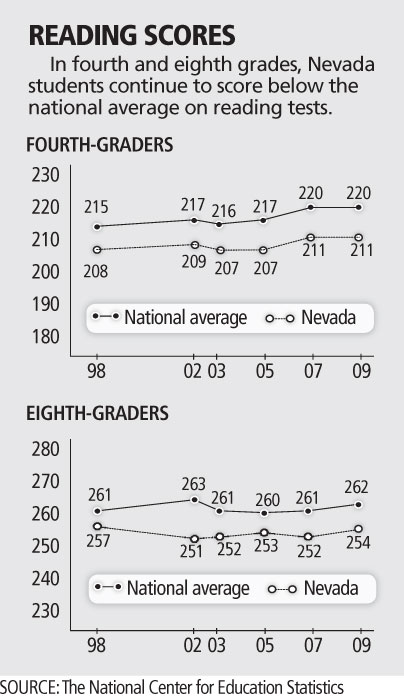




Although Nevada's fourth- and eighth -graders made significant gains on a national math test last year, their progress was stalled on the equivalent test for reading, according to National Assessment for Educational Progress results released Wednesday.
Reading scores were statistically flat between 2007 and 2009, with Nevada's test scores falling below the national averages and lagging behind those in 43 other states and jurisdictions at both grade levels.
"Obviously, staying at the bottom is not acceptable," said Chris Wallace, president of the Nevada Board of Education.
He also said that state efforts to reform public education and increase accountability have him "excited" for the future.
Nevada's NAEP scores are based on a random sampling of roughly 3,200 fourth-graders and 2,900 eighth-graders who took the same test given to their peers across the nation.
NAEP scores are based on a 0 to 500 scale. On the 2009 fourth-grade reading test, Nevada's average score was 211, unchanged from 2007. The national fourth-grade average was 220.
In eighth grade, Nevada's average score was 254, a statistically insignificant improvement from 252 in 2007, according to the NAEP report. The national eighth-grade average was 262.
Like Nevada, the nation's average reading scores remained basically flat.
"We shouldn't be satisfied with these results," said U.S. Secretary of Education Arne Duncan in a statement Wednesday. "By this and many other measures, our students aren't on a path to graduate high school ready to succeed in college and the workplace."
According to Nevada's fourth-grade results, 43 percent of those tested lacked basic reading skills, 33 percent demonstrated basic reading skills, 20 percent were proficient at reading, and 4 percent had advanced reading skills.
In eighth grade, 35 percent of those tested lacked basic reading skills, 43 percent had basic skills, 21 percent were proficient and 1 percent was advanced.
Tor Loring, NAEP coordinator for Nevada, clarified that "proficiency" for NAEP does not mean the same thing as it does in the federal No Child Left Behind school accountability act. Loring said the "basic" rating under NAEP is probably closer to what "proficiency" means under No Child Left Behind.
On the NAEP tests, "proficiency" shows a higher level of skill than simply performing at grade level.
Loring was encouraged by Nevada's NAEP results in math, released last year. The state was one of only five or six jurisdictions to improve in fourth and eighth grades.
"I was disappointed to see we didn't increase dramatically like we did in math," Loring said of the reading test results. "One would assume an increase in one (test) might indicate increased reading ability or cognitive ability. ... It appears to be two unrelated issues."
In Nevada, the reading scores of minority and low-income students lagged behind the scores of white students and more affluent students by as much as 15 to 20 points.
Girls continue to outperform boys in reading, which is "happening across the board" in the United States, Loring said.
"It's something that's reflected in the national results," Loring said. "What exactly is causing that gap? Again, you can't really point to cause and effect. I personally don't believe it's a biological issue. I think there are various contexts that might be related to developmental stages. Maybe boys are more active, maybe boys are more distracted. Maybe girls are being encouraged more.
"You know, who knows?"
Contact reporter James Haug at jhaug@reviewjournal.com or 702-374-7917.