Traffic suited drivers to a T before changes

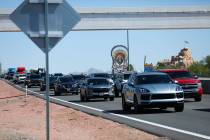
Readers are pleased when certain intersections are designed to keep traffic flowing smoothly, then slightly irritated when they are changed in a way that creates more traffic. Traffic engineers are often aware of the downside of the changes, but can do little about redesigns after statistics show there are a greater number of accidents or if growth in the area demands alterations. Jim starts us off with a perfect example of this:
Jim wants Hi T's: Cheyenne Boulevard eastbound between Interstate 215 and Rampart has a number of "Hi T" intersections that allow the third lane to continue moving while the traffic light at the intersection cycles. These intersections make so much sense it hurts. In the past, there was a "Hi T" for Rampart traffic northbound at Del Webb Boulevard, and, as I recall, one on Valley View northbound at the Meadows Mall. These were removed. Why?
Transportation engineers are also big fans of Hi T's, also known as Turbo T's, because they move traffic more efficiently with fewer stops. These intersections include a single through lane on the right next to two lanes controlled by a traffic signal. But the problem is there are limited locations where they can be placed. According to city of Las Vegas spokeswoman Diana Paul, this design can only be used at T-intersections with no driveways or side streets in close proximity. Apparently, motorists caused accidents when they weaved across the lanes to access driveways or streets.
Good memory, Jim. The Del Webb Hi-T intersection was taken out back in 1999. The reason is that motorists who live in the Sun City Summerlin neighborhood -- the area served by the intersection -- had difficulty negotiating them. The city determined more reaction time was needed to make certain turns. For example, even though Cheyenne Avenue is 2,500 feet away, motorists were getting into accidents trying to move across Rampart to turn onto Cheyenne.
The Hi-T intersection next to the Meadows Mall was taken out in 2002 when preparations were made for the Springs Preserve across Valley View Boulevard. That intersection became four-legged to create a main entrance to the new attraction.
The bottom line is city engineers wish they could be placed on every major thoroughfare, but that is not feasible.
Mark asks: Could you please enlighten me about the project under way on Decatur Boulevard just north of 215? This looks like a major undertaking and is a real mess for traffic heading north on Decatur.
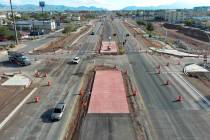
Mark is correct. This is a mess. I got lost on my way to Aliante Golf Club and was further delayed by the orange cones decorating Decatur. The large concrete boxes sitting on the side of the road will soon be installed in the roadway. Those boxes, which are "ginormous," guide floodwaters to basins. This particular project is a $30 million endeavor funded by the city of Las Vegas. The scope of the work is on Decatur between Elkhorn Road and Interstate 215 and on Elkhorn between Decatur and Torrey Pines Drive.
Work began in December and should be finished by summer of next year.
Pat is curious about Sahara Avenue: What is going on with West Sahara Avenue? There are countless orange cones for lane mergers in places where there doesn't seem to be any action at all. At other places it looks like they may be creating pullout bus lanes.
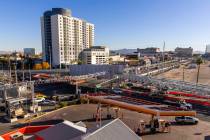
The construction along Sahara Avenue between Hualapai Way to the west and Richfield Street to the east is all part of the Regional Transportation Commission's $34.4 million Sahara express route project. For that stretch, as well as from Paradise Road to Boulder Highway, the transportation agency is using the existing break-down lanes next to the curb as a designated bus lane. Also, from Teddy Drive to Decatur Boulevard, the agency is widening the sidewalks and adding landscaping adjacent to the sidewalks and in the median. It has caused significant congestion as traffic is squeezed down to two lanes in many places.
You might not see them, but crews are working, Pat. According to the RTC, there are two shifts; one from 9 p.m. to 5 a.m. and the other from 6 a.m. to 2:30 p.m. This project is being funded by a federal grant. It is expected to be completed in February.
Here's Pat, part deux: Is it true that those orange cones do not belong to city and county road crews but have to be rented? I've been told that they cost $20 a day. Can that be true? If so, this is scandalous. Please share more about this, too.
It is hard to pin down the exact cost to rent the cones, Pat, because it varies with the subcontracting companies. A lot of construction companies do rent them from the subcontractor, who places them and then removes them. I remember all the construction on Martin Luther King Boulevard and outrage over cones that blocked lanes when the road work was clearly finished. City of Las Vegas officials explained that the subcontractors who place the cones are given the expected finish date of the project. If crews happen to finish early, the cones will remain until the cone-dropping company returns per contract.
If you have a question, tip or tirade, call Adrienne Packer at (702) 387-2904, or send an e-mail to roadwarrior@reviewjournal.com. Include your phone number.
Crews will begin Monday replacing the roadbed underneath the Union Pacific Railroad tracks in the Green Valley area. Each week, one major road will close and the closure will last five days. Here is the rundown:
Monday -- Green Valley Parkway between Warm Springs and Robindale roads.
May 31 -- Valle Verde Drive between Warm Springs and Windmill Lane.
June 6 -- Arroyo Grande Boulevard between American Pacific Drive and Windmill.
June 13 -- Stephanie Street between American Pacific and Wigwam Avenue.
June 20 -- Gibson Road between American Pacific and Wigwam.
Lone Mountain Road will be closed across U.S. Highway 95 between 9 tonight and 5 a.m. Thursday.
Between 9 tonight and 5 a.m. Thursday, the Interstate 215 east ramp to northbound Interstate 15 will be closed.
Through May 26, the ramp from I-15 south to Russell Road will be closed all hours.
Gowan Road between Rainbow Boulevard and Tenaya Way will be closed until September.
Through June 30, northbound Eastern Avenue will be reduced to two lanes from just north of Reno Avenue through the Tropicana Avenue intersection. Eastbound Tropicana will be reduced to two lanes from Burnham Avenue to Topaz Street.
Las Vegas Review-Journal
GASOLINE PRICES
The average price of gasoline in the Las Vegas Valley on Tuesday was $3.82 per gallon; the current national average is $3.91. Here are the Las Vegas Valley's best deals:
Northeast: $3.59, Circle K, North Eastern and East Searles avenues
Northwest: $3.69, Vegas Express, North Decatur Boulevard and Vegas Drive
Southeast: $3.69, ARCO, East Flamingo Road and Mountain Vista Street
Southwest: $3.67, Smarty's, South Durango Road and West Twain Avenue
Source: gasbuddy.com