Pilots for Predators graduate
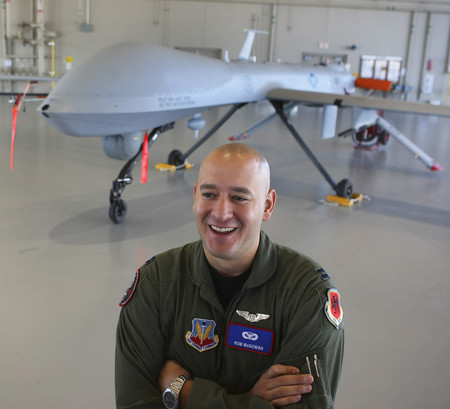




INDIAN SPRINGS -- As a security forces officer in Iraq, Rob McGowan saw firsthand the vital role that remotely piloted Predator spy planes play in fighting the nation's global war on terrorism.
With pilots controlling the MQ-1 Predators alongside sensor operators in ground stations sometimes thousands of miles from the battlefield, he watched them fire missiles to protect troops in combat and use high-tech video cameras to snoop on militants trying to hide or plant roadside bombs.
As one of those troops on the ground, he appreciated what those pilots sitting at computer consoles were doing. He thought it would be an inspiring job to be at the controls, if only he had a chance.
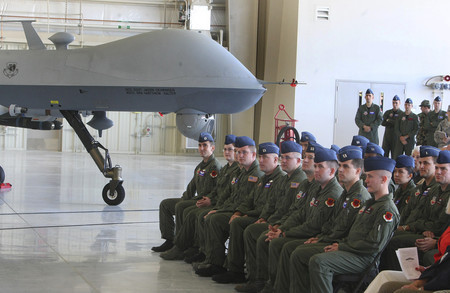
That opportunity came in January and became a reality Friday, when after nine months of intense training, McGowan and seven other Air Force captains received their unmanned aerial system pilot wings from Gen. Norton Schwartz, the Air Force chief of staff.
They were the first class of so-called Beta pilots to earn their wings after switching careers to be selected for a special training program for officers who had never before flown an aircraft from a cockpit but who wanted to be Predator pilots.
"I decided, 'Hey, give it a shot,' " the 29-year-old former Nellis Air Force Base police officer said after the graduation in a hangar at Creech Air Force Base, the nation's hub for Unmanned Aerial Systems training and operations, 45 miles northwest of Las Vegas.
"I had never flown anything," he said. "I had always wanted to fly."
But with vision that requires him to wear contacts or corrective lenses, he realized while growing up in Akron, Ohio, that he would always be passed over to be a pilot of a fighter jet or bomber or other aircraft.
"That's what originally kept me out of the cockpit."
Until this year, all Predator pilots and those at the controls of the Predator's big brother, the MQ-9 Reaper, had experience in the cockpits of other, manned aircraft.
Friday's graduating class included pilots who had been in such past Air Force careers as civil engineering, air battle management, navigation and space-and-missile operations.
"I think they were really looking for a wide spectrum," McGowan said about commanders who selected the class from many applicants.
A 2003 criminal justice graduate from Ohio State University, McGowan wasn't a joystick junkie who played a lot of video games.
Though there are some similarities with those games and being at a console to operate a Predator by remote control, "there's nothing video-game about it."
Instead, he said, the sky and the terrain they patrol are real, as are the targets and the people and troops they're protecting.
Training began with a course in Colorado to fly a small, single-engine airplane so that he and his classmates could experience the seat-of-the-pants feeling in a cockpit.
"You solo on Day 13," he said. "You're pretty nervous before you take off, but once your up, the training kicks in."
That was followed by instrument flight training in Texas that prepared them for four months of intense training at Creech in ground stations with computer consoles equipped like a cockpit with sticks, throttles and rudder pedals.
"We definitely had to succeed," McGowan said. "We felt the pressure the whole way. That was a good motivator."
Col. Trey Turner, chief of operational training at the Pentagon, said the effort "was to develop a course of training for someone off the street to fly an unmanned system."
At the graduation exercise, Schwartz spoke of the "insatiable demand" for remotely piloted combat air patrols to support ground forces in Afghanistan and Iraq.
"You are part of the major Air Force development of the decade," he told the graduates, which included nine sensor operators and two lieutenant undergraduate pilots.
"You are blazing a trail toward the Air Force of the future. ... You will be in the front row of history when the game changes," Schwartz said.
He said the Air Force has "only scratched the surface of what unmanned aerial systems can provide."
"Given these technological leaps forward, it's not hard to imagine a multitude of other missions for our unmanned aircraft including air transport, air refueling, suppressing enemy air defenses, forward air control, combat search and rescue, and more," Schwartz said.
Contact reporter Keith Rogers at krogers@reviewjournal.com or 702-383-0308.
THE GRADUATES
Ten pilots and nine sensor operators graduated from Predator training Friday at Creech
Air Force Base.
The pilots are:
Capt. Jeremy Fortier
Capt. William Freemantle
Capt. Chris Gesch
Capt. Rob McGowan
Capt. Steven Petrizzo
Capt. Jack Rhodes
Capt. Timothy Rott
Capt. Michawn Yuvienco
1st Lt. Steven Kadrich
1st Lt. Nicholas Reeves
THE SENSOR OPERATORS ARE:
Tech. Sgt. Alyson Hathaway
Staff Sgt. Gary Hathaway
Senior Airman Connor Spake
Airman 1st Class Daniel Brinlee
Airman 1st Class Stephen Fason
Airman 1st Class James Shockley
Airman 1st Class Samantha Tobin
Airman Lisa McKnight
Airman Benjamin Zimmer