Political Eye: Senate race endorsements send messages

Political endorsements of candidates are rarely surprises.
Yet they can signal to single-issue voters or community groups that this candidate is OK.
Take last week in the U.S. Senate race.
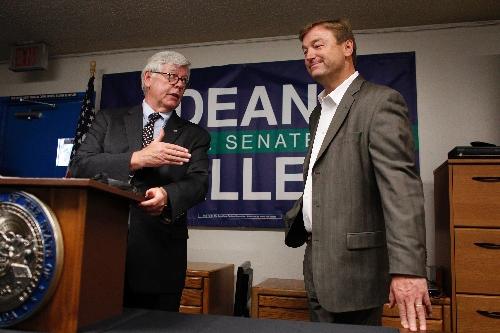
The head of the National Rifle Association came to Las Vegas to announce the NRA endorsement of U.S. Sen. Dean Heller, a Republican who is a strong supporter of the Constitutional right to keep and bear arms.
And, of course, NRA President David Keene and Heller held the event at The Gun Store.
"As a sportsman and a gun owner, I actively oppose any laws that restrict our rights as well as misguided anti-gun legislation," Heller said in a statement after accepting the endorsement. "Protecting the Second Amendment should be a priority of all elected officials, regardless of political affiliation and I welcome this endorsement,"
The NRA gave Heller an "A" in its report card and an "F" to his Democratic opponent, Rep. Shelley Berkley.
Keene said he took the trouble to personally back Heller because the Senate race is so close.
"This election has serious consequences, and gun owners across Nevada can truly make a difference," Keene said in a statement put out by the Heller campaign. "These gun owners have a right to fear that Shelley Berkley's policies will harm Nevadans' Second Amendment rights for generations to come. A victory for Dean Heller is crucial for sportsman and gun owners to enjoy the freedoms promised them."
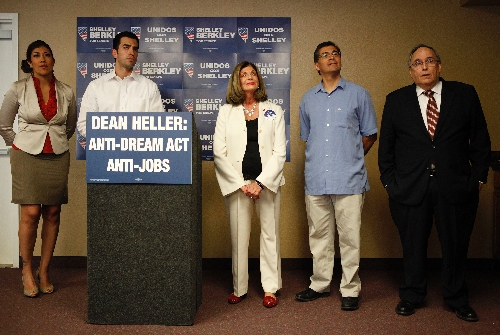
Berkley, meanwhile, touted the endorsements from two Spanish-language newspapers in Las Vegas, including El Mundo, the oldest and largest in Nevada. Both Berkley and Eddie Escobedo Jr., the owner of El Mundo, took shots at Heller on everything from missing some Hispanic meetings to immigration policy.
Berkley said in a statement, "While my opponent continues to turn a blind eye to the Latino community in Nevada by skipping candidate forums, blowing off scheduled meetings, and voting against the DREAM Act while cutting funding for Pell grants and support for small businesses, I'll continue to prioritize Latino families across Nevada by fighting to create good-paying jobs, giving Nevada small businesses the tools to expand and hire, making education affordable and accessible for all, and continuing to press for passage of the DREAM Act."
The DREAM Act would provide a path to U.S. citizenship for young undocumented immigrants whose parents brought them to this country when they were young. Heller opposed the act, saying it's akin to amnesty, although he backs giving citizenship to immigrants who serve in the U.S. military, one of the proposal's provisions.
Escobedo, in a statement put out by the Berkley campaign, managed to hit on all her talking points.
"Shelley will continue standing up for Latino working families by fighting for good-paying jobs, giving small businesses the tools to hire again, protecting Medicare and Social Security, and voting for the DREAM Act," Escobedo said. "Senator Dean Heller's record on Latino issues is atrocious, and he continues to stand with Republicans like Mitt Romney in putting Wall Street millionaires, billionaires, big oil companies, and corporations that ship our jobs overseas first, and Latino working families last."
The other Berkley endorsement came from La Prensa Latina, another Spanish-language newspaper in Nevada.
Messages sent, messages received.
GETTING INACTIVE VOTERS ACTIVE
Last week, President Barack Obama's campaign was touting its huge Democratic voter registration advantage over the Republican Party in Nevada, but also was using the most optimistic number to make its case.
Obama's team is counting "active" and "inactive" voters on the rolls, giving the Democrats an overall advantage of more than 124,000 as of the middle of last week. Remove the inactive voters and the statewide advantage over the GOP falls to about 85,000, although it's likely to tick up before the close of registration Tuesday .
Why use the more optimistic figure? Partly to show the Democratic Party strength that will make it far easier for Obama to win Nevada against his Republican challenger Mitt Romney. But the campaign also wanted to encourage voters and Obama supporters after his first dismal debate performance against Romney that helped the former Massachusetts governor move up in the opinion polls, including in Nevada.
A poll conducted for the Las Vegas Review-Journal after the Oct. 3 debate showed Obama hanging onto a narrow lead of 47-46 over Romney in a battleground state that is considered the president's to lose. Obama and Romney debate a second time Tuesday and a third and final time on Oct. 22.
Inactive voters do vote, and they could make the difference in a close race, according to Larry Lomax, the registrar of voters for Clark County, where 70 percent of Nevada's population lives.
In a presidential election year, Lomax said from 7 percent to 9 percent of the general electorate are inactive voters while total turnout is about 80 percent of registered voters. That's nothing to sneeze at. Only about 1 percent of the primary electorate are inactive voters, he said, but those are usually low turnout affairs overall.
So what is an inactive voter?
Lomax said a person is placed on inactive status after the Clark County Election Department receives information that the person appears to have moved and not updated the address at which they are registered. Also, a person is considered inactive if election officials send the person a postcard with an attached postage paid return card asking the person to update their address and the person does not return the card within 30 days.
"After a person is placed on inactive status, they cannot be canceled until they fail to vote in two consecutive federal elections (or any other elections conducted during that time period) after they were placed on inactive status," Lomax said.
Jeremy Bird, national field director for the Obama campaign, said in an interview that whether you're an active voter or an inactive voter, he is confident the president's team of volunteers will find you.
"The key there is they can vote," Bird said. "Our strategy is to build our neighborhood team so that each of our teams knows who the voters are. They go to their houses, send them text messages. Fortunately, in a place like Nevada, we have several days of election days and we can get them."
Early voting begins Saturday and lasts for two weeks before the Nov. 6 election.
Contact Laura Myers at lmyers@reviewjournal.com or 702-387-2919. Follow @lmyerslvrj on Twitter.
Political Eye Blog