Reid, Boehner debt plans both lack votes to pass

WASHINGTON -- The government barreled closer to crisis Tuesday as House Speaker John Boehner and Senate Majority Leader Harry Reid scrambled to build support for rival plans to control the national debt, but both appeared doomed without significant bipartisan modifications.
House Republicans delayed a vote on Boehner's bill, which had been set for today, after congressional budget analysts dealt the legislation a potentially devastating setback by saying it would save far less over the next decade than the $1.2 trillion advertised. The Congressional Budget Office projected that the spending cuts would save only about $850 billion over that period.
The news from the CBO alarmed conservatives, who were already balking at what they considered timid spending reductions. It also meant Boehner's bill would not meet his own demand that the cuts exceed the size of the $900 billion debt-limit increase.
House Republicans were racing Tuesday night to rewrite portions of the measure to bring the numbers into line. The vote could now come Thursday.
As Boehner, R-Ohio, pressed toward a cliffhanger vote in the House, President Barack Obama signaled that he would veto the measure because it would force another battle over the debt limit early next year. Meanwhile, Reid, D-Nev., pronounced the proposal "dead on arrival" in the Senate, where Democrats were struggling to rally votes for their own plan to raise the debt limit by $2.7 trillion -- enough additional borrowing authority to cover the nation's bills into 2013.
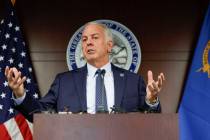
Reid went on the offensive Tuesday against the GOP plan. "Speaker Boehner's plan is not a compromise," he said. "It was written for the tea party, not for the American people. Democrats will not vote for it. Democrats will not vote for it. Democrats will not vote for it. It is dead on arrival in the Senate -- if they get it out of the House."
Reid cited a report that his own proposal would satisfy bond rating agencies and avert a downgrade of U.S. debt while the Boehner plan would not.
In a Senate speech, Reid moved to address criticism of the bill he introduced Monday to allow an additional $2.4 trillion in continued government borrowing, accompanied by $2.7 trillion in spending cuts and other savings.
Republicans attempted to characterize some of the savings in Reid's initiative as largely illusory. Sen. Mitch McConnell, R-Ky., said Tuesday it was "nothing more than another attempt to pull the wool over the eyes of the American people."
Obama endorsed Reid's bill in his nationally televised speech on Monday night, but Boehner, said in his televised rebuttal it was "filled with phony accounting and Washington gimmicks."
"Every bit of our proposal was taken from the Republican playbook," Reid responded Tuesday. "It is everything that Republicans have demanded wrapped up in a bow and delivered to their door."
The legislative maneuvering played out against a backdrop of public outrage, as the Capitol switchboard became jammed and visitors swamped congressional websites, possibly heeding a call Obama made Monday in a prime-time address for Americans to contact their representatives in Congress.
At the height of the deluge, the Capitol was receiving 40,000 calls per hour -- twice as many as normal. Some people encouraged lawmakers to stand firm, others demanded a resolution to the weeks-long stalemate that threatens to undermine the sputtering U.S. recovery and damage the nation's global standing. Still others were simply worried that the impasse could prevent their Social Security checks from arriving on time.
Kate Cyrul, a spokeswoman for Sen. Tom Harkin, said the Iowa Democrat's office had received more than 700 emails and letters overnight, the majority of which "expressed frustration with the debt process and said that we should reach a compromise."
The national debt already has hit the $14.3 trillion legal limit. Unless Congress acts by next Tuesday, Treasury officials say they could start running short of cash for federal health care and retirement benefits, military salaries and payments due investors, potentially throwing the U.S. government into default for the first time.
Even if a default is avoided, credit-rating companies are threatening to downgrade the nation's AAA rating, a move that could drive up interest rates for governments at all levels and for ordinary Americans.
While Boehner faces major challenges in getting the House to approve his proposal, Reid was faring no better in the Senate. Democratic aides acknowledged that the Senate bill is unlikely to pass without Republican support. That backing was not forthcoming Tuesday.
With less than a week left to strike a deal, Reid was engaged in talks with Boehner and McConnell about a potential compromise. But they remained divided over the size of a debt-ceiling increase and the mission of a new debt-reduction committee that would be created under both measures.
Late Tuesday, the trio was still searching for a way to ensure that Congress adopts a far-reaching strategy in the coming months for reducing the national debt or to guarantee that lawmakers would raise the debt limit a second time without such a plan.
"We're going to have to get back together and get a solution," McConnell told reporters. "I'm prepared to accept something less than perfect because perfect is not achievable. ... We're trying to get a result here."
One option under discussion was reviving parts of a plan the Senate's so-called Gang of Six announced last week that has won support in both parties. Negotiators discussed creating a new mechanism for moving a plan forward if a debt-reduction committee, which would be composed of 12 lawmakers appointed by party leaders, were unable to reach agreement. In that case, a bipartisan group of 10 senators -- five from each party -- could bring its own plan before the Senate without fear of amendment or filibuster.
"We need to do whatever we can do to reassure capital markets and make sure we don't have a downgrade to our debt. And part of that is going to be creating a path forward to give the markets confidence that we are going to act comprehensively on our debt and our deficit," said Sen. Michael Bennet, D-Colo., a Gang of Six supporter, who huddled with more than a dozen Senate Democrats in search of a solution.
If Boehner's bill doesn't clear the House, Reid's talks with McConnell about how to build GOP backing for the Senate measure would take on even greater urgency.
Even before the CBO analysis, Boehner was struggling to find support among conservatives, who say the measure would do too little to control government spending. Two key conservative groups, the pro-business Club for Growth and Heritage Action came out against plan, as did more than a dozen House Republicans.
Many more said they were leaning against it. The cost estimate could only hurt, they said, in part by providing an eerie echo of the disappointing CBO report that earlier this year revealed that a government funding bill would save much less than expected -- nearly killing a plan to avert a government shutdown.
In a sense, House Republicans were undone by their own success. The CBO said Boehner's bill would save $1.1 trillion over the next decade compared with the budget as it stood in January, before Congress battled over sharp reductions to 2011 spending on domestic agencies.
Boehner won that fight, cutting nearly $250 billion from projected spending over the next decade, the CBO said. But that forced the agency to draw up new budget projections in March. Measured against the new figures, Boehner's debt-limit bill would save only $850 billion more through 2021, the CBO said.
Democrats said they were stunned that Boehner seemed unprepared for the news. "They should have known this was coming for months," one party aide said.
Stephens Washington Bureau Chief Steve Tetreault contributed to this report. He can be contacted at tetreault@stephensmedia.com or 202-783-1760. Follow him on Twitter @DadTetreault.
PDF of Reid debt amendment