Study details scope of rail project needed for Yucca
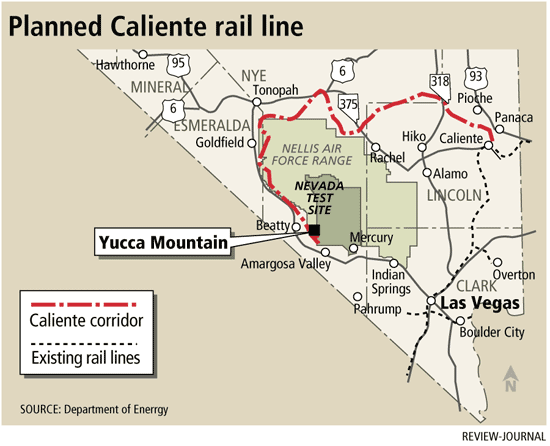




An average of 17 trains would chug across rural Nevada each week for 50 years carrying nuclear waste, construction materials and scraps to and from the Yucca Mountain repository being developed by the U.S. Department of Energy.
During a railroad construction period that could take anywhere from four to 10 years, as many as a dozen construction camps 30 miles apart would be set up for workers in the Nevada outback.
The crews, drawn largely from Clark County and some from Nye County, would build up to 240 bridges, 138 large culverts and up to five highway crossings along the line running from Caliente and heading west and then south to the repository.
At locations along the roughly 330-mile route, a total of 176 wells would be drilled to provide water for the effort. Coarse rock needed for rail bed ballast would be excavated from four new quarries.
Some details of what the largest U.S. railroad construction project in 80 years might look like emerged from an environmental impact study the department released late Thursday.
The rail study, and an associated report on the potential impacts of how nuclear waste containers would be handled once they arrive at the Yucca site, are steps forward in the DOE's campaign to establish a repository 100 miles northwest of Las Vegas.
Information within the 1,263 pages of the repository report will be incorporated into a construction license application that department officials said they plan to file with the Nuclear Regulatory Commission in June.
The environmental impact statement analyzing the so-called Caliente railroad corridor totals 2,544 pages, including discussions of alternative routes through Nevada that were studied and rejected.
For the first time, DOE indicated it would be wiling to share the railroad with commercial shippers for general freight, a decision that had been sought by Nevada farmers.
Rail cars carrying commercial freight would not be included on nuclear waste trips but could share a ride with cars carrying repository construction material, water and fuel, the department said.
The DOE announced a series of hearings in Nevada and California for November and December for the public to comment.
The reports, available at www.ocrwm.doe.gov, were issued without fanfare.
"The documents speak for themselves," DOE spokesman Allen Benson said.
The release of the voluminous materials triggered officials for the state of Nevada, as well as environmental advocates and industry officials, to begin their own analysis on Friday.
"We and other parties are going to have to take the time to look at it," said Bob Loux, director of the Nevada Agency for Nuclear Projects.
Robert Halstead, a transportation consultant for the state, said at first glance he identified a half dozen issues that Nevada probably will challenge, including a mention that more nuclear waste might travel through the state on truck.
He said he is concerned that DOE officials think "they can ram this Caliente rail route through. I know for sure we're going to fight them to the mat on the Caliente route," Halstead said late Friday.
While most radioactive material would travel by rail under DOE's plan, some 9,600 rail casks, the number of truck shipments was increased from 1,110 to 2,700 in the new report.
DOE said it assumes that trucks will be needed to haul waste from the 22 to 26 reactors that don't have rail access. Previously it was assumed rail spurs would be built.
"We need to know what they mean when they say that," Halstead said.
The consultant also said the state might question DOE on "regions of influence," the land surrounding the rail line that might be disrupted by construction and operations. Halstead said the department's quarter mile wide areas might be too narrow in some valleys.
Special canisters for transporting, aging and disposing waste would be loaded with spent nuclear fuel assemblies at reactor sites and sealed after arriving at an above-ground receipt facility. From there, canisters would be put in aging casks and moved to concrete pads.
Once the thermal heat output "decayed to an acceptable level" the canisters would be repackaged and hauled to a 41-mile maze of tunnels for entombment, according to a summary of the documents.
Surface facilities would be constructed in phases. That means "for several years, radiological operations would be occurring while construction" is ongoing, the summary reads.
Waste transfer operations would be conducted "using mostly remotely operated equipment.
Thick, reinforced concrete shield walls, shielded canister transfer and controlled access techniques would protect workers from radiation exposure," project planners wrote.
They estimated that about 80 percent of the doses to workers would occur during operations "principally from surface handling of spent nuclear fuel and subsurface monitoring and maintenance activities."
State consultants have said the aging pads and surface facilities make for an interim storage site that is not allowed in the same state hosting the repository.
Changes would have to be made to the Nuclear Waste Policy Act to address the surface facilities issue as well as DOE's draft plans for doubling the repository's capacity to hold 135,000 metric tons of spent fuel and other highly radioactive waste.
"This requires congressional approval, which I don't think they can get," Halstead said.
Other issues that need to be resolved, according to DOE officials, include the need for Congress to withdraw land from public access for the repository, surface facilities and a buffer zone.
In addition the Environmental Protection Agency and the Nuclear Regulatory Commission must finalize their two-tiered radiation safety standards for covering both a 10,000-year period for the repository and a 1 million-year period during which peak doses would occur.
"Water use and water development projects will continue to be a major concern in the region of influence regardless of the water demands associated with the proposed repository or railroad," the summary notes.
"Growth in water demand in Nevada has been very rapid: water use against the backdrop of regional water transfer plans remains an over-arching controversial issue."
Contact Stephens Washington Bureau Chief Steve Tetreault at stetreault@ stephensmedia.com or (202) 783-1760. Contact reporter Keith Rogers at krogers@reviewjournal.com or (702) 383-0308.
More about Yucca Mountain
HAVE YOUR SAY
The Department of Energy has scheduled eight public hearings to field comments on two draft documents related to rail corridors and the planned Yucca Mountain nuclear waste repository.
Hearings will be:
• Nov. 13 in Hawthorne at the convention center, 932 E St., from 4 p.m. to 7 p.m.
• Nov. 15 in Caliente at the youth center on U.S. 93, from 5:30 p.m. to 8 p.m.
• Nov. 19 in the Reno-Sparks area at the convention center, 4590 S. Virginia St., from 4 p.m. to 7 p.m.
• Nov. 26 in Amargosa Valley at the Longstreet Inn and Casino off Route 373, from 4 p.m. to 7 p.m.
• Nov. 27 in Goldfield at the school gym, Hall and Euclid streets, from 4 p.m. to 7 p.m.
• Nov. 29 in Lone Pine, Calif., at Statham Hall, 138 N. Jackson St., from 4 p.m. to 7 p.m.
• Dec. 3 in Las Vegas at the Cashman Center, 850 Las Vegas Blvd., from 4 p.m. to 7 p.m.
• Dec. 5 in Washington, D.C., at the Marriott at Metro Center, 775 12th St. N.W., from 2 p.m. to 5 p.m.
Written comments should be sent to the EIS Office, U.S. Department of Energy, Office of Civilian Radioactive Waste Management, 1551 Hillshire Drive, Las Vegas, NV 89134.
Written comments can also be submitted by fax, 1-800-967-0739, or by accessing www.ocrwm.doe.gov.