Talk heats up over taxing miles driven
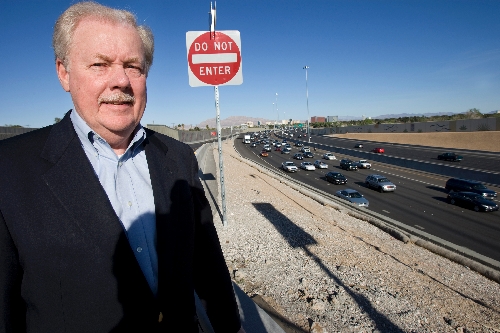





CARSON CITY -- The chairman of the state Senate committee that oversees Nevada highways said it is essential that the state tax motorists for the miles they drive.
"We really have a problem," said Sen. Mike Schneider, D-Las Vegas, noting that motorists are getting more miles per gallon on their vehicles because of improved fuel efficiency.
He predicted that within 15 years a substantial number of people will be driving electric or hybrid cars that use little or no gasoline. Unless Nevada has a new way of funding highway construction, he said the roads they use will wear out.
"We need more roads and a new mechanism for funding them," Schneider said.
Charging motorists for every mile traveled would be a departure from what is done now: People pay a per gallon tax when they put fuel into their cars and trucks. That rate is about 53 cents a gallon.
Hurdles to assessing a mileage tax are figuring out how many miles each vehicle travels, getting that information to tax collectors, and finding the best way to assess a tax.
Suggestions include creating a device that stays with the vehicle and transmits the information, and assessing the tax each year when vehicle owners get mandatory smog checks.
Proponents say they don't know what the tax per mile would be, but it could amount to about 9 cents. They said that under such a tax, motorists would end up paying more taxes for roads than they do now.
Schneider's counterpart in the Assembly, Transportation Chairman Kelvin Atkinson, D-North Las Vegas, isn't as enthusiastic about switching to a miles traveled tax, but he also figures that a new way must be developed to fund highway construction.
"It needs to be vetted next (legislative) session," Atkinson said. "You can't have electric cars not paying anything. Right now, I am about 50-50 (toward changing to a mileage tax). You can see it would be a heated debate."
Schneider said he wants the Legislature next year to look at the Nevada Department of Transportation's ongoing Vehicle Miles Traveled study. The agency held a public forum to mixed results March 30 in Reno and intends to hold another one April 29 at the Clark County Government Center.
At the Reno meeting, Deputy Transportation Director Scott Rawlins said Nevada will be between $4.5 billion and $6 billion short of the amount of money it needs to cover highway construction costs over the next six years.
Rawlins said the Transportation Department must find a way to raise more in highway taxes than it does under the current fuel tax.
Many drivers would pay more with a mileage tax than they do today with fuel taxes to achieve that goal.
The Transportation Department now receives about $1 billion a year in revenue from federal and state fuel taxes. Based on Rawlins' comments, the agency would need twice as much revenue to keep up with construction needs.
Motorists drive about 22 billion miles a year on all roads in the state, according to the agency's facts booklet. That is more than double the 9 billion miles traveled in 1990.
To come up with $2 billion a year in revenue, a tax of 9 cents per mile would have to be charged based on those figures.
Scott Magruder, the Transportation Department spokesman, warns against trying to figure what tax would be charged since the agency doesn't even know yet whether it will propose switching to a mileage tax.
The department has just begun a $260,000 study into whether a mileage tax system would be a better way of funding construction. The study is not likely to be finished before 2013 or 2014.
Although the Clark County Regional Transportation Commission has backed down from contributing anything toward the study, Magruder said the study will go forward.
"It is just a study now, but we know more fuel-efficient cars are coming," Magruder said. "We have to find a way to pay for our roads and do away with our fuel tax."
He acknowledged there are many unanswered questions, including how to tax trucks and visitors who drive in Nevada without refueling.
President Barack Obama recently announced rules to require the auto industry to produce vehicles that average 34.1 miles per gallon by 2016. That is about 10 miles per gallon more than the current average. In addition, starting in 2012 automakers must improve fleet gasoline mileage by about 5 percent per year.
However, Obama in 2009 rejected implementing a federal mileage tax, even though a federal commission backed the concept.
Nevada now charges about 53 cents per gallon in state, local and federal fuel taxes, but that rate has not been increased since 1992.
Since that time, according to the Nevada Department of Transportation, what can be bought with that tax has dropped by 52 percent because of inflation and better gasoline mileage.
Among those critical of the mileage tax proposal is the American Civil Liberties Union, which has questioned whether motorists' privacy rights would be jeopardized if the state tried to collect mileage taxes off Global Positioning System transponders. With such devices, the government conceivably could track where people were driving.
Both Schneider and Atkinson said privacy rights must be protected by whatever mileage calculation device is used.
"That's something we have to figure out," Schneider said.
He said his wife just purchased a car that gets twice the mileage of her old car.
Also, the Nissan Leaf and Chevrolet Volt electric cars will go on the market this fall. The Leaf can get 100 miles on a single charge.
Schneider predicted that the world of the future will be without gas stations but with places where motorists can get quick charges for their electric cars.
Magruder said there has been no decision on the device that the Transportation Department will recommend to keep track of miles driven by cars and trucks.
But he said there is general agreement that the state could not require drivers to pay their mileage taxes once a year when they get an annual smog check and the odometer is checked. Such a step could force a driver to pay $500 or more at one time.
Schneider said Oregon studied a device that could be connected to the odometer that would charge the mileage tax each time the car was filled with gasoline, but such a device would be useless once people switch to electric cars.
Contact Capital Bureau Chief Ed Vogel at evogel@reviewjournal.com or 775-687-3901.