Trail system touted
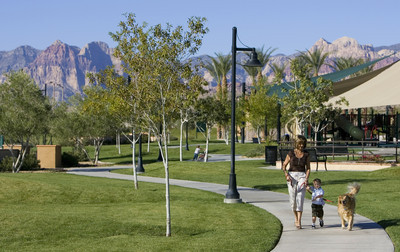



Like the rest of America, it's time for Southern Nevadans to get off their duffs and hike, walk or bike on the trails around the Las Vegas Valley.
It would be healthful, educational, safe and long-lasting if the system that planners from state, federal and local agencies envisioned Thursday becomes reality.
That was the essence of the daylong, first-ever Open Space and Trails Summit at Springs Preserve sponsored by the Outside Las Vegas Foundation and a host of entities.
At the end of the day, 14 elected officials signed a document of intent to get off their own duffs and work together to make it happen, or as local Bureau of Land Management Field Manager Juan Palma told the 200 attendees: "Do it."
"We've got to lengthen our stride much more in the next few years. We have to start running to implement and implement faster and sooner," he said.
A priority, he said after the summit, will be to use $2 million in grant money to analyze how to separate vehicle traffic from bicyclists who use Route 159 to ride to Red Rock Canyon. The project, with help from the private sector, will be in planning for a year followed by construction over the next 36 months.
As backers of the foundation's proposed Southern Nevada Trails Forever Initiative, summit participants will explore how best to use funds from the sale of public lands to preserve and enhance the nature experience on the valley's dwindling open space with an integrated trail system that's been batted about for years.
Palma said more than $1 billion has been allocated through public land sales in Southern Nevada with $400 million going for parks; $319 million for trails; $122 million for natural areas; and $191 million for acquisitions to complement preservation of open space in and around the Las Vegas Valley. Of that, only 20 percent of the total has been spent.
Alan O'Neill, executive director of The Outside Las Vegas Foundation said he doesn't know precisely what shape the initiative will take but it will rely in part on the nonprofit private sector "to help marshal citizen involvement."
The idea is to mesh existing and anticipated trails and greenways financed by developers with those planned regionally on public lands.
A prime example would be to connect recreational paths developed by the Howard Hughes Corp. in Summerlin with Red Rock Canyon National Conservation Area. Early planning for the link is under way, said Tom Warden, Howard Hughes Corp. vice president.
"It's going to happen a long way off. It could be more than a decade before we get there," he said. "We should use the (Las Vegas) Beltway as a conduit for a regional trail system at large. Our piece of it could be a model. One of the challenges is going to be, 'How do you maintain it in the future?' "
O'Neill said an integrated trail system will be an incentive in the future for parents and students to be less dependent on vehicles that burn fossil fuels and emit greenhouse gases. At the same time it will provide the public an opportunity to exercise.
In 1969, roughly half of all students walked or rode bicycles to school. Today, fewer than 15 percent of all school trips are made by walking or biking, according to the summit's newsletter.
"We have all the tools in place to build a world-class system," O'Neill said during a break in the summit. Trail planners and officials from Portland, Ore., Denver, San Francisco and its East Bay Area offered insights on how they've tackled the challenge.
Keynote speaker Charles Jordan, board chairman of The Conservation Fund in Portland, warned that it will take 15 years just to "lay a good, solid foundation" for a trail system built for and maintained by the grandchildren of today's parents.
The first black person to be elected chairman of the board of a premiere conservation organization, Jordan, 70, said today's youth are at risk of going down a stream of crime and violence that puts them in harm's way.
"We're way off on the timetable," he said, noting that urban trail systems nationwide must be accessible to all, including "100 million people of color."
"How can we win the conservation movement and leave that many people out?" he asked. "If we can get our kids out into the woods, the woods will take care of them. We've got to give them something to live for."
Assistant Secretary of the Interior Lyle Laverty said in a luncheon address that the nation is losing four acres of open space each minute.
"Development is outpacing us," he said. "The challenge for all of us is how do you find a balance to maintaining growth with quality of life? ... What do you want Las Vegas to look like when the population doubles, and what kind of legacy do you want to leave your grandchildren?"