



Truth may be stranger, but fiction can offer some persuasive arguments

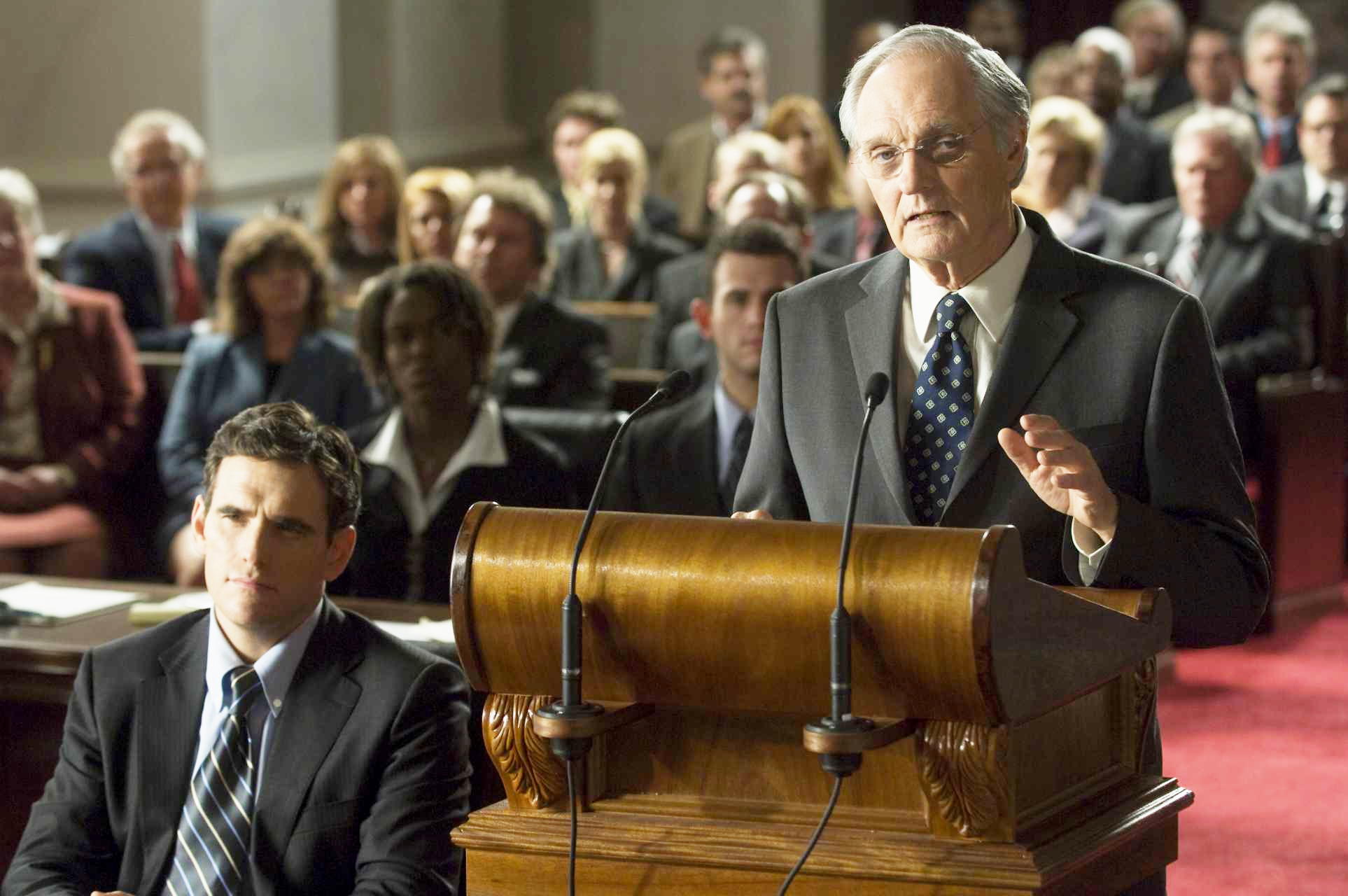
- Alan Alda addresses Supreme Court in movie 'Nothing But the Truth'

Oyez, oyez, oyez.
The court of public opinion is in session. The matter before you is whether this country needs a federal shield law to prevent prosecutors and judges from locking up journalists who refuse to reveal their sources.
In evidence, I present writer/director Rod Lurie’s film “Nothing But the Truth,” a thinly veiled fictionalization that explores some of the issues that arose in the case against New York Times reporter Judith Miller, who spent 85 days in jail for refusing to reveal her sources for a story she never wrote. Miller’s incarceration was part of the investigation into who leaked that Valerie Plame worked for the CIA.
Lurie uses that conflict to build his story and tell how the people involved are affected. Frankly, one could come away from the movie either supporting or opposing a shield law, depending on where your sympathies lie.
But if you take nothing else away from the movie, it should be the speech before the U.S. Supreme Court by Alan Alda, who portrays a newspaper reporter’s high-power attorney.
Here is that speech:
“In 1972 in Branzburg v. Hayes this court ruled against the right of reporters to withhold the names of their sources before a grand jury, and it gave the power to the government to imprison those reporters who did. It was a 5-4 decision. Close.
"In his dissent in Branzburg, Justice Stewart said, ‘As the years pass the power of government becomes more and more pervasive. … Those in power,’ he said, ‘whatever their politics, want only to perpetuate it. … (and) the people are the victims.’”
"Well, the years have passed, and that power is pervasive. Ms. Armstrong could’ve buckled to the demands of the government. She could’ve abandoned her promise of confidentiality. She could’ve simply gone home to her family, but to do so would mean that no source would ever speak to her again, and no source would ever speak to her newspaper again. And then tomorrow when we lock up journalists from other newspapers, we’ll make those publications irrelevant as well. And thus we’ll make the First Amendment irrelevant.
“And then how will we know if a president has covered up crimes or if an army officer has condoned torture.
“We as a nation will no longer be able to hold those in power accountable to those whom they have power over. And what then is the nature of government, when it has no fear of accountability?
“We should shudder at the thought.
“Imprisoning journalists, that’s for other countries. That’s for countries who fear their citizens, not countries that cherish and protect them.
“Sometime ago I began to feel the personal human pressure on Rachel Armstrong, and I told her that I was there to represent her and not a principle. And it was not until I met her that I realized that with great people there is no difference between principle and the person.”
Yes, Branzburg is a real case and the quotes from Justice Potter Stewart are real.
Here is a brief portion Justice Stewart’s 1972 dissent:
“The record in this case is replete with weighty affidavits from responsible newsmen, telling how important is the sanctity of their sources of information. When we deny newsmen that protection, we deprive the people of the information needed to run the affairs of the Nation in an intelligent way.
“Madison said:
‘A popular Government, without popular information, or the means of acquiring it, is but a Prologue to a Farce or a Tragedy; or, perhaps both. Knowledge will forever govern ignorance: And a people who mean to be their own Governors, must arm themselves with the power which knowledge gives.’
“Today's decision is more than a clog upon news gathering. It is a signal to publishers and editors that they should exercise caution in how they use whatever information they can obtain. Without immunity they may be summoned to account for their criticism. Entrenched officers have been quick to crash their powers down upon unfriendly commentators.
“The intrusion of government into this domain is symptomatic of the disease of this society. As the years pass the power of government becomes more and more pervasive. It is a power to suffocate both people and causes. Those in power, whatever their politics, want only to perpetuate it. Now that the fences of the law and the tradition that has protected the press are broken down, the people are the victims. The First Amendment, as I read it, was designed precisely to prevent that tragedy.”
By the way, the ending of Lurie’s film has an interesting twist that can give one an entirely different perspective on all that had previously transpired.
Simply reading Lurie’s scripted court speech is informative, but Alda’s performance added to the impact. So here is a portion of the audio:


