U.S. regulators take over First National Bank
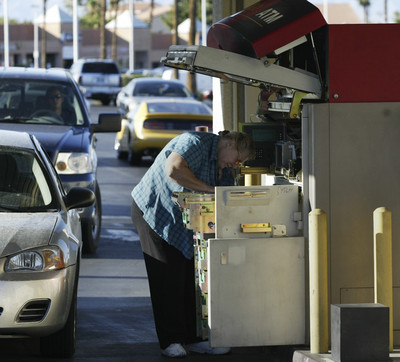



It looked like business as usual when a woman with a child walked up to the front door of the First National Bank branch at 4950 W. Flamingo Road about 5 p.m. Friday.
The door was already locked, and she walked away having come about a minute too late, probably unaware that First National had closed for good.
The bank's five Las Vegas branches, however, will open Monday under a new banner: Mutual of Omaha Bank.
The Omaha, Neb.-based insurance company is buying First National Bank of Nevada, which was placed under federal receivership late Friday, the first Nevada-based bank to be seized in 18 years.
Mutual of Omaha will assume the $3 billion in deposits at First National and an affiliated institution, First Heritage Bank of Newport Beach, Calif., Federal Deposit Insurance Corp. officials announced Friday evening. Mutual of Omaha also will acquire some of the banks' assets in the deal.
The sale means that all of First National's depositors -- even those with uninsured deposits exceeding the FDIC's $100,000 limit -- will avoid any losses.
Customers will be able to access their checking accounts, debit cards and automated teller machines this weekend and will be able to withdraw money from tellers on Monday. Yet customers need not do so, said David Barr, a spokesman for the Federal Deposit Insurance Corp.
"Their deposits will continue to remain insured by the FDIC," Barr said. "There really is no need for customers to do anything. They should look at it as business as usual and as just a change of ownership."
Jim Nolan, a spokesman for Mutual of Omaha Bank, agreed.
"We think it's a good news story for the depositors of the bank. Not a penny will be lost," he said.
Mutual of Omaha, a 99-year-old member-owned insurance company, entered the banking business in January 2007. It had $800 million in assets and branches in Nebraska and Colorado only, prior to acquiring First National.
The company wants to expand its banking operations into areas with high growth, particularly those where it has strong name recognition and many insurance clients, Nolan said.
Nevada, Arizona and Southern California fit that description, he said. The bank will serve both consumers and business customers.
Some analysts had expressed fears that numerous homeowner associations with more than $100,000 on deposit at First National, would lose money with the shut down. The bank holding company provided services to homeowner associations around the country and counted on homeowner associations for $1.2 billion of its $3 billion in deposits.
Local banking officials Friday evening welcomed the way FDIC officials handled the First National shutdown and sale.
Because all deposits are being assumed by Mutual of Omaha, "there is no financial destruction to the local community, and we are very lucky the FDIC approached it that way," said Bill Martin, CEO of Service1st Bank and a former federal bank regulator.
The Nevada Financial Institutions Division made the first announcement of First National's closing Friday night, but federal regulators bore full responsibility for oversight at the bank because of its national charter. The FDIC said the closing will cost the government's insurance fund $862 million.
First National Bank is the fifth bank and the biggest bank to fail in Nevada since the Great Depression. Frontier Savings, which had $247 million in deposits, was seized in 1990. The other failures were Great West Bank and Mineral Bank, both of Las Vegas, and Sierra Savings & Loan of Gardnerville.
Ray Lamb owned First National, which was known as Laughlin National Bank in 1998 when he acquired it. The bank is not related to another First National Bank in Nevada that operated here several years earlier.
First National's closure is the seventh FDIC-insured bank to have been shut down this year. The most recent and largest closure occurred earlier this month when the FDIC seized IndyMac Bank of California.
First National often took a nontraditional approach to banking. For a while, it operated branches in Wal-Mart stores. Now, it has 25 branches around Nevada and Arizona, and none is located in the discount stores.
The bank was active in making home mortgage loans, ranging from subprime to prime, during the housing boom of the early 2000s. It also made construction and land loans. Bankers described those as high-risk niches, which produced big profits that turned to losses with the Southern Nevada real estate bust.
At the end of March, First National Bank reported 11 percent of its loans were past due. The bank reported a $140 million first-quarter loss. The bank had been trying to raise $200 million in additional capital, but reported that was difficult to do.
The Office of the Comptroller of the Currency, which regulates national banks, said that First National was undercapitalized and had dissipated its assets "due to unsafe and unsound practices."
"In reality, most financial institutions (in Nevada) are pretty sound," said Robert Sarver, chairman and CEO of Western Alliance Bancorporation, which operates Bank of Nevada.
Western Alliance was an unsuccessful bidder for First National, but Sarver said he hopes to buy other struggling banks with FDIC assistance.
Contact reporter John G. Edwards at jedwards@reviewjournal.com or 702-383-0420.