Unsolved crimes project begins with first exhumation




By most definitions, the case was closed a long time ago.
It was March 1997. A homeless Las Vegas man was beaten to death and dumped in the desert.
Thomas Woodward, then in his 20s, was arrested, pleaded guilty to voluntary manslaughter and was sentenced to a maximum of 10 years in prison.
Woodward served his time. He was released. The justice system had run its course.
In comparison with other murder investigations in Las Vegas, this one was not high profile. No one really knew the victim, detectives discovered. He was suspected of being an illegal immigrant without relatives in Nevada.
But one question was left unanswered. The question brought county officials and Las Vegas police officers into a huddle around an unmarked grave just after sunrise Wednesday: Who was this man?
The exhumation at Davis Funeral Home was the first in a long-term Clark County forensic science project to exhume as many as 50 unidentified people who were buried by the county.
That laborious task was made possible by a $400,000 U.S. Department of Justice grant the county coroner's office received in October. The money will be used to pay the $4,000 to $6,000 cost of each exhumation, depending on location and difficulty.
Because there are about 160 bodies with no identities in the county, those mysteries most likely to be solved using DNA analysis will be chosen first, Coroner Mike Murphy said.
"We'll go as far as the grant money will take us," he said.
Wednesday's case jumped to the front for several reasons, he said.
Because of information received after the man was buried, investigators think they know his name, Antonio Marino, between 35 and 40 years old, possibly from El Salvador.
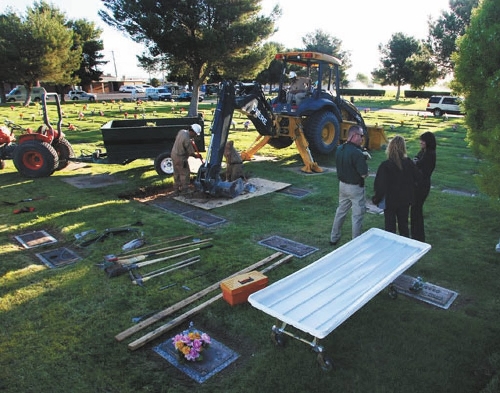
Murphy and dozens of others watched as funeral home workers dug through the dirt, first with machinery and then with shovels. The workers removed the body of another person before reaching their target, who was stacked just beneath.
The cheap cardboard coffins in which the bodies were buried already had deteriorated . The first body, which was not part of the investigation, was reburied in a new cardboard coffin after the exhumation.
The second body, the one the county was after, was placed in a white bag and into the back of a van, which took it to the coroner's office.
After the body is re-examined by medical examiners, a DNA sample will be taken by an outside laboratory, privately contracted to avoid interfering with active cases. DNA, which was not extracted from the victim for various reasons in 1997, probably will be taken from a "long bone" in the leg, likely the femur, Murphy said.
Dental X-rays and additional photographs will be taken.
Any viable samples will be plugged into the FBI's nationwide data system, which could identify the man.
If the data search doesn't identify him, Murphy said, the coroner's office thinks it has located Marino's family in El Salvador, who might be able to provide samples for comparison.
Marino's family has not been notified about developments, Murphy said, because it would be premature to "get hopes up" if DNA cannot be extracted from the body. The entire process could take 60 to 90 days, he said.
"It's difficult to understand how painful it is for a family to have questions about loved ones go unanswered. The pain of not knowing where a loved one is always seems to be greater than finding out a loved one is dead."
Because of the expense, exhumations are unusual in Las Vegas and across the country. Murphy said there have been eight exhumations in the eight years he has been coroner. Because of the grant, there will be 30 this year, he said. Some are the victims of unsolved crimes.
Because the man exhumed Wednesday was the victim of a violent crime that already was solved, there was an added benefit for police to learn details of the exhumation process without the pressures an active case would bring, said Lt. George Castro of the Metropolitan Police Department.
Castro, who watched the exhumation with several detectives, said the information gleaned Wednesday could be vital in preparing future cases.
"There's no established procedures and protocols for us," Castro said. "They're (exhumations) a very rare occurrence in Las Vegas, and it would be a missed opportunity not to be here."
Also present at the exhumation was retired police Detective Roy Chandler, now a part-time investigator for the coroner's office and one-half of the team that worked the case in 1997.
Chandler said the case was unusual because police often don't solve murders when the victim cannot be identified. Interviewing friends and family of the victim usually is how a detective finds leads, he said.
"You can obtain information about a place to start," Chandler said. "In this case, we had absolutely nothing."
Luckily, during an interview with a suspect, Woodward, Chandler eventually received a confession.
But unlike most cases that result in conviction, one piece of information was always missing from the investigation -- the victim's name.
A positive identification would bring closure to the detectives and prosecutors who worked the case, Chandler said. But for the victim's family, he said, that is often unobtainable.
"Families of a homicide victim never get closure. They might get a resolution, but not closure."
Murphy acknowledged they might not be able to positively identify the man. DNA might not be extractable, they might not find a sample for comparison, or something else could happen.
But he said patience is one thing he has grown to learn from his job as coroner.
"There's a lot of steps to be taken, and this is the first of many. A journey of 1,000 miles begins with a step."
Unidentified body exhumed