West CTA stresses science
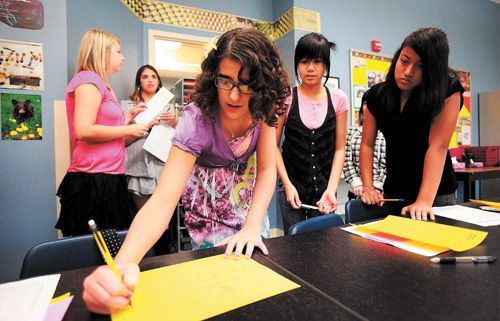





At West Career and Technical Academy, one of five new Clark County School District campuses that opened to students Monday, computer-controlled greenhouses can simulate the climate of a rainforest.
Academy students also can design buildings by computer, test structures in a lab and train as lab technicians.
The school, located at 11945 W. Charleston Blvd., not far from Red Rock Canyon, has a $25,000 grant from the U.S. Environmental Protection Agency to fund outdoor learning opportunities.
It all makes for an exciting year, said West CTA Principal Monte Bay during a tour of the high school on the first day of school for the district's 309,000 students.
The 2010-11 school year represents a break with the district's past in many ways. Superintendent Walt Rulffes plans to retire after a successor is chosen by the Clark County School Board. The district no longer operates elementary schools on a year-round schedule. And the opening of West CTA and four new elementary schools represents the end of the 1998 bond program, which provided $4.9 billion for 101 new schools and 11 replacement schools, and $1.6 billion in capital improvements.
The four new elementary schools include two in North Las Vegas, Duncan, 250 W. Rome Blvd., and Triggs, 4470 W. Rome Blvd.; one in Las Vegas, Stuckey, 4905 Chartan Ave.; and one in Henderson, Wallin, 2333 Canyon Retreat Drive.
Duncan was built for $17.8 million, Stuckey for $19.6 million, Triggs for $14.1 million and Wallin for $23.4 million.
West is the last of five career and technical academies opened by the district in the past four years. It cost $83.5 million.
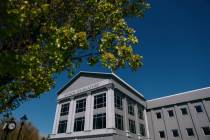
West, which strongly focuses on the sciences, looks more like a community college than a high school. Its buildings surround a central courtyard. On the campus, "nine acres were left untouched, specifically for students to study plant life and geology," Bay said.
Bay said students will soon be involved in a pollution study of the Las Vegas Valley, which will contrast the pristine Red Rock Canyon with the dirtier parts of the city and use global positioning systems to track the flow of debris.
Karli Heaton, 14, enrolled at West to study biotechnology and was impressed by the diverse class offerings.
"They have a really great program selection," she said.
For energy efficiency, West CTA has solar panels and geothermal wells. The entire campus offers wireless access to the Internet.
Paul Gerner, the district's associate superintendent for facilities, was impressed by one of the less technological aspects of the school. It has polished concrete floors that are simple to clean.
"You take care of them with a wet mop. You should be able to do that for 50 years. I like that sort of thing," Gerner said.
To help save money, the district increased class sizes in first through third grades by two students each and switched 76 year-round elementary schools to traditional, nine-month calendars.
With greater numbers of students starting school at the same time at the former year-round campuses, there was some traffic congestion Monday but "nothing unusual" for a first day of school, said Michael Rodriguez, a district spokesman.
School Board member Carolyn Edwards said she was grateful to the county for easing parking restrictions at some schools to allow curbside parking at times parents were dropping off or picking up their children.
Some parents taking their children to former year-round schools showed up early to avoid traffic at campuses such as Wright Elementary School, south of Blue Diamond Road and east of Durango Drive, which has 1,153 students, or Batterman Elementary School, south of Russell Road and east of Hualapai Way, which has 960 students.
Batterman is "expecting 250 more students (than last year)," said Nancy Brandt, mother of fourth-grader, Cypris. "During orientation, they actually told us the flow of traffic would be more controlled, which is good for kids" crossing the street, she said.
Nicki Cardenas drove her fourth-grade daughter, Danika, to Batterman to help deliver back-to-school donations of paper towels and tissue paper.
The Cardenas family also wondered how the school would deal with the influx of students caused by a nine-month calendar.
"The multipurpose room is tiny," said Nicki Cardenas, referring to the space that is used as a cafeteria and a theater.
"They should put tables up on the stage," Danika suggested.
But her mother said her daughter's perspective was a little skewed. "She's small so everything seems big."
Contact reporter James Haug at jhaug@review journal.com or 702-374-7917.