EDITORIAL: Union spending: The dark money no one talks about
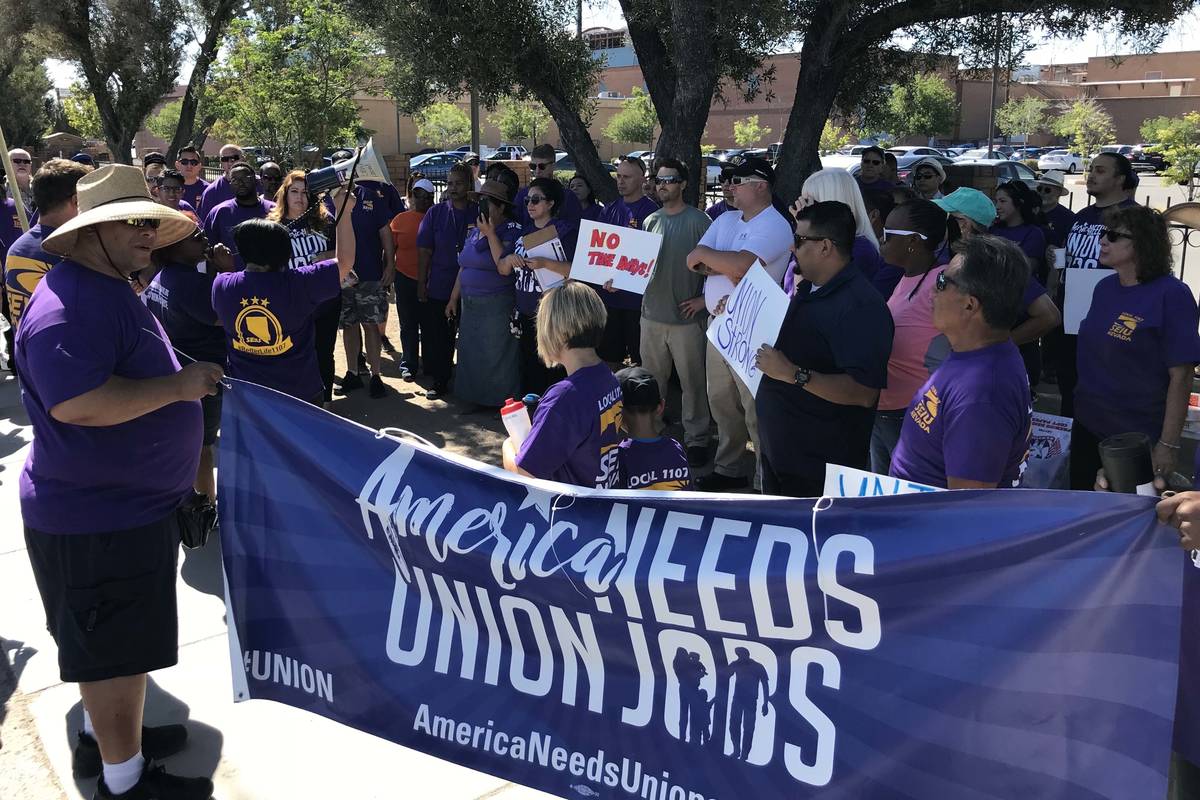




Those who yearn to get money out of politics need to give labor unions closer scrutiny.
The attention paid to campaign finance reform tends to ebb and flow. But the narrative seldom changes. Democrats claim they want to limit the influence of big money on the political process. Of course, the best way to do that would be to stuff the public sector back behind its constitutional boundaries. Then, individuals and special interests would have less incentive to try to influence legislation.
But that approach runs directly counter to the progressive agenda to grow the government as large as possible. (Full disclosure: The Review-Journal is owned by the family of the late Sheldon Adelson, who was an active political donor.)
Instead, Democrats want to pass the DISCLOSE Act, which would mandate that super PACs and 501(c)4 organizations disclose larger donors. Additional campaign finance requirements are included in H.R. 1, Democrats’ omnibus bill to federalize elections. Sen. Majority Leader Chuck Schumer brought both bills up during an early-morning session last week. Republicans refused to grant the bills unanimous consent, and their future in the Senate is uncertain.
“A dark-money ‘tsunami of slime’ is washing over our democracy with virtually no way for the public to see who’s behind it,” Sen. Sheldon Whitehouse, D-R.I., said in February when he introduced the DISCLOSE Act. He added, “It’s time to require big corporations and anonymous ultra-rich donors to take responsibility for their crooked influence campaigns.”
First Amendment concerns aside, the irony is that, according to Open Secrets , “super PACs and other big-money groups” spent “far more to boost Biden than help Trump.”
Notice the lack of objection when “dark money” benefits the liberal politicians who claim to oppose it. And perhaps the least remarked-upon source of big money in politics comes from labor unions.
A National Institute for Labor Relations Research study estimates that unions spent $1.8 billion during the 2020 election cycle. Contributions to federal PACs totaled $57 million. Direct spending on state and local PACs was $300 million. The largest portion, however, could be found only by examining reports unions are required to turn into the government. A section on those reports requires unions to list spending on “political activities and lobbying.” That totaled more than $1.4 billion for 2019 and 2020. The group also found tens of millions of dollars of political expenses hidden in other categories.
Around 90 percent of direct union spending goes to Democrats, according to Open Secrets. Little wonder they don’t appear as concerned with this type of “dark money.”