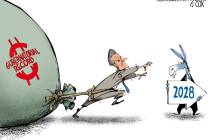
Quit crying and start reinventing

It's been more than two years since defenders of Nevada's public sector first screamed that no part of any government could sustain a single budget cut.
Remember the fall of 2007? Statewide unemployment hit 5.4 percent in November, at that time a 41/2-year high. Many housing experts thought the market's slow slide was nearing bottom. Local economists were predicting modest growth for 2008. The thousands of new hotel rooms under construction supposedly ensured that Las Vegas would fare better than the rest of America in the event of a prolonged recession.
State government, meanwhile, had to confront a mere $50 million revenue shortfall.
And what howling that minuscule shortfall inspired. Various liberal interests immediately began laying the groundwork to raise taxes on the gaming industry. Cuts to vital government services would be Draconian (aren't they all?), voters were assured.
The Chicken Little set ended up wiping egg off their faces, time and again. As the valley's economic distress grew, the purported suffering of government paled in comparison. Although plenty of planned budget increases had to be taken off the books, overall spending grew, public employee pay raises were preserved, and layoffs were largely averted. Each successive sky-is-falling prediction became less credible.
Today, caterwauling over cuts is beyond tiresome. It's pointless. No amount of political agitation will stop the ax from falling everywhere. More tax hikes? You can't squeeze water from a stone.
Government, as it currently operates in Nevada, is no longer sustainable. It must be reinvented, and the dialogue on how to do it finally might be under way.
Consider the following fiscal realities:
-- Record tax hikes and the federal stimulus giveaway won't save the state's $6.9 billion general fund, which was intended to cover K-12 schools, higher education, social services and public safety through summer 2011. State revenues could come up $400 million short, even if lawmakers go ahead with their plan to borrow $160 million to fund operations. A budget-balancing special session of the Legislature is a lock for 2010.
-- When the 2011-13 biennium rolls around, the state won't be able to lean on federal welfare, the tax hikes of 2009 will sunset, and lawmakers will have to start paying back the aforementioned $160 million, plus interest. Unless the economy rebounds, the 2011 Legislature might have as little as $5 billion to cover operations.
-- The state unemployment rate stood at 12.3 percent in November, down from October only because many laid-off workers have left town or stopped actively searching for work. Meanwhile, Nevada has borrowed $264 million from the federal government to meet rising demand for unemployment benefits, and soon will need to beg for more. At some point, we have to start paying that back, too.
-- Assuming Congress passes its crushing new health care mandates, thereby raising costs for everyone, Nevada will be obligated to increase its Medicaid spending by $600 million between 2014 and 2019. Government always lowballs its cost estimates when expanding welfare programs. Double that figure to $1.2 billion, just to be conservative. Then realize that we'll have to pay higher taxes or cut spending elsewhere to come up with all that dough.
-- The state has more than $10 billion in unfunded pension and health care obligations for retired public employees. Perhaps as soon as this decade, the state will begin diverting untold millions of dollars each year from the general fund to the checking accounts of people who aren't working.
-- Clark County, the city of Las Vegas, Henderson and North Las Vegas are planning combined spending cuts of as much as $300 million for the fiscal year that starts July 1.
A handful of stubborn leaders are clinging to the status quo, holding to the misguided belief that Nevada's government structure can be preserved amid this revenue drought. Senate Minority Leader Bill Raggio, R-Reno, wants lawmakers to make equal, across-the-board cuts to all state agencies, as though each tiny bureaucracy is equally important to the public.
The breakthrough in rethinking government might have come last week, when county and higher education officials announced they would explore converting deficit-plagued University Medical Center, which currently runs on a blank check from taxpayers, into a research and teaching hospital that could draw grants, donations and more insured, paying patients.
In addition, Las Vegas Mayor Oscar Goodman used his State of the City speech to champion local government consolidation as a way to cut costs and improve public service.
"There's so much duplication. There's so much that we could do together as a megalopolis that we can't do together as independent little municipalities working with the county that treats itself as a municipality," Goodman said, touting a cause that only a few years ago was a nonstarter. "That discussion has to take place. It's long overdue."
It's a start. Reinvention happens all the time in the private sector. Where would Apple be if it had stuck with building only personal computers? Companies that don't change their vision or their structure in response to the chance of changing market conditions -- let alone actual market upheaval -- end up dead.
Nevada casinos, for example, have been forced to adjust to a new economic reality: visitors who don't part with much of their discretionary income. The free spending that allowed state governments to grow unchecked isn't coming back anytime soon.
With elections around the corner, voters need to make a campaign issue out of it. If candidates aren't willing to answer hard questions about spending priorities -- What are you going to shut down? How big a pay cut should public employees take? Why am I paying for their retirement as well as mine? What would you privatize or outsource? -- you'll know they're part of the problem, not part of the solution.
Will big thinkers step up and run?
Glenn Cook (gcook@reviewjournal.com) is a Review-Journal editorial writer.