Annual training prepares team for emergencies
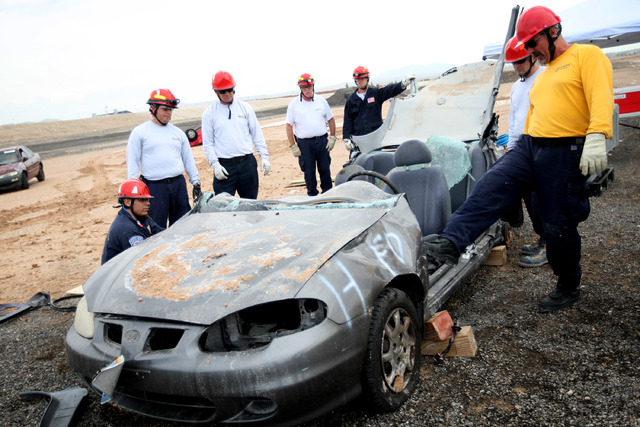
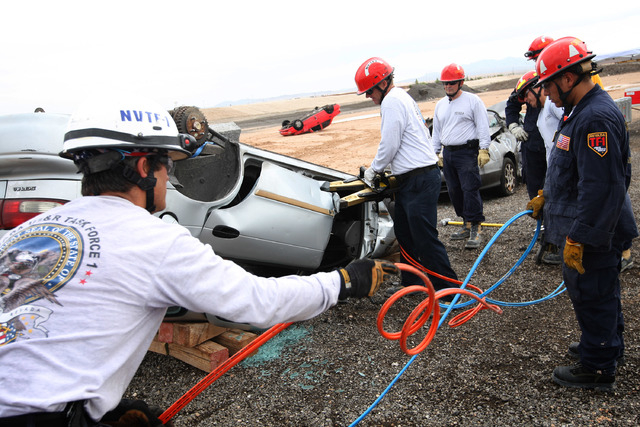
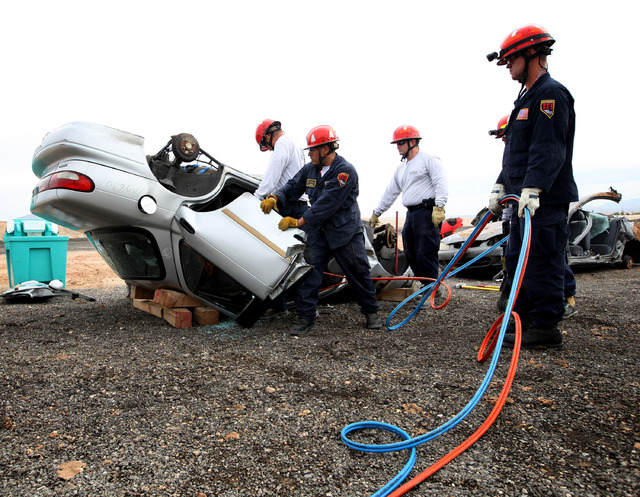
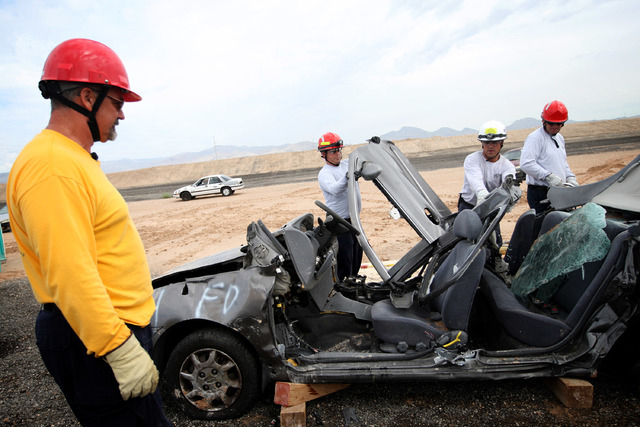
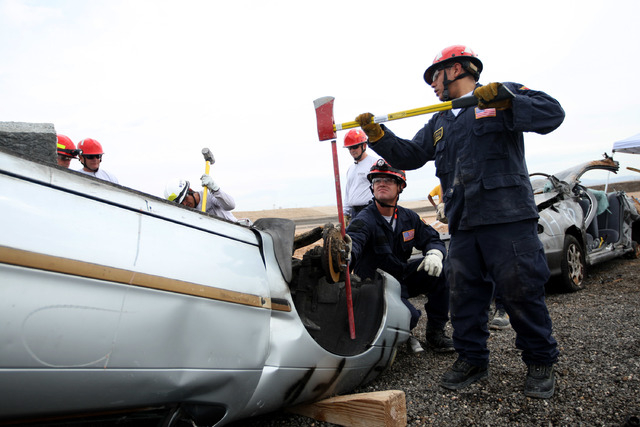



Amid slabs of concrete, smashed cars, dirt and power tools Tueday, Nevada Task Force 1, funded by FEMA, vigorously began a weeklong training course in structural collapse rescues.
“Take your time, set it up good,” rescue team manager Mike Bako told his team as they started to secure an upside-down vehicle pinned by a huge concrete slab. “Get it secure.”
For eight hours every day for six days — with a break for Sept. 11 — Nevada Task Force 1, the only search and rescue task force in the state designated to conduct vehicular, structural and collapsed building rescues, stages rescue situations every year for required refresher training. They respond to terrorist attacks, bridge, building and freeway collapses and natural disasters.
“All the fire agencies have different tools. We come out here (to the training site) to use tools specific to the task force,” Bako said. “Training is important to make us fluent. If everyone tries to do it their way, it doesn’t get done efficiently.”
The team planned and discussed each step of the rescue. The process, which can be completed in three to four minutes when a life is at stake, takes about 30 minutes during training.
“We learn more from mistakes than the actual training,” Bako, a recently retired North Las Vegas firefighter and 12-year member of the task force, said. “We always end each training with discussion.”
The meticulous nature of the group is part of what creates quick and successful rescues.
“Everything is proportional to the time of life,” he said. “If the life is going fast, we’re going to take more risks.”
The risks are high, and the danger is very real, even in training.
“Metal can fly, glass could break, you could get pinched very easily,” Bako said.
The training site is full of purposeful hazards to simulate what the team could encounter after a terrorist attack or natural disaster.
The concrete rubble pile has the potential to shift, like it would after an earthquake’s aftershocks. The training trenches have fissures that could dump tons of dirt on rescue personnel. A collapsed bridge is rife with danger, shored up with wood as the roof presses down on cars.
The team can deploy within four hours of an emergency, typically earthquakes and hurricanes in California.
“Terrorist events are fortunately very small. In Southern Nevada there are not a lot of disasters here,” Clark County Deputy Fire Chief and Emergency Manager Fernandez Leary said. “The most likely incident that could happen here is a earthquake.”
The task force is comprised of firefighters from Clark County, Las Vegas, Henderson and North Las Vegas, as well as civilian personnel.
The rescue component of the task force is comprised of four rescue teams, with five members and a leader, and a manager. Engineers, logistics, safety experts and medics complete the task force of about 180 to 200 members. About 80 people are deployed for each emergency.
Firefighters and other personnel on the task force took time out of their annual training to remember the lives lost on Sept. 11, 2001, as the 12th anniversary of the tragedy arrived.
“9/11 … just fortifies our reason for being here,” Bako said.
The team traveled to New York with the other 27 task forces spread throughout the country to assist after the terrorist attack. They have also assisted in hurricanes Ike and Katrina and the Oklahoma City bombing.
“We hope that nothing will ever happen,” Weist said. “But if it does we want to be there.”
The 27 other task forces are located in Arizona, California, Colorado, Florida, Indiana, Maryland, Massachusetts, Missouri, Nebraska, New Mexico, New York, Ohio, Pennsylvania, Tennessee, Texas, Utah, Virginia and Washington.
Contact reporter Rochel Leah Goldblatt at rgoldblatt@reviewjournal.com or 702-383-0264.