





During the fall of 2023, Shelby Mower’s family members became concerned when the 25-year-old Las Vegas resident hadn’t returned calls or text messages.
On Nov. 17, 2023, Mower’s mother reported her missing to the Metropolitan Police Department, though her brother said the family hasn’t heard from Mower, a bartender who lived in Summerlin, since.
“It’s been a tornado,” Tyson Mower said. You hope and pray nothing bad happened. You wonder about it at night. We hope to one day hear from her.”
It’s the type of missing person case that can affect a family for generations, though the Clark County coroner’s office has been making an effort to help solve more cases.
On Saturday, the coroner’s office will host the second annual “Missing in Nevada Day” at UNLV’s University Gateway Building.
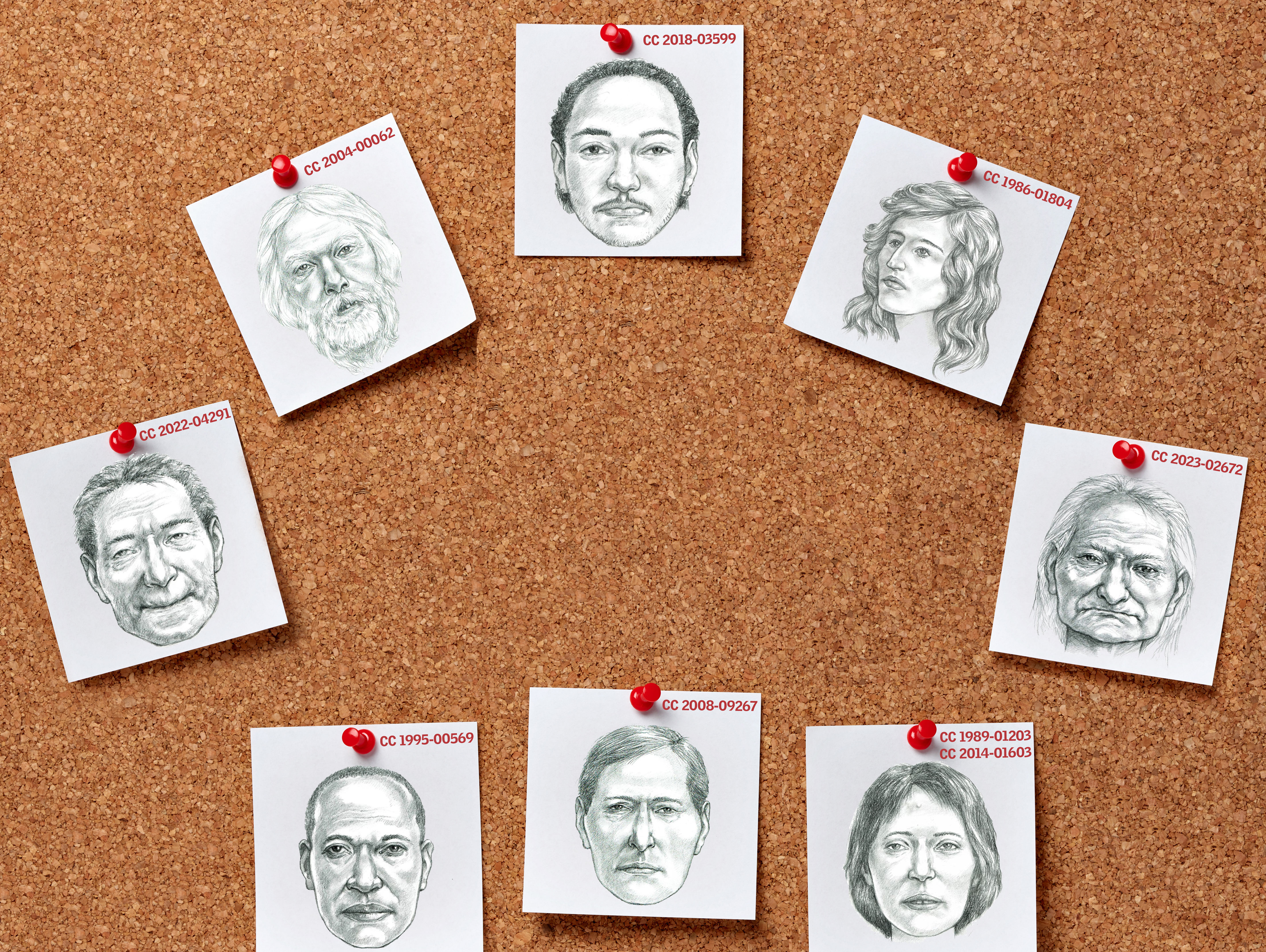
FACES OF THE UNIDENTIFIED
Sketches and information for 28 bodies in the Clark County coroner’s office
It’s a chance, according to coroner Melanie Rouse, for loved ones to connect directly with Metro investigators, missing person advocates and forensic specialists.
In a worst-case scenario, it’s a chance for loved ones to possibly be able to help identify one of the over 300 unclaimed bodies in Clark County.
“Those are the ones that have been entered into national databases,” Rouse said. “We’d like to provide names for some of these individuals.”
The ID
This is the part of the process where some dogged forensic scientists about 1,200 miles away from Las Vegas come in.
In the past year, the Oklahoma State University School of Forensic Sciences has helped to identify two bodies in Clark County.
One was a man who was found in a rock crevice west of Summerlin near Fox Hill Park in 2022. The other, a woman, was identified after her body was found near Interstate 15 north of downtown Las Vegas that same year.
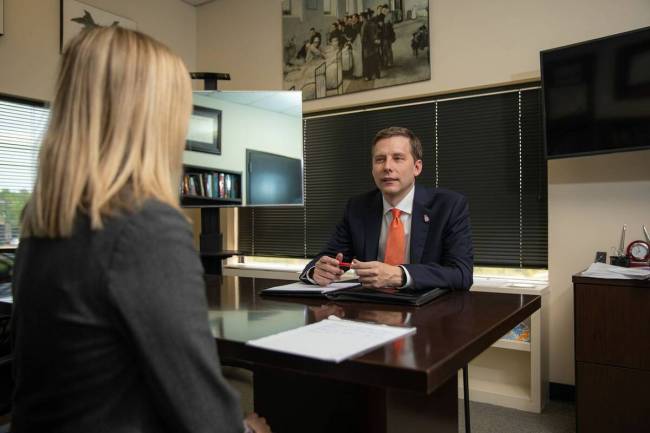
Rouse and Dr. Jason Beaman, chair of the OSU School of Forensic Sciences, declined to give the names of the two individuals to the Las Vegas Review-Journal for privacy reasons.
The school, which works with different municipalities and departments across the country, has been working with Clark County officials for over a decade, Beaman said, and specifically in forensic genealogy for about two years.
As long as scientists get a good enough DNA sample — Beaman, 46, said the best often come from teeth or a bone at the base of the skull called a petrous bone — researchers can then try to match the DNA profile with relatives through the hobby genealogy website GEDmatch.
“The website will tell us who the closest relatives are, then we’ll try to find out who that person is,” Beaman said. “We’ll build out that family tree and we’ll start looking for someone missing. If it’s someone from Las Vegas, we start looking for someone who was living somewhere in or around Las Vegas.”
A big part of the process, Beaman said, is what he calls “investigative digging,” which is similar to what a detective or journalist might do — searching for phone numbers or addresses.
Often, Beaman said, people who go missing were struggling with mental health issues and/or drug addiction.

“Normally, what we’ll do is we’ll respond to the agency with a name and how we think that person is related to the missing person,” Beaman said. “We never get involved in the investigative process after that.”
Sometimes, Beaman said, he’ll find out from an agency that the name his team passed along belonged to a person who had been searching for a missing loved one for many years.
“We know that on some of those calls, the person will say within seconds that they’ve beenlooking for their loved one for years and they will be very appreciative,” Beaman said. “Other times, it might be a person who had been estranged from their family for years, possibly unhoused, and the reaction is different.”
Beaman, a forensic psychiatrist by trade, said the work he and his team do can be dark at times, but he said he does it because he believes everyone deserves to have their story known.
“Almost everybody we’re looking for has made some bad decisions in life,” he said. “Sometimes, they’re not people who you would necessarily associate with — victims of homicide, people who were unhoused. At some point, every child was innocent and loved by the world. Just because somebody made some bad decisions, that doesn’t mean their story should end, forgotten in the desert outside Las Vegas.”
MIND book and hope
To help aid in its effort to identify bodies, the county recently put together a 30-page file with renderings of faces of some of the unidentified bodies in the county’s possession.
Called the Missing in Nevada Book, it features photos of clothing that was on the body when it was found, tattoos, and jewelry. Some descriptions don’t have much information at all.

The most recent entry shows a sketch of a man who was found in November at the mouth of a culvert just off State Route 160 near the Nye County line. He had red and black Puma sneakers on and a tattoo on his left forearm that read “Lucky Stars.”
The oldest John Doe sketch shows a man whose body was found on Sept. 20, 1984, near an abandoned building in North Las Vegas. He was found wearing Levi’s jeans and had a yellow pinkie ring, according to the booklet.
Identification with the name “Richard Allen” was found near the body all those years ago, but the case has never officially been solved.
“We encourage anyone with information about a missing loved one to come forward and provide information,” Rouse said. “We want people to know that this is going to be a safe environment to come forward.”

With found bodies, Beaman said the sun is one of the biggest enemies to DNA preservation hopes, which means Southern Nevada can be unforgiving. That can hinder the process to retrieve useful DNA.
“Fifty or 60 years, that might be pushing it for a body, but we are pretty good at getting DNA,” Beaman said. “It depends on a lot of different factors. In desert environments, however, if the body is protected from the sunlight, it can kind of putrefy and mummify a little bit and have really good DNA for a very long time. A body can be kind of preserved for decades.”
One of the most important tasks for families looking for loved ones, Beaman said, is to make sure that person is in NAMUS, the National Missing and Unidentified Persons System, a federal government database.
According to NAMUS, about 600,000 people go missing in the United States each year, though many are quickly found.
“We use NAMUS all the time; 100 times per day,” Beaman said. “But if the person isn’t in there, that’s a big missed opportunity for a connection.”
Faces in the crowd
Tyson Mower, who lives with his wife and three children in Idaho, won’t be able to attend the Missing in Nevada event, though he looked through the MIND booklet and didn’t see anyone who resembled his half-sister, Shelby.
Mower said his oldest remembers Shelby, but his other two children, not so much. Because he tends to travel a fair amount for his job and spends time in airports, Mower said he comes across enough people to have his hopes raised, then dashed.

“You tend to double-take a lot of faces because you think it might be her,” Mower said. “When you realize it’s not, your gut sinks a little bit.”
Mower said he thinks there’s about a 50/50 chance Shelby is still alive somewhere. After all, she was a private person. In the missing person police report on her, it says she “doesn’t like people to know where she lives or works.”
After she disappeared, Mower said he did some investigating of his own, though he wasn’t able to find a lot. There was a boyfriend named Lou whom family members weren’t familiar with and a storage unit, Mower said, that was mysteriously emptied at some point.
But Shelby’s cellphone number is used by someone else now, and Mower said nobody seems to know anything.
“We hope one day to hear from her,” he said. “We hope to get that call or that knock on the door. We’re hanging on. We still have hope.”
If they can’t attend in person, Rouse said she encourages people to reach out to the county via email at missinginnevada@clarkcountynv.gov. She said the key to finding a person’s name is to get as much information as possible.
“Even though we may have the greatest set of information on our unidentified individual, if we don’t have anything to compare it to, then we can’t make an ID,” Rouse said. “You have to compare the unidentified person to information from when that person was alive, which could be done by dental records, X-rays, DNA analysis. There are several ways to make an identification, but if we don’t have anything to compare it to, if someone is not reported missing, then I can’t compare it to anything.”
Contact Bryan Horwath at bhorwath@reviewjournal.com. Follow @BryanHorwath on X.