Scale insects difficult to control

I should report an email to me regarding rabbit problems in landscapes. One reader suggests that she has always used mothballs around her plants and never had a problem with rabbits. Some of you might know mothballs can contain either naphthalene or paradichlorobenzene. It was not clear which one she meant.
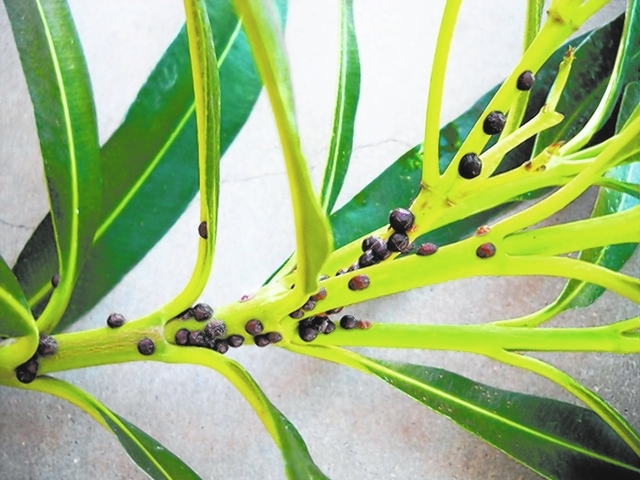
Q: I have a serious infestation of hard-shelled, black insects on my oleanders. I have a treelike hedge of oleanders on both sides of my home. One oleander is heavily infested but the problem is spreading rapidly to all the others. They are not on the leaves but are on the stems and trunks and higher than I can reach.
A: This is one of the many scale insects. Scale insects are not terribly common in Southern Nevada. They are difficult to control because they live and feed under a protective “shell” they created.
Because the insect does not move around once it creates its “shell,” it doesn’t attract much attention.
Frequently they come to our attention because the sticky sap they excrete and lands on leaves is shiny and attracts ants.
Oftentimes the question becomes how to control the ants, not realizing the ants are there because of the sticky substance from insects like scale, mealybugs and aphids.
The usual control recommendation is to either spray horticultural oil all over the plant to suffocate them when they are under the shell or use conventional insecticidal sprays.
If you choose to use the horticultural oil (my best suggestion) I would do it now and repeat the spray a week later. The idea is to suffocate the insect under the scale by covering it with the oil. It usually does a good job.
After this, spray the oleander with insecticidal soap once a week until the weather gets hot. This will catch the young as they are emerging this spring looking for a new home. The soap and water does a good job killing the young ones but not the ones under the shell. That’s the oil’s job.
Another option is to cut the oleander down to about 2 inches, fertilize, water it and let it regrow. Tough to do if they are in tree form.
Spray soap and water as the new growth emerges from the 2-inch stubs. This spray protects it from getting reinfested.
Q: I have been collecting vegetables scraps for composting over the past six months but did not have a cover on my bin. I have found the compost loaded with a bug or worm. There are too many to pick out. Can I use this compost? I’m afraid if put in soil they will kill plants, but my compost is really good!
A: These types of insects are pretty common in compost as it develops. What you have found are the larval or immature form. Your question is one of the most common questions asked about composting on my blog.
Many of these types of insects feed on decaying foods and composts that are not quite finished composting. Once the compost is finished, they are seldom a problem.
I don’t know how much compost you are talking about but if it is possible to layer the compost in a sheet, the birds will come in and gobble them up.
You can cook them in the sun and they will decompose into your compost. To do it correctly the compost must be “fluffy” or loose enough to allow the heat to spread through it evenly and quickly.
Then spread the compost in a layer several inches thick. It should be slightly moist but not wet. Cover it with a clear plastic drop cloth and hold the plastic in place with some nails or staples. The edges of the plastic must be sealed with soil so no heat escapes and no cold air gets in.
Hold the plastic in place with some rocks, blocks or bricks so it does not blow away. Leave it in direct sunlight for about two weeks. The temperature will get hot enough to kill most, if not all, of the insects.
Q: Can you tell what the problem is with my patio tree and what I can do about it? The leaves are all covered in brown spots. I am not sure which plant it is.
A: From the looks of the plant it seems to me to be a photinia pruned as a patio tree. From the pictures you sent with the black spots on the leaves I think it is either photinia leaf spot disease or, more likely, anthracnose. Neither one do we see much here.
Both diseases can attack photinia and Majestic Beauty hawthorne so if your tree is either one of these, this might be the problem. Majestic Beauty is particularly prone to anthracnose while the smaller shrub-type hawthornes usually are not.
Unhealthy plants are more likely to get a disease than healthy ones. Anthracnose usually makes dark brown or tan spots that look like irregular targets with concentric irregular rings in them.
Poor air circulation and wet leaves will make this disease worse. These diseases are thought to spread when leaves are wet or if you spray them with a hose to keep them moist. So irrigate only at the base of the tree and do not spray the leaves.
The tree and the interior of its canopy need air circulation to stay dry. Prune out entire limbs from the trunk or branches so that air can move through the canopy and not stagnate.
Leaf spot disease is caused by a different fungus and can reattack the tree year after year if you don’t pick up diseased leaves that have dropped and dispose of them.
The disease is less likely to be active when it is hot out. So if you have to spray the foliage then avoid doing it during the cooler months. Do it during the summer in the morning hours.
I noticed something on the bottom of your leaves when I magnified the picture you sent. Aphids? Soap and water sprays on the undersides of the leaves will control them. Do it every three days for about four applications.
Your tree is not in the best of health. Apply iron chelate in the form of EDDHA and a good flowering tree fertilizer now, in very early spring, and once again later in the season.
Bob Morris is a horticulture expert living in Las Vegas and professor emeritus for the University of Nevada. Visit his blog at xtremehorticulture.blogspot.com. Send questions to Extremehort@aol.com.