Black swans not a cheap hobby for Desert Shores residents





The ugly duckling grew up to become a white swan.
These ducklings grew up to be black ones. And there's nothing ugly about them.
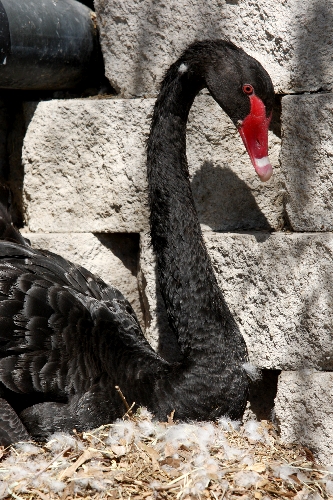
Desert Shores has a group of black swans, an exotic species from Australia. They belong to two residents but call the lake home.
"They're for everyone to enjoy," said Sandy Dunham, co-owner of the birds. "If it were up to me, we'd have tons of them."
She and neighbor Dee Paturzo are referred to as the Swan Ladies. They bought the first two swans, a mated pair, about five years ago. Two babies were born in mid-April.
"They're a lovely addition to the community," said Rita Peterson, Desert Shores general manager, of the black swans. "We're a lake community. Everybody loves the water fowl."
The exotic swans have the run of the lake and sleep where they want, so they don't fall into the "household pet" category, but they interact well with humans, especially humans who feed them.
"You open the door, and they're like the Rockettes -- they all turn their heads at once," Paturzo said.
The swans do not squawk or "talk" but make distinct cooing-type sounds.
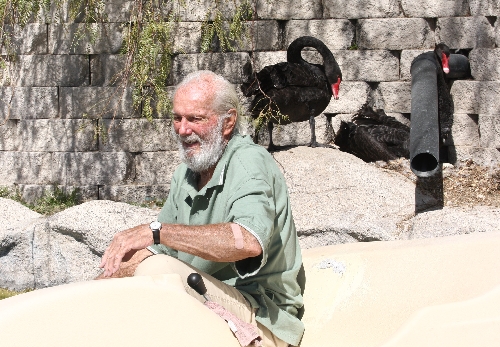
If Paturzo and Dunham are the Swan Ladies, then their neighbor Roland Bergheer, they said, is Grandpa to the exotic birds. He feeds them every morning at 5:30.
Sometimes he feeds them at the dock off his lake front condominium. Other times, he goes onto the lake to feed them from his paddle boat.
The 82-year-old also watches over the nest when eggs are laid, keeping everyone abreast of the pending big day.
"If he leaves her to come across the lake to my place, he'll holler for her, to let her know he's on his way back, " Bergheer said of the swans.
When the eggs hatch, the baby swans, known as cygnets , head straight to the water. Humans must snatch them up before they swim away.
The cygnets are taken to the veterinarian's office, where they are checked out and their wings are pinioned. It's done on the day they're born so they can't fly away. They are reunited with the mother as soon as possible.
Not all survive. Of the two born in April, only Bobby Sue is thriving. The other was weak and is being cared for by a vet.
Of those swans that survived past infancy, three have died over the years. Two were hit by cars, one in March. The third was found lifeless in the water, although the vet could not attribute a cause , Dunham said.
Sometimes a swan will show up with a fish hook caught in its mouth or fishing line wrapped around it.
The birds are expensive, both to buy and to keep.
Each one costs $500 to $600. Shipping adds another $150 to the price tag. They were purchased from a breeder in the Midwest.
"They send them through the post office," Dunham said. "They come in a crate like for a German s hepherd."
The Desert Shores C ommunity A ssociation requests that people not feed the swans and ducks for aesthetic reasons -- the mess on the sidewalks. Paturzo and Dunham request that people not feed the swans, too. But that's because they know that bread offers almost zero nutrition . Instead, they spend $45 a bag on special food .
"They'll die if you feed them bread," Bergheer said.
The swans are given cute names -- Taxi, Lady and for one mated pair, Lucy and Desi. The three "teenagers" are named Red, White and Blue.
Contact Summerlin and Summerlin South View reporter Jan Hogan at jhogan@viewnews.com or 387-2949.